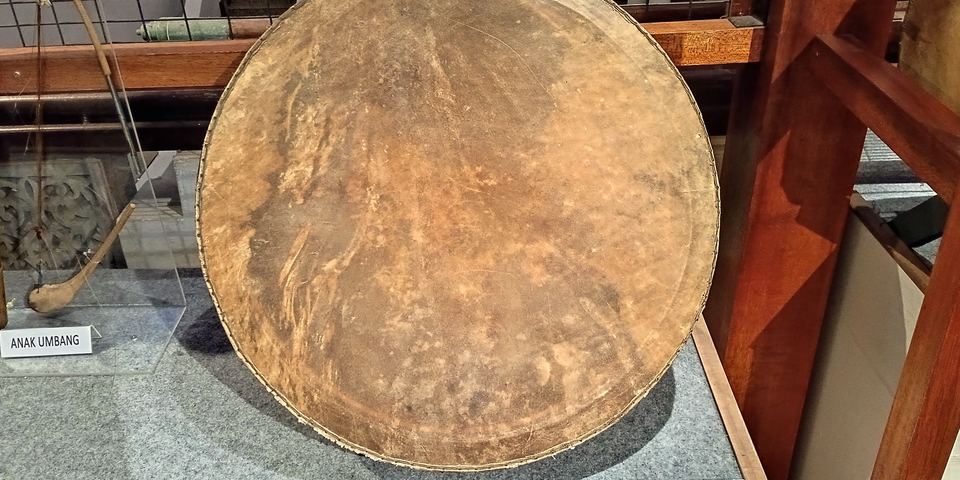
The rebana
The rebana is a frame drum of Southeast Asia. Muslim communities of Indonesia, Malaysia, Brunei and Singapore play it. A goatskin is stretched over one side of a shallow wooden frame. The player holds the drum in one hand and strikes the skin with the other. It accompanies songs of praise, wedding celebrations and dances.
The sound of the rebana
The first recording joins four single strokes on a Malaysian rebana. The first two strokes ring longer, and the last two are shorter. The other buttons play one long stroke and one short stroke.
Names of the rebana
Rebana is the Malay and Indonesian name. In Javanese the drum is called terbang. Some trace the word rebana to the Arabic robbana, which means our Lord. Others link it to arbaa, which is the Arabic word for four.
Smaller rebanas played at Malay weddings are called kompang.
Where the rebana is played
The rebana is played across the Malay world. It is heard in Indonesia, Malaysia, Brunei, Singapore and southern Thailand. The Cham people of Cambodia use it, and so do the Cape Malays of Cape Town in South Africa.
In Indonesia it belongs to Muslim communities such as the Betawi of Jakarta and the Minang of West Sumatra. The towns of Gresik, Ponorogo and Jepara on Java are centers of rebana making.
The role of the rebana in music
The rebana accompanies songs that praise God and tell of the Prophet Muhammad. These include zikir, which is the chanted remembrance of God. The players often sing as they drum. Most players are men, and women also play in some religious study groups.
With the gambus, a lute, the rebana accompanies the zapin dance.
Music for the rebana
In Jakarta, neighborhoods have their own kinds of rebana. Rebana biang is a large drum about ninety centimeters across. It has no jingles. Rebana ketimpring has small jingles in its frame and is played by a group of three. The rebana also plays at weddings and at circumcision ceremonies.
In Kelantan and Terengganu in Malaysia, the large rebana ubi is played at festivals. Groups compete there with their sound and rhythm.
Rebana kasidah is a modern form of rebana music. It is a popular style, and its singer is usually a woman. Dangdut is a separate popular music of Indonesia, and it also draws on Arabic music.
How the rebana is made
The frame is turned from wood. Jackfruit and coconut wood are common choices. A goatskin covers one side. A ring of rattan is pushed in between the skin and the frame from behind. It stretches the skin and makes the sound stronger.
On the kompang this rattan ring is called the sedak. Some makers now use a plastic ring, and some heads are cowhide, buffalo hide or synthetic rubber.
How the rebana is played
The player holds the rebana in one hand and strikes it with the fingers or the palm of the other. On the kompang, a stroke near the edge with the fingers held together gives a deep sound called bum. A stroke in the center with the fingers open gives a sharp sound called pak.
In the traditional style, the players sing verses in Arabic or in classical Malay while they drum. In the modern style they also add movement or dance.
How the rebana has changed
Early rebanas had no decoration. Over time makers began to paint them brown, yellow, red or blue. Malaysia now holds kompang competitions for groups of players.
Choosing a rebana
The size depends on the music. A kompang is about twenty-three to thirty-eight centimeters across and suits wedding processions. The large rebana biang is so big that the player may rest it on the feet and knees.
Goatskin is the traditional head. Check that the rattan ring sits evenly, because it sets the tension of the skin.
First steps on the rebana
Hold the frame in one hand. Strike near the edge with the fingers of the other hand held together, and listen for bum. Strike the center with the fingers open, and listen for pak. Play the two strokes in turn with the metronome. Next, keep the pattern going while you sing a short line.
A short check
Choose one answer per question.
On the kompang, which stroke gives the deep sound called bum?
Bum comes from a stroke near the edge with the fingers held together. Pak comes from a stroke in the center with the fingers open.
What is a kompang?
The kompang is a small rebana. Groups of kompang players greet the bride and groom at Malay weddings.
What does the ring of rattan do?
The rattan ring is pushed in between the skin and the frame. It stretches the skin and makes the sound stronger.
Sources
Common questions
What is a rebana?
It is a frame drum with a goatskin head. It is used mainly in the Islamic music of Indonesia, Malaysia and Brunei. The player strikes it with the hand.
What is the difference between a rebana and a kompang?
Kompang is the name for the smaller rebana of Malay weddings and processions. It is about twenty-three to thirty-eight centimeters across.
Where does the rebana come from?
It came to the Malay world with Islam and with the music of the Middle East. Some large rebanas of Jakarta may be older than the coming of Islam to Indonesia.
What is a rebana made of?
The frame is made of a wood such as jackfruit or coconut wood. The head is goatskin, and a ring of rattan holds it tight.
Does a rebana have jingles?
Some do and some do not. Rebana ketimpring has three pairs of jingles, while the large rebana biang has none.
When is the rebana played?
It is played at religious gatherings, weddings, processions and feasts. At Malay weddings, kompang groups greet the bride and groom.
World MusicIndonesian musicDangdutDafGamelan