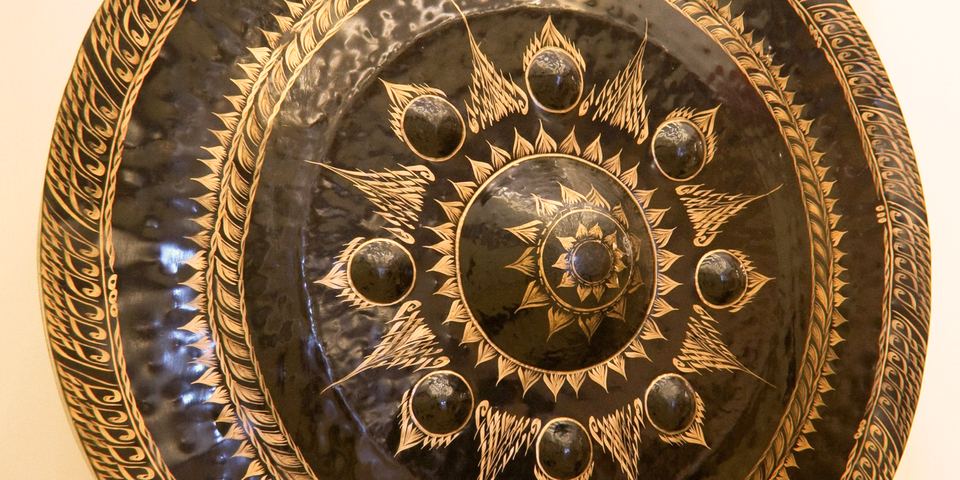
The gong
A gong is a disk of metal that sounds when it is struck. Most gongs are made of bronze, and the player strikes them with a padded beater. Some gongs have a raised central knob called a boss, and these sound a clear pitch. Flat gongs give a rushing wash of sound. Gongs began in Southeast Asia and China.
A gamelan plays this piece. A gamelan is an orchestra of gongs and other bronze instruments from Indonesia.
Music: Envato (PremiumBeat)
Listening to the gong
Listen for the deepest sound in the gamelan. The largest gong sounds less often than any other instrument. Its stroke comes at the end of a long phrase. The deep tone rings on while the faster instruments begin the next phrase. Count the beats between two strokes of the large gong. Within one section of a piece, the count stays the same.
Then listen inside a single gong tone. The note starts with a soft thud from the padded beater. A low hum follows and slowly fades. In a fine Javanese gong the hum swells and falls a few times a second. Makers compare a slow swell to the waves of the sea. The recording below comes from a village gamelan in Bali. The gongs of that gamelan mark the phrases in the same way.
Names of the gong
The English word gong comes from Java in Indonesia, where it is written ꦒꦺꦴꦁ in Javanese script. In the Javanese gamelan the word gong now names only the largest gong, the gong ageng. Its name means great gong. The next sizes are the gong suwukan and the kempul. The kenong and the bonang are smaller gongs. They lie on cords in a wooden frame, and their bosses face upward.
In Chinese the gong is called luó, written 鑼. In Japanese the hanging gong is the dora, written 銅鑼. The large flat gong of the Western orchestra is the tam-tam. In the orchestra the word gong often means a gong with a raised center, which sounds a clear pitch. In the Philippines the kulintang is a row of small tuned gongs that plays melodies.
History of the gong
Gongs began in mainland Southeast Asia and southern China. A bronze drum of the Dong Son culture of northern Vietnam is more than two thousand years old. Its surface shows players with what look like sets of gongs. The oldest certain written mention comes from Chinese records of the sixth century. They describe the gong as a foreign instrument from a land between Tibet and Burma.
Java, Burma, Annam in Vietnam and southern China became the great centers of gong making. In Java and Bali the gong became the central instrument of the gamelan in the courts and villages. In China, gongs cleared the road for officials and their processions. Chinese opera bands paired a large gong with a small one, and temples used gongs in worship.
The gong reached Europe through trade with Asia. At the end of the eighteenth century, the French composer François-Joseph Gossec brought the tam-tam into the orchestra in a funeral march. Berlioz recommended it for scenes of mourning. Tchaikovsky, Mahler and Puccini later made it a regular member of the percussion section.
The gong in the gamelan
In a Javanese gamelan the gongs hold the form of the music. Scholars call this layer the colotomic structure. The longest phrase is called a gongan. The gong ageng sounds once at its end. Smaller gongs divide the gongan into equal parts. The kenong and the kempul mark the inner points. The gong suwukan takes the place of the gong ageng when the phrases are short.
The gong ageng is the most honored instrument of the ensemble. A gong ageng usually has its own name, and that name can pass to the whole set. Javanese tradition says that the spirit of the gamelan lives in the great gong. Before a performance, players may place flowers, food or incense in front of it.
The gong in the orchestra
In the Western orchestra the tam-tam often marks scenes of mourning or terror. Berlioz used four tam-tams in his Grande Messe des morts. This work is a Requiem, which is a Mass for the dead. Tchaikovsky gave the tam-tam one soft stroke in the last movement of his Sixth Symphony. Stravinsky asked for scraped strokes and quickly stopped strokes in The Rite of Spring. Messiaen wrote for sets of tuned gongs.
In Asia the gong also has uses outside the concert hall. Buddhist temples in China and Southeast Asia strike gongs in worship. In Java a great gong may be struck to open a building or to launch a ship.
How the gong works
A gong is a circular plate of bronze. Fine gong bronze is close to four parts copper to one part tin. With that much tin, the cast metal is brittle. The smith heats the plate until it glows red and plunges it into cold water. The quick cooling keeps the metal workable, and the smith can then hammer it into shape.
A gong vibrates most strongly near its center. A bell is the opposite, because it vibrates most strongly at its open rim.
A bossed gong has a raised knob, the boss, in the center. Striking the boss gives a focused tone with a clear pitch. The rim of a gong ageng turns back deeply, so the gong looks like a shallow kettle. A flat gong such as the tam-tam vibrates in many patterns at once. Its sound starts softly and grows into a roar.
The beater matters as much as the gong. A heavy gong takes a large, soft beater, and a small gong takes a harder one. A padded beater brings out the low tone. A hard beater brings out the bright overtones.
How the gong is played
The player strikes a hanging gong a little off center, or on the boss of a bossed gong. A large tam-tam may first get a light touch that sets it moving. The main stroke then speaks sooner and fuller. The skill lies in keeping that first touch silent.
A hand pressed against the face of the gong stops the sound. In a gamelan the player of the gong ageng waits through a whole phrase for a single stroke. That stroke must fall exactly on the last beat of the phrase. Players also roll softly on a large gong with two beaters to build a long swell.
What makes a fine gong
The quality of a gong begins with its metal. High-tin bronze, cast and hammered by hand, gives a warm and long tone. Cheaper gongs are made of iron or brass, and some are only plated with bronze. Their sound is shorter and harsher.
The hammering shapes the voice of the gong. In Java the gong ageng is the first instrument of a new gamelan to be made. It is also the hardest to make, and the smith often has to recast it when cracks appear. The master smith tunes it, and the rest of the gamelan is tuned to it. Slight differences between the two halves of the gong create the slow swell in its tone. A fine gong ageng was once kept in a museum in Delft. Its lowest tone was measured at about forty-five vibrations per second.
A flat tam-tam is judged by its bloom, which is the way its sound swells after the stroke. A fine one gives a soft shimmer at a light stroke. At a heavy stroke it gives a long roar that does not crack harshly. Its hammer marks are even, and its center and rim keep the dark finish of the forge.
Choosing a gong
Decide first which kind of gong you need. A bossed gong gives a pitch for music in a scale. A flat tam-tam gives a wash of sound for orchestral music and for sound effects. A wind gong is a thin flat gong with a long shimmer, and it serves the same purpose.
Strike the gong softly and then loudly before you buy it. A good gong gives a full tone at a soft stroke and stays clear at a loud one. Check that the pitch of a bossed gong is steady. The cords and the frame should let the gong hang freely, so the whole plate can ring.
Who keeps these instruments
Historic gongs from across Asia are on view in several museums. The Musical Instrument Museum in Phoenix shows decorated gongs beside a full gamelan from Indonesia. The Metropolitan Museum of Art in New York holds gongs from Burma, Thailand, Malaysia, Bali and Japan in its collection of musical instruments. The Ringling Museum in Sarasota keeps a bossed gong in a frame carved with dragons.
In Java the great gamelans belong to the royal palaces, the kratons, of Yogyakarta and Surakarta. The palaces keep them as heirlooms, and the sets have their own names. Gong smiths in Central Java still forge gongs by hand in the old way. Universities in Indonesia, Europe and America keep gamelans for teaching, and their students learn by playing together.
First steps on the gong
A single gong and a soft beater are enough at first. Strike the gong a little off center and let it ring until the sound has gone. Then try the same stroke more softly. Learn to start the sound without a click from the beater.
Next, practice placing strokes in time. Set the metronome to a slow pulse and strike the gong once per group of eight beats. Count quietly through the long wait. This is the work of the gong player in a gamelan. A gamelan group at a school or a university is the best place to learn.
A short check
Choose one answer per question.
What is the boss of a gong?
A bossed gong has a raised knob in the center. Striking the boss gives a focused tone with a clear pitch.
In a Javanese gamelan, what does the gong ageng mark?
The gong ageng sounds once at the end of the longest phrase. This phrase is the gongan, and smaller gongs mark the points inside it.
Where does a gong vibrate most strongly?
A gong vibrates most strongly near its center. A bell vibrates most strongly at its open rim.
Sources
Common questions
What is a gong made of?
Most gongs are made of bronze with a high share of tin. Cheaper gongs are made of brass or iron.
What is the difference between a gong and a tam-tam?
A gong in the narrow sense has a raised boss and sounds a clear pitch. A tam-tam is flat and gives a wash of sound with no single pitch.
Where does the gong come from?
Gongs come from mainland Southeast Asia and southern China. The word itself comes from Java.
What is a gong ageng?
It is the largest gong of the Javanese gamelan. Its deep stroke marks the end of the longest musical phrase.
How do you play a gong?
Strike it a little off center with a padded beater. A soft stroke lets the tone grow, and a hand on the face stops it.
Is a gong a kind of bell?
Both are instruments of struck metal. A gong vibrates most near its center, and a bell vibrates most at its open rim.
World MusicGamelanIndonesian musicSinging bowlMetronome