Gamelan: the gong ensembles of Indonesia
A gamelan is an ensemble of tuned percussion from Indonesia. Its players strike bronze bars and gongs of several sizes with mallets, and hand drums called kendang lead the tempo. Gamelan belongs to the Javanese, Sundanese and Balinese peoples. It accompanies dance, ceremonies and the puppet theater called wayang.
This Balinese gamelan piece uses metallophones, gongs and kendang drums. In gamelan, the deepest gong sounds least often and marks the end of a long phrase.
Music: Envato (moonlight_sounds)
Listening to a gamelan
The music is built in layers. The deepest gong sounds least often, and it marks the end of a long phrase. Smaller gongs divide the phrase into equal parts. The metal bars in the middle range play the main melody, and the highest bars play fast patterns around it. The drummer leads the changes of tempo and loudness, and the ensemble follows the drum.
Balinese gamelan has a shimmer of its own. Its instruments are built in pairs, and one of a pair is tuned slightly higher than the other. When both sound together, the tone pulses. Balinese musicians call this pulse ombak, which means wave. In the fast style called gong kebyar, two players share one rapid melody. The first plays mostly on the beat. The second plays mostly off the beat, and the two parts lock together.
The first button below plays the rehearsal of a village gamelan in Bali. The other two sound single bars of an iron gamelan. The demung is the low saron, and the saron here is the middle size. The bars are tuned to the notes of pélog, which is a scale of seven notes.
The name gamelan
The word gamelan comes from the Javanese word gamel, which means to strike with a mallet. It is written ꦒꦩꦼꦭꦤ꧀ in Javanese script and ᬕᬫ᭄ᬩᭂᬮ᭄ᬮᬦ᭄ in Balinese script. In the polite register of Javanese, the gamelan is called gangsa. An old explanation links this word to tigang and sedasa. These words mean three and ten. The best gamelan bronze has ten parts of copper to three parts of tin.
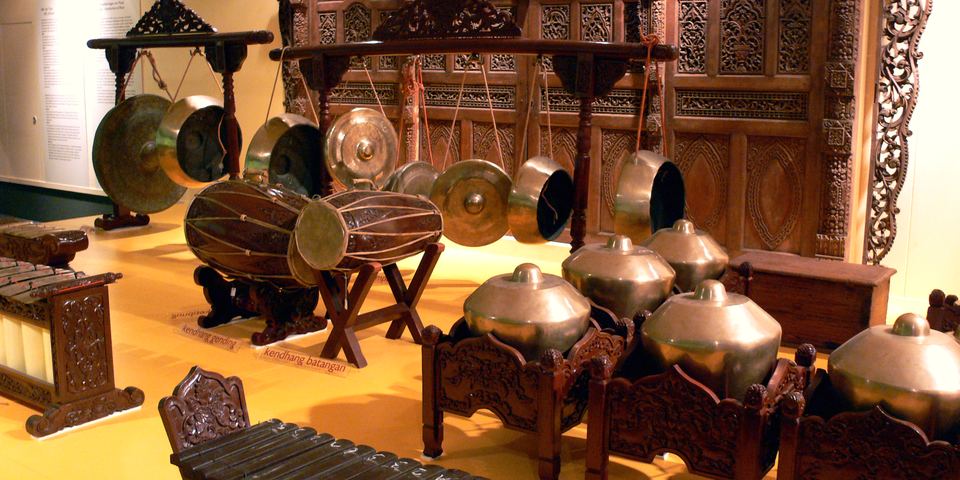
Gamelan is the word for the whole ensemble, and the instruments have names of their own. In Java the saron, demung and peking play the melody on bronze bars. The bonang is a row of small gongs set on cords in a frame. The kenong, kempul and gong ageng are the gongs that mark the phrases. In Bali the bar instruments of the kebyar style are called gangsa, and a row of small gongs is called the reyong.
History of gamelan
The oldest image of an ensemble in Indonesia is a stone relief at the Buddhist temple of Borobudur in Central Java. It dates from the eighth century. Its musicians play drums, flutes, cymbals, bells, xylophones and metal bars. A Javanese legend says that the god-king Sang Hyang Guru invented the gong as a signal to summon the gods. The instruments took their present form in the Majapahit kingdom of East Java.
The royal courts of Java became the great patrons of gamelan. The palaces of Yogyakarta and Surakarta keep old sets that are played only on special occasions. The Gamelan Sekaten sounds for one week a year in front of the Grand Mosque. It plays for the celebration of the birth of the Prophet. The old Sekaten set is split between the two palaces, and both had a matching second half made.
Balinese gamelan took its own path. Early in the twentieth century a new style appeared in north Bali. It was called kebyar, which means to flare up or burst open, after its sudden changes of tempo and loudness. The first public performance on record took place at a gamelan competition in the village of Jagaraga. Kebyar spread across the island and became part of the ceremonies of Balinese Hinduism.
Gamelan also reached Europe. At the Paris Exposition Universelle, musicians from Central Java played a gamelan, and the composers Debussy and Satie heard them. UNESCO lists gamelan on its Representative List of the Intangible Cultural Heritage of Humanity.
How the parts fit together
In Javanese gamelan, the saron family plays the core melody. This melody is called the balungan, which means skeleton. The bonang, the gender and the singers play faster and freer parts around it. The higher an instrument sounds, the more notes it usually plays.
Gongs mark the cycles of the music. The largest gong, the gong ageng, marks the end of the longest cycle. Smaller gongs called kenong, kempul and ketuk divide the cycle into shorter parts. In a lancaran, a form of sixteen beats, the gong sounds once and the kenong divides the cycle into four. The gong page describes these gongs and their sound.
The kendang drums lead the ensemble. The drummer sets the tempo, signals the changes of section and brings the piece to its end. In Bali the leading gangsa player, on the instrument called the ugal, also cues the others with the movement of the mallet.
Music for gamelan
Gamelan accompanies religious rituals, ceremonies, dance, dance drama and wayang puppet theater. It also accompanies singers. In Java a female singer called the sindhen and a male chorus called the gerong may join the ensemble. Some sets are sacred, and they are played only in the rituals of a royal court.
Balinese gamelan sounds at temple festivals and at holy days such as Galungan. Gong kebyar is also heard at concerts and island-wide competitions. Its pieces move between slow, quiet passages and sudden loud outbursts. The styles of Balinese gamelan have their own repertoire of pieces for dance and for listening.
How a gamelan is made
Most instruments of a gamelan are metallophones, which are bars or gongs of metal struck with mallets. The finest sets are bronze. Cheaper sets are made of brass or iron. A Javanese saron usually has seven bronze bars over a wooden frame. It comes in three sizes, and the sizes step down an octave from one to the next. The peking is the highest, and the demung is the lowest.
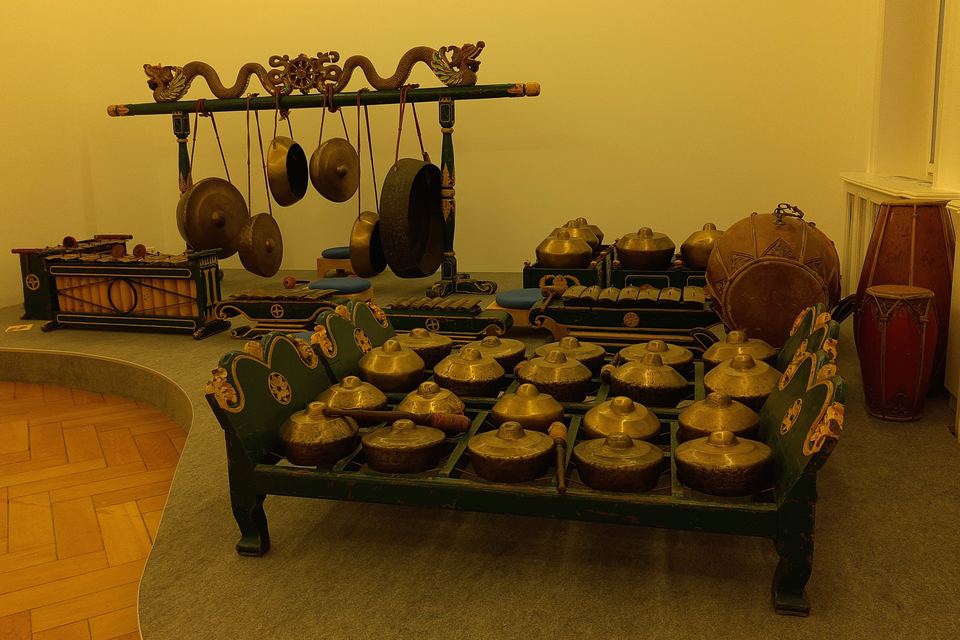
In Bali the gangsa have bronze keys hung on cords over bamboo tubes. The tubes resonate with the keys above them and make the tone longer and fuller. The gongs of both islands are hammered from hot bronze by smiths. The frames are of carved wood, and they are often painted red and gold.
Javanese gamelan uses two tuning systems. Sléndro has five notes in the octave, and pélog has seven. The steps between the notes are unequal, and an ensemble has a tuning of its own. Gong kebyar uses a scale of five notes drawn from pélog. It is called pelog selisir.
How a gamelan is played
Players of the saron sit on the floor and strike the bars with a mallet. The free hand grips the bar that sounded before, so the notes do not blur. The peking plays most often and keeps a steady pulse. The larger saron play fewer notes.
Balinese gangsa players strike the key with a hammer-shaped mallet in one hand and stop it with the other. In kotekan, two players divide a rapid melody between them. The polos part falls mostly on the beat, and the sangsih part falls mostly between the beats. A part alone sounds full of gaps. Together the two parts form a single fast line.
What makes a fine gamelan
A fine gamelan needs fine bronze. Bronze with a high share of tin rings long and warm. Brass and iron sets cost less and sound shorter. The smith forges the bronze while it is hot. Then the smith hammers and files the bars and gongs until they sound the right pitch.
A gamelan is tuned as a whole, and no two sets share a tuning. The maker tunes the instruments to one another, and a bar from one set will not match the notes of another set. In Bali the pairs of instruments must beat at a steady speed in all registers. The shimmer of the ensemble then stays even from the lowest note to the highest.
A fine set also has fine frames. The court gamelans of Java rest on carved wooden frames that are painted and gilded. The gongs may hang from a frame carved with dragons. Old sets in the courts carry names of honor, and the people who play them treat them with respect.
Joining a gamelan
The instruments of a gamelan are tuned to one another, so a single saron is of little use on its own. Students usually learn in a group that owns a full set.
Many universities and cultural centers outside Indonesia keep a gamelan and welcome beginners. In Java and Bali, village groups and schools of the performing arts teach the music. A newcomer usually begins on a simple part, such as the slow core melody or a gong, and moves to the faster parts later.
Who keeps these instruments
The oldest gamelans that still exist are kept in the palaces of Central Java. The palaces of Surakarta and Yogyakarta hold sets that are thought to date from the twelfth century. In Cirebon, on the north coast of Java, the Kasepuhan palace keeps its Gamelan Sakati. The sets have their own names, and the palaces care for them as heirlooms.
Museums in Europe show full sets. The Ethnological Museum in Berlin keeps a gamelan with its gongs, kenong and saron in carved frames. The Weltkulturen Museum in Frankfurt shows another set. The Musical Instrument Museum in Phoenix displays a full gamelan from Indonesia beside its decorated gongs. Universities in Indonesia, Europe and America keep gamelans for teaching, and their students learn by playing together.
First steps in gamelan
Find a gamelan group near you, at a university, a cultural center or a school of the performing arts. Ask to begin on a saron. Learn the core melody of one piece in cipher notation, in which the notes of the scale are numbers.
Practice the damping of the saron. Strike a bar with the mallet, and as you strike the next bar, grip the first one with the free hand. Then count the beats of a lancaran with the metronome, and listen for the gong at the end of the cycle. The gong page explains how the gongs mark the cycles.
A short check
Choose one answer per question.
What does the gong ageng mark in a Javanese gamelan?
The largest gong sounds once at the end of the longest phrase. This phrase is called the gongan. Smaller gongs divide the phrase into equal parts.
Why does a Balinese gamelan shimmer?
In a pair, one instrument is tuned slightly higher than the other. Together they make a regular pulse that Balinese musicians call ombak.
What is kotekan in Balinese gamelan?
In kotekan, one player plays mostly on the beat and the other mostly off the beat. The two parts lock together into one rapid line.
Sources


Common questions
What instruments are in a gamelan?
A gamelan has metal bars and gongs of several sizes, which the players strike with mallets. Kendang drums lead the tempo. Many ensembles also have xylophones, bamboo flutes and singers. Some add a bowed string instrument called the rebab and a zither called the siter.
Where does gamelan come from?
Gamelan comes from Indonesia. It is the traditional music of the Javanese, Sundanese and Balinese peoples.
What is the difference between Javanese and Balinese gamelan?
Javanese gamelan builds a piece on a core melody called the balungan, and much of it is calm. Balinese instruments are built in pairs tuned slightly apart, which gives the Balinese sound its shimmer, and its kebyar style is fast and sudden.
What is gong kebyar?
Gong kebyar is a style of Balinese gamelan that began in north Bali early in the twentieth century. Its name means to flare up, after its sudden changes of tempo and loudness.
What scales does gamelan use?
Javanese gamelan uses two scales. Sléndro has five notes in the octave, and pélog has seven. A gamelan is tuned in its own way.
What does the large gong do?
The gong ageng is the largest gong. It marks the end of the longest cycle of the music. After it sounds, the section repeats or the piece moves on.
World MusicIndonesian musicGongSantoorKalimba