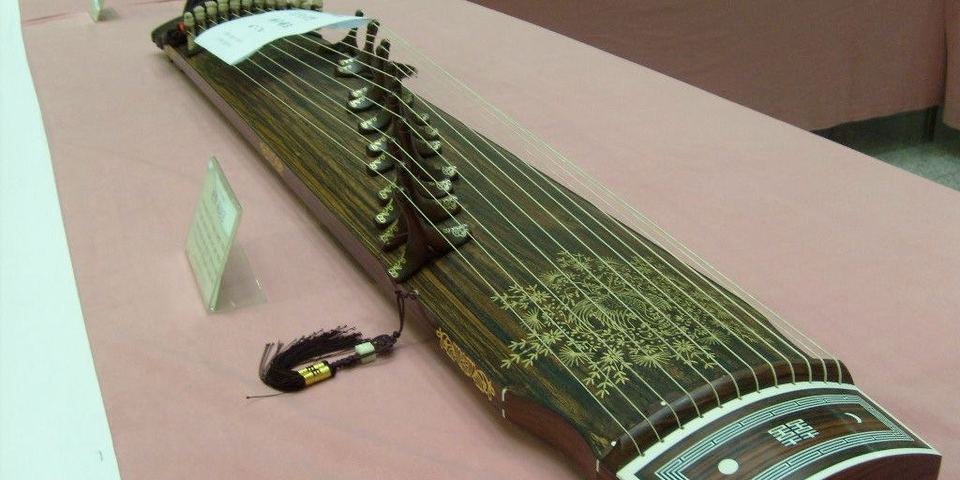
The gayageum
The gayageum is a Korean zither. It has a long wooden body and twelve silk strings, and the strings rest on their own movable bridges. The player sits on the floor and plucks the strings with the right hand. The left hand presses the strings to bend the pitch. Its tone is soft and delicate.
The sound of the gayageum
A single low string of a modern gayageum is plucked once and left to fade.
Listen to the long decay. On the gayageum the left hand can press the string during the decay and bend the pitch.
Names of the gayageum
Gayageum is the usual spelling today, and kayagum is an older one. Gaya was an ancient group of kingdoms in southern Korea. The word geum means a zither.
The traditional gayageum has two forms. The pungryu gayageum is the older, larger form. The sanjo gayageum is smaller.
Where the gayageum is played
The gayageum is the best-known traditional instrument of Korea. It is played in South Korea and North Korea, and by Korean communities abroad. In North Korea a version with twenty-one strings is common.
The role of the gayageum in music
The pungryu gayageum accompanies court music, chamber music and lyric songs. Its strings are set wide apart for slow music.
The sanjo gayageum plays solo music and folk music. It is the most common form today.
Music for the gayageum
Sanjo means scattered melodies. It is a solo form with fast tempos and some improvisation, and it arose in the nineteenth century. A janggu drum accompanies it. Several schools of gayageum sanjo pass down their own versions.
Composers have also written new music for the gayageum since the middle of the twentieth century. Some of it is for gayageum with eighteen, twenty-one or twenty-five strings.
How the gayageum is made
The pungryu gayageum is about one hundred sixty centimeters long and thirty wide. Its body is carved from one piece of paulownia wood. The sanjo gayageum is about one hundred forty-two centimeters long. Its top is paulownia, and its sides and back are a harder wood.
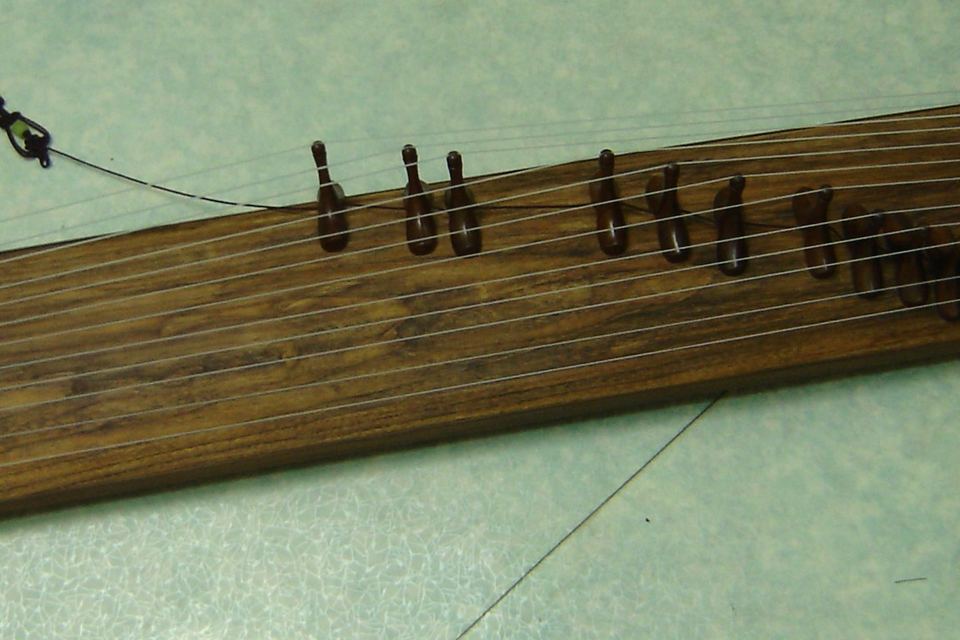
The silk strings rest on movable bridges called anjok, and no two strings share a bridge. At the tail the strings are tied to thick cords, which are wound into a decorative coil.
How the gayageum is played
The gayageum player sits on the floor with legs crossed. The head of the gayageum rests on the right knee, and the tail rests on the floor.
The right hand plucks and flicks the strings near the fixed bridge at the head. The left hand presses the strings on the other side of the bridges. That raises the pitch and adds vibrato and other ornaments.
How the gayageum has changed
The Samguk sagi, a history of old Korea, says that King Gasil of Gaya had the first gayageum made in the sixth century. He modeled it on the Chinese zheng. The musician Ureuk then composed music for it. Fragments found in Gwangju suggest the instrument is older still.
Since the late twentieth century, some players have used nylon strings, and makers have built instruments with more strings for modern music.
Choosing a gayageum
For traditional music, choose a twelve-string sanjo gayageum with silk strings. For modern music, a gayageum with more strings gives a wider range.
Ask whether the anjok come with the instrument, and keep spare strings. Silk strings need gentle care in dry or damp weather.
Relatives in East Asia
The gayageum belongs to a family of long zithers with movable bridges. The Chinese guzheng is the model from which it grew. In Japan the related zither is the koto. Mongolia has the yatga. Vietnam has the đàn tranh.
The members of the family share the movable bridges and the left-hand bends. They grew their own repertoire and sound.
First steps on the gayageum
Sit cross-legged and rest the head of the gayageum on your right knee. Pluck one string with the index finger of the right hand near the fixed bridge. Let it ring.
Next, press the same string with the left hand on the other side of its bridge, and listen to the pitch rise. Release slowly and let it fall back. Gayageum players bend notes in this way in most pieces.
Then play the strings from the lowest to the highest at a slow, even tempo with the metronome. Check the tuning with the tuner, and move a bridge if a string sounds out of tune.
A short check
Choose one answer per question. The explanation appears below the correct answer.
What does the left hand do on the gayageum?
The left hand presses the strings on the far side of the bridges. That raises the pitch and adds vibrato.
What are the anjok?
The strings rest on movable bridges called anjok, and no two strings share a bridge. Moving a bridge changes the tuning.
What is sanjo?
Sanjo means scattered melodies. It is a solo form with fast passages and some improvisation.
Sources
Common questions
How many strings does a gayageum have?
The traditional gayageum has twelve strings. Modern instruments may have eighteen, twenty-one or twenty-five.
What is the difference between the gayageum and the guzheng?
The gayageum grew from the Chinese zheng. The traditional gayageum has fewer strings, uses silk, and is played on the floor resting on the knee.
Is the gayageum like the koto?
Both are long zithers with movable bridges. The koto is Japanese and is often played with picks. The gayageum is plucked with the bare fingers.
What are gayageum strings made of?
Traditional strings are twisted silk. Some players now use nylon, and modern instruments may use nylon-wound steel.
Is the gayageum hard to learn?
Simple melodies come early, because a string gives one note. Bending pitch smoothly and playing sanjo take years of study.
Where can I hear gayageum music?
It is heard in Korean court music, in sanjo and in folk songs. Many modern Korean groups also use it in new music.
World MusicEast Asian stringsGuzhengGuqinLevel 3 course