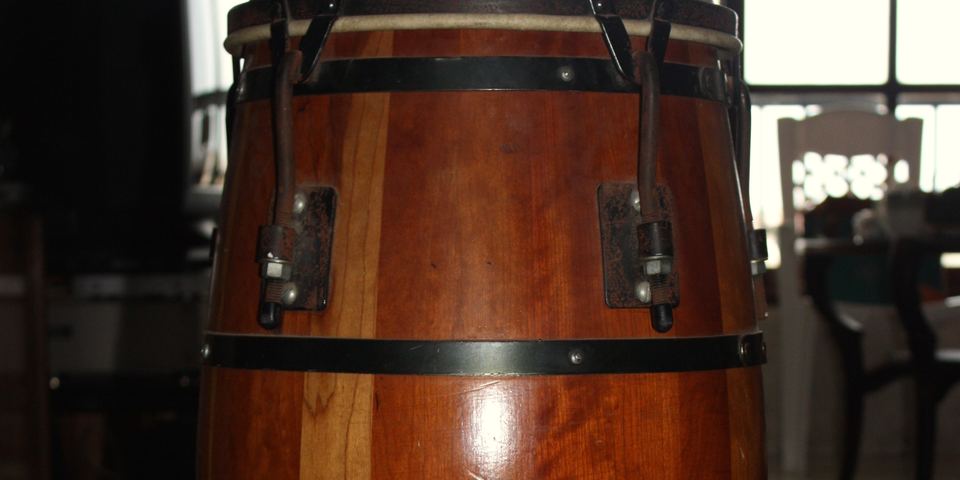
The conga
The conga is a tall, narrow hand drum from Cuba with a single head. In Cuba it is called the tumbadora. Its shell is built from staves, like a barrel. Congas come in three main sizes: the small quinto, the middle conga and the large tumba. Players strike them with the hands in rumba, son, salsa and Latin jazz.
This piece is a guaguancó. This style of Cuban rumba is played on three conga drums of different sizes. Listen for the steady pattern of the two lower drums. Above them, the player of the small quinto improvises.
Music: Envato (SCOREWIZARDS)
The sound of the conga
The first recording plays steady strokes on a conga. In the second, the strokes speed up little by little.
Then you hear one stroke apiece on the three main drums: the quinto, the conga and the tumba. A larger drumhead gives a lower sound.
Names of the conga
Conga is the usual name outside Cuba. In Cuba the drum is the tumbadora. A conga player is a conguero.
The English name came from la conga. La conga is a rhythm of the Cuban carnival. The drums that played it became known as conga drums.
Where the conga is played
Cubans of African descent developed the conga late in the nineteenth century or early in the twentieth. Its ancestors are thought to include the yuka and makuta drums of Bantu origin and the bembé drums of Yoruba origin.
Dance bands first used the conga in the second quarter of the twentieth century, and it became a staple of mambo bands. It then spread through salsa and much other Latin music.
The role of the conga in music
In rumba a drummer plays one drum. The tumba and the conga keep a repeating pattern. The quinto is the lead drum. Its player improvises above the other two.
In son, salsa and Latin jazz, one conguero usually plays two or three drums at once.
Music for the conga
The conga plays in rumba, son, salsa, songo, merengue, Afro-Cuban jazz and Latin rock. In the calypso and soca of Trinidad, players sometimes strike it with mallets.
How the conga is made
Most modern congas have a shell of wooden staves or of fiberglass. Screws tighten the drumhead. A typical conga stands about seventy-five centimeters (thirty inches) tall.
Older congas had heads tacked to the shell, and players tuned them by heating the head. The screw-and-lug hardware of modern congas makes tuning much easier.
How the conga is played
The conga has four basic strokes. The open tone is struck with the four fingers near the rim, and it rings clearly. The muffled tone is struck the same way, but the fingers stay on the head.
For the bass tone, the whole palm strikes the head a little off the center. The palm is slightly cupped. The slap is the hardest of the four. It makes a sharp, loud pop.
Players sit with a drum between the knees, or they stand with the drums on a stand.
How the conga has changed
By the middle of the twentieth century, players were using sets of two to four drums. Screw tuning made it practical to keep a set of drums at steady pitches.
Choosing a conga
Begin with one drum. A second drum can come later, and two drums are often tuned a perfect fourth apart.
Choose a height that suits the way you play. Some players sit, and others stand. Check that the lugs turn evenly, so that the head can be tuned the same all the way around.
The tumbao pattern
The basic conga pattern of son and salsa is the tumbao, also called the marcha. Its main strokes are two open tones.
Count the tumbao as a cycle of two beats. Divide the beats into four equal parts. When a beat is written as a quarter note, these parts are sixteenth notes. In the count "one e and a, two e and a," the open tones fall on the "and" and the "a" of beat two. Some musicians call the first of them the ponche.
Between the open tones the other strokes stay soft. A common soft stroke is the heel-toe, in which the hand rocks from the heel of the palm to the fingertips. Practice slowly with the metronome until the open tones fall evenly.
A short check
Choose one answer per question. The explanation appears below the correct answer.
Which drum is the lead drum of rumba?
The quinto is the smallest and highest of the three main drums. It improvises above the others.
How is the open tone played?
The fingers strike near the rim and bounce off, so the head rings clearly.
Where do the open tones of the tumbao fall?
In the cycle of two beats, the two open tones sit on the last offbeats of beat two. Some musicians call the first of them the ponche.
What is the Cuban name for the conga?
In Cuba the conga is called the tumbadora.
Sources
Common questions
Are congas and bongos the same?
No. Bongos are a small pair joined by a bridge and held between the knees. A conga is a tall drum that stands on the floor or on a stand.
What are conga drums made of?
Shells are made of wooden staves or of fiberglass. The head is skin or a synthetic material. Metal lugs tighten it.
How many congas does a player need?
A single drum is enough to learn the strokes and the tumbao. Band players usually use two or three.
How do you tune congas?
Tighten the lugs a little at a time, all around the head. Many players tune the drum by its open tone.
What is a tumba?
It is the largest and lowest of the three main congas. In rumba it often plays the steady pattern.
Is the conga hard to learn?
The slap takes the longest to master. Begin by making the open tone and the bass tone sound clearly different.
World MusicBongosClave rhythmMetronomeLevel 3 course