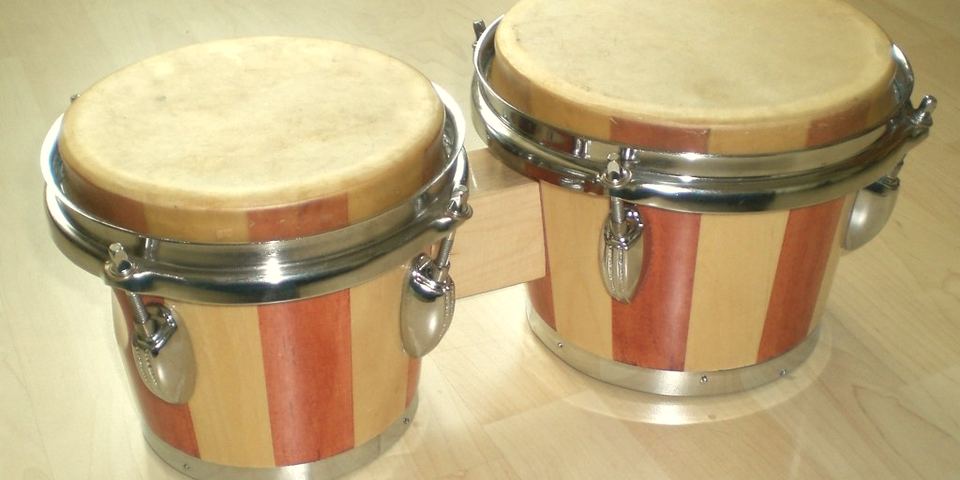
The bongos
Bongos are a pair of small hand drums joined by a wooden bridge. They come from eastern Cuba. The larger drum is the hembra, and the smaller drum is the macho. The player holds them between the knees and strikes the heads with the fingers. Bongos play in the rhythm section of son and salsa.
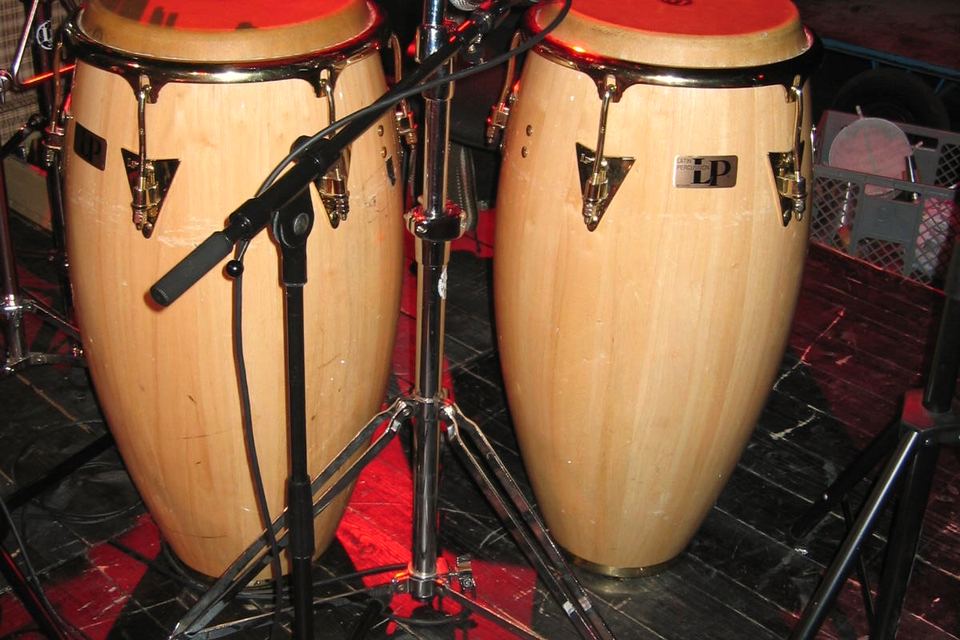
Congas lead this guaguancó, which is a style of Cuban rumba. The recordings lower on this page play the bongos alone. Compare the deep open tones of the congas here with the dry, high strokes of the bongos.
Music: Envato (SCOREWIZARDS)
The sound of the bongos
The martillo pattern comes first. It is played slowly with three fingers of the right hand. A cumbia rhythm on bongos follows.
Names of the bongos
Bongó is the Spanish name. The Cuban scholar Fernando Ortiz traced it to mgombo or ngoma, which are Bantu words for drum. Hembra means female, and macho means male. A bongo player is called a bongosero.
Where the bongos are played
Bongos were first documented in the Oriente region of eastern Cuba late in the nineteenth century. They played in nengón and changüí and later in son. As son spread, bongos reached Havana, the United States and many other countries.
The role of the bongos in music
In son and salsa the bongosero plays a steady pattern of eight strokes called the martillo, which means hammer. Between patterns the bongos add free flourishes. In some groups the bongosero also plays a cowbell.
Music for the bongos
Bongos are heard in son cubano, salsa, bachata and Latin rock. They often play beside the larger congas and the timbales.
Composers of concert music also write for bongos, which are then played with sticks or mallets. Edgard Varèse used them in Ionisation.
How the bongos are made
Bongos are about twenty centimeters high. The two heads measure about twenty and twenty-five centimeters across. The shells and the bridge are usually wood, and fiberglass is also common.
The heads are usually calfskin. Metal hardware holds and tunes them. Older bongos had heads fixed with tacks. Players tightened them with the heat of a flame.
How the bongos are played
A right-handed player holds the bongos between the knees. The larger drum goes on the right. The fingers and the palms strike the edges of the heads.
The large bongó de monte of changüí is held the other way. Its player rubs a finger across the head to make a sliding howl called the bramido.
How the bongos have changed
Bongos may come from pairs of the tall bokú drums of eastern Cuba. Musicians of the region say that these drums were cut in half to make bongos. Historians describe the instrument as African in concept and Cuban in invention.
Choosing bongos
Most modern bongos have wooden or fiberglass shells and tuning hardware. Tune the macho higher than the hembra.
Check that the bridge holds the two drums firmly. Choose a size that sits comfortably between your knees.
A first bongo pattern
The martillo is a steady pattern of eighth notes. It has eight strokes in a bar of four beats. Practice it slowly with the metronome, as in the first recording. Keep the strokes even before you add accents.
A short check
Choose one answer per question.
Which drum of the pair is the macho?
The macho is the smaller drum, and the hembra is the larger. A right-handed player keeps the hembra on the right.
What is the martillo?
Martillo means hammer. It is the steady pattern of eighth notes that bongos play in son and salsa.
Sources
Common questions
Which bongo is the macho?
The macho is the smaller, higher drum. The hembra is the larger, lower one.
What are bongos made of?
Bongo shells are usually wood or fiberglass. The heads are usually calfskin, and metal hardware tunes them.
How do you hold bongos?
Sit and hold them between the knees. A right-handed player keeps the larger drum on the right.
What is the difference between bongos and congas?
Bongos are small and joined in a pair, and they sound higher. Congas are larger, separate drums with a lower sound.
Where do bongos come from?
They come from the Oriente region of eastern Cuba. Their design probably owes much to drums of Central Africa.
Can bongos be played with sticks?
Yes. In concert music, bongos are often mounted on a stand and struck with sticks or mallets.
World MusicClave rhythmDarbukaMetronomeConga