Timing in milliseconds
Clap against the click. The page shows in milliseconds how early or late your claps land.
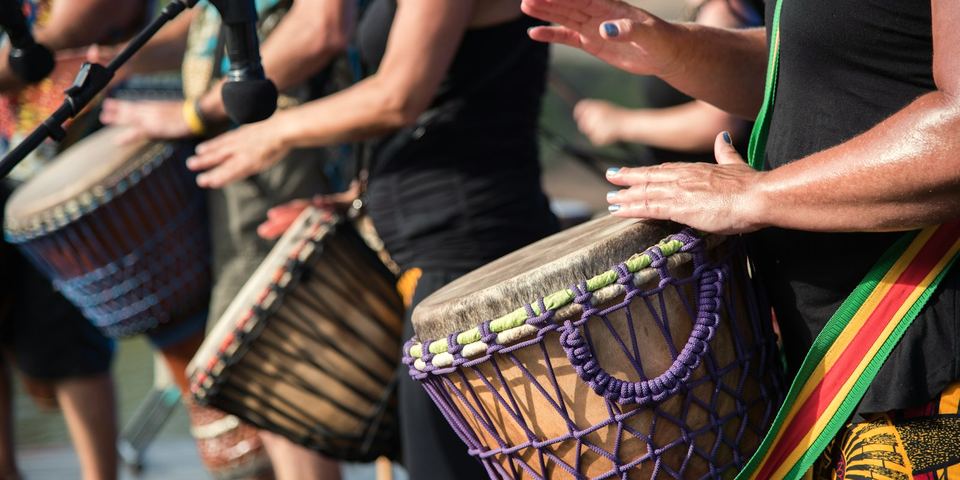
A polyrhythm is two or more even rhythms played at the same time. Their beats do not divide evenly into one another. The most common is three against two. The first part plays three even beats while the second plays two in the same span. Both parts start together, and their other beats fall at different times.
Make a polyrhythm of three against two over this piece for djembes and bells. Tap the beat with one hand as you listen. Then tap three even strokes with the other hand across a pair of beats, and repeat the pattern.
Music: Envato (PremiumBeat)
Count six equal steps aloud. The part in three strikes on one, three and five. The part in two strikes on one and four.
Tap the part in three with the right hand and the part in two with the left. Say the six counts aloud at first. Once the hands are steady, drop the counting and listen to the pattern that the two hands make together.
This polyrhythm needs twelve steps. The part in four strikes on one, four, seven and ten. The part in three strikes on one, five and nine.
Learn the part in three first, because its beats are farther apart. Add the part in four once the three is steady.
A bar of 6/8 holds six eighth notes in two groups of three. A bar of 3/4 holds the same six eighth notes in three groups of two. When music moves from one grouping to the other, the change is called a hemiola. In a hemiola, three groups of two take the time of two groups of three.
Hear the same six notes with the accent on one and four, and then on one, three and five.
In a polyrhythm, both parts share one cycle. The part in two and the part in three always start together. In a polymeter, the parts have bars of different lengths, so their first beats meet only after several bars.
The pattern of three against two underlies most polyrhythmic drumming in West Africa. Several drums and a bell repeat short parts of their own, and the parts cross one another. Listeners new to the music often hear the off-beat parts as the main beat.
The clave of Cuban music grew from these African rhythms.
Composers of the Romantic era, among them Chopin and Brahms, wrote cross-rhythms often. In piano music the two rhythms often lie in different hands. A pianist learns the hands separately first, as in the steps above.
Carnatic music, the classical music of South India, has an art of speaking rhythms aloud in syllables. It is called konnakol. Its performers use it to build complex polyrhythms over the steady cycle of the tala.
Set the metronome to a slow tempo and let it click the part in two. Tap the part in three against it.
The clap mirror measures your claps against a steady click to the thousandth of a second. Clap the beat there first, and move to the polyrhythm when the beat is secure.
Clap against the click. The page shows in milliseconds how early or late your claps land.
Choose one answer per question.
In three against two, how many equal steps make one cycle?
A cycle of three against two holds three times two steps, which makes six. The part in three strikes on alternate steps, and the part in two strikes once in three steps.
On a count of six, where does the part in two fall?
The part in two strikes on steps one and four. The part in three strikes on one, three and five.
What is a hemiola?
A bar of six can split into two groups of three or three groups of two. Moving from one grouping to the other is a hemiola.
In four against three, how many equal steps make one cycle?
A cycle of four against three holds four times three steps, which makes twelve. The part in four strikes once in three steps, and the part in three once in four steps.
It is the sound of two even rhythms at once whose beats do not line up, except at the start of a cycle. The simplest is three against two.
Count to six. Clap on one, three and five for the three. Tap on one and four for the two.
A cross-rhythm runs against the main beat of the meter. A pattern of three beats across a bar of two is one example. Many writers use the two words for the same thing.
Difficulty grows as the numbers grow and share no factor. A rhythm of five against four is much harder than three against two.
A hemiola is three against two in time. When both groupings sound together, it is a polyrhythm. When one follows the other, it is a change of grouping.
Learn the hands separately at a slow tempo. Put the hands together while counting the shared steps aloud. Raise the tempo only when both hands are even.
World MusicClaveTime signaturesLevel 5Metronome