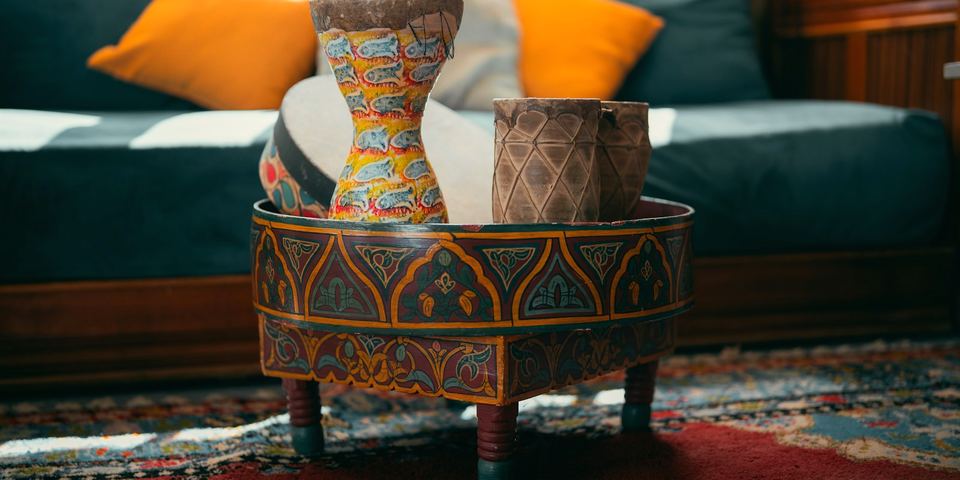
The darbuka
The darbuka is a goblet-shaped hand drum with one head. It is played in Arab, Turkish and Balkan music. The player strikes the center of the head for a deep stroke called dum. A sharp stroke near the edge is called tek. Many players know the drum as the doumbek. In Turkey it is also called the dümbelek.
A darbuka plays under an oud and a flute in this dance piece. Listen for the deep dum and the sharp tek of the drum.
Music: Envato (soundroll-music)
The sound of the darbuka
The first recording repeats a short groove, which is a rhythm pattern that loops. The second is a fill. A fill is a short break between repeats of a groove. The third is another groove.
Names of the darbuka
The name darbuka comes from the Arabic verb daraba, which means to strike. Other spellings include darabukka and derbake. In Egypt it is called tabla. The tabla of India is a different instrument.
Where the darbuka is played
The darbuka is most common in North Africa, the Middle East and the Balkans. It is also heard in parts of South Asia and Eastern Europe.
The role of the darbuka in music
The darbuka keeps the rhythm and decorates it. A rhythm of Arab music is a cycle of dum and tek strokes with rests between them. The player adds rolls, snaps and quick extra strokes around this cycle.
Music for the darbuka
Darbuka rhythms lie beneath the folk music and dance of the Middle East. The maqsum is a common rhythm of Egyptian music. It is often heard in baladi, which is an urban folk style of Egypt. The table counts the maqsum in eighth notes.
| Count | Maqsum stroke |
|---|---|
| 1 | Dum |
| and | Tek |
| 2 | rest |
| and | Tek |
| 3 | Dum |
| and | rest |
| 4 | Tek |
| and | rest |
How the darbuka is made
The body was first made of clay or wood. In the twentieth century, makers turned to metals such as copper and aluminum. The head was once goatskin or another animal skin. Most heads today are synthetic. Many metal drums have bolts that tighten the head.
Egyptian drums have a rounded edge where the head meets the body. The rounded edge helps fast rolls. Turkish drums leave the edge of the head exposed, which allows finger snaps.
How the darbuka is played
Players hold the darbuka under one arm or lay it sideways across the lap. Some drums take a strap for playing while standing or dancing.
The stronger hand plays the dum in the center. Either hand plays the tek near the edge, and a tek played by the weaker hand is called ka. A closed stroke, with the hand resting on the head, is called pa.
Say the strokes aloud as you play them, as players do when they teach a rhythm: dum, tek, tek, dum, tek.
How the darbuka has changed
Goblet drums appear in ancient Mesopotamia and ancient Egypt. Drums of clay and wood were usual for centuries. Metal bodies and synthetic heads spread in the twentieth century.
Choosing a darbuka
Choose the style of drum for the music you want to play. An Egyptian drum suits rolls, and a Turkish drum suits finger snaps.
An aluminum drum with a synthetic head is a common first drum. A natural skin head gives a warmer tone, but it reacts to damp air and heat.
Sources
Common questions
What is the difference between a darbuka and a doumbek?
The two names refer to the same goblet drum. Darbuka is the name used in Arabic.
What are dum and tek?
Dum is the deep stroke in the center of the head. Tek is the sharp stroke near the edge. Players write most darbuka rhythms with these two words.
What is the maqsum rhythm?
The maqsum is an Egyptian rhythm of four beats. Its strokes run dum, tek, tek, dum, tek.
Is a darbuka the same as a tabla?
In Egypt the word tabla means the darbuka. The tabla of India is a different instrument. It is a pair of drums played with the fingers.
Should I buy a darbuka with a synthetic head?
A synthetic head keeps its sound in damp weather and needs little care. A skin head sounds warmer but changes with the weather.
How do you hold a darbuka?
Hold it under one arm, usually the arm of the weaker hand. You can also lay it sideways on your lap while you sit.