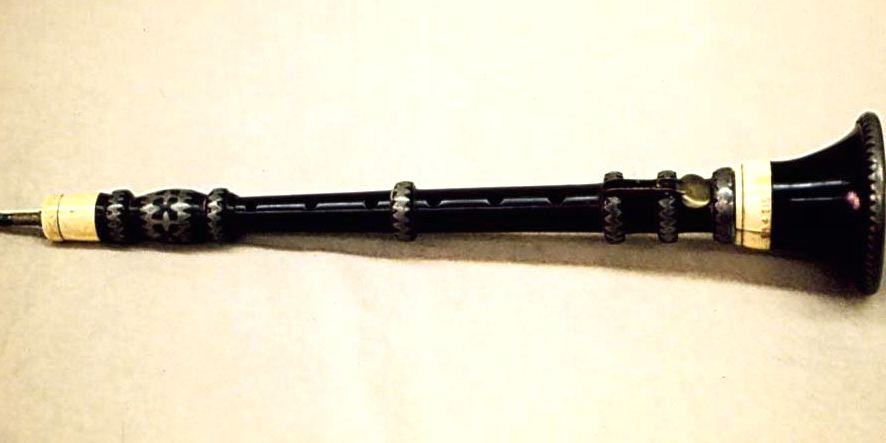
The shawm
The shawm is a woodwind instrument with a double reed and a conical wooden body that ends in a flared bell. It sounds loud and piercing, like a trumpet. The shawm was most popular in Europe in the Middle Ages and the Renaissance. Its relatives are still played in Catalonia, Turkey, India and China.
The sound of the shawm
The first recording is a short melody on a hand-made shawm. Listen to how loud and bright it sounds. Next you hear the gralla with a drum at a street festival in Barcelona. The gralla is the shawm of Catalonia. The suona, the shawm of China, ends the set.
Names of the shawm
The English word shawm comes from Old French. Its root is calamus, which is the Latin word for reed. In German the shawm is the Schalmei, and its larger sizes are the bombard or pommer.
Spain has several folk shawms. They include the dulzaina and the gralla. The Italian shawm is the ciaramella, and the Portuguese one is the charamela.
Where the shawm is played
The shawm probably came to Western Europe from the eastern Mediterranean around the time of the Crusades. Double-reed instruments of the same kind were already played in the Middle East.
Its relatives include the zurna of Turkey and the Balkans, the surnay of Persia, the shehnai of India and the suona of China. The Maya of highland Guatemala play a shawm called the chirimía in processions.
The role of the shawm in music
Town bands of the Renaissance played shawms with the sackbut, the early trombone. These bands announced civic events and marked the hours of the day, so the shawm was also called the wait-pipe.
The shawm was an outdoor instrument. For soft music indoors, players chose the crumhorn and other capped reeds.
Music for the shawm
Shawm bands played dances and music for processions. Players often improvised over well-known tunes.
Today early-music ensembles play shawm music on copies of old instruments. In Catalonia the gralla plays with a drum at street festivals.
How the shawm is made
The body of a shawm is usually turned from a single piece of wood. Its bore widens steadily, and it ends in a flared bell.
The double reed is made of the same cane as oboe and bassoon reeds. On larger shawms the reed sits on a curved metal tube, the bocal. Larger shawms also have a key for the lowest notes. A perforated wooden cap called the fontanelle covers this key.
How the shawm is played
The player puts the reed fully into the mouth and rests the lips against the pirouette. The lips touch little of the reed, so the shawm is hard to play softly.
Zurna players often use circular breathing. They breathe in through the nose while they push air from the cheeks, so the sound never stops.
How the shawm has changed
In the sixteenth century makers narrowed the bore and the finger holes. The sound grew softer, and players could reach a second octave.
In the seventeenth century French makers developed the oboe from the shawm. Its reed is held directly between the lips, which gives more control. By the eighteenth century the oboe had replaced the shawm in concert music. The bassoon grew from the dulcian, a folded bass shawm.
Choosing a shawm
Early-music makers build copies of Renaissance shawms in several sizes. The sizes range from the small soprano to the bass.
A shawm needs good reeds. Ask the maker which reed suits the instrument, and keep several reeds.
First steps on the shawm
Put the reed into the mouth until the lips rest on the pirouette. Blow with steady pressure, and keep the cheeks firm.
Play one long note with all the finger holes covered. Then lift the fingers one at a time from the bottom, and listen to the scale rise.
A short check
Choose one answer per question.
What kind of reed does a shawm use?
The shawm uses a double reed of cane. The oboe and the bassoon use the same kind of reed.
What is the pirouette?
The pirouette surrounds the lower part of the reed. The lips rest against it.
Which instrument grew out of the shawm?
The oboe kept the double reed and conical bore of the shawm. The player's lips touch the reed directly.
Why was the shawm played mostly outdoors?
The conical bore and flared bell give a loud, trumpet-like sound. It suited town bands and processions.
Sources
Common questions
What is the difference between a shawm and an oboe?
The oboe player holds the reed between the lips, which controls loudness and tone. The shawm player puts the reed inside the mouth, so the sound is louder and harder to soften.
Is the shawm still played?
Yes. Early-music ensembles play copies of old shawms, and folk shawms such as the gralla, the zurna and the suona are played daily.
What is a bombard?
It is a larger, lower shawm. In German the name later became pommer.
What is the suona?
The suona is the shawm of China. It is played at weddings, funerals and festivals.
Why does the shawm sound so loud?
Its wide conical bore and flared bell project the sound. The lips barely control the reed, so the shawm sounds at full strength most of the time.