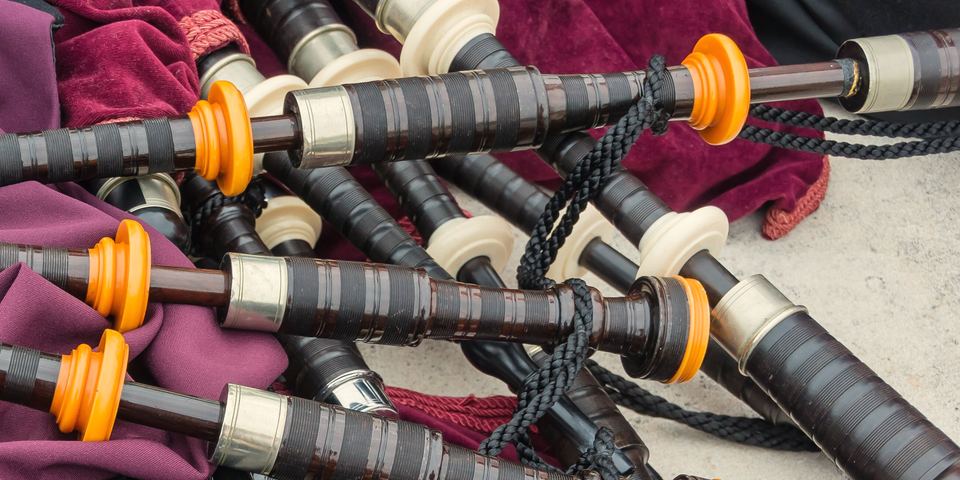
The bagpipe
A bagpipe is a reed instrument that takes its air from a bag. The player fills the bag and squeezes it with the arm. The air sounds a melody pipe called the chanter and drones that hold steady notes. The best-known bagpipe is the Great Highland bagpipe of Scotland. Its Gaelic name, a' phìob mhòr, means the great pipe.
Celtic bagpipes play Auld Lang Syne. The melody is a traditional Scottish tune.
Music: Envato
Listening to the bagpipe
On a bagpipe, the drones sound before the tune begins and hold their notes without a break. On the Highland pipes the two tenor drones sound the A of the chanter an octave lower. The bass drone sounds it two octaves lower. The notes of the melody sound against this steady A. Some notes blend with it, and others clash, and this mix gives the pipes their color.
Auld Lang Syne is a pentatonic melody, which means that it uses five notes. It lies well on the nine notes of the Highland chanter. The air never stops, so the piper cannot leave a silence between two notes. When a note repeats, the piper separates the two with a grace note. A grace note is a short, quick note played by another finger. The button below plays low G. It is the lowest note of the Highland chanter.
Names of the bagpipe
Many cultures have their own bagpipes with their own names. Western Europe has the uilleann pipes of Ireland, the gaita of Galicia and Asturias and the biniou of Brittany. Italy has the zampogna. Farther east and south are the gaida of the Balkans, the tulum of the Black Sea coast of Turkey and the mezwed of Tunisia.
In Scotland the Great Highland bagpipe is called a' phìob mhòr in Gaelic. Its solo art music is called piobaireachd. The Gaelic spelling is pìobaireachd, and the English spelling is often pibroch. Its other name is ceòl mòr, which means the great music. Marches, dances and airs make up ceòl beag, which means the little music.
History of the bagpipe
Bagpipes are old. Some scholars link them to the askaulos of ancient Greece, whose name joins the words for a wineskin and a reed pipe. In the first century, the Greek writer Dio Chrysostom described a ruler who could play a pipe with a bladder under his arm. That ruler was probably the Roman emperor Nero. The Roman writer Suetonius also called Nero a player of the tibia utricularis. The name means a pipe with a bag.
In the thirteenth century, bagpipes appear in European pictures and writings. The Cantigas de Santa Maria, a book of songs compiled in Castile, shows several kinds. Records of a battle at Perth mention war pipes at the end of the fourteenth century. A Scottish poem of the sixteenth century is the first to mention a distinct Highland pipe.
In the Highlands, families of hereditary pipers served the chiefs of the clans. The MacCrimmons, pipers to the MacLeods of Dunvegan on the Isle of Skye, are the most famous of them. Ceòl mòr seems to have taken shape as a distinct form in the seventeenth century. After the battle of Culloden, many Highland regiments were raised for the British army, and they took their pipers with them. A popular story says that the government then banned the pipes. The text of the law gives no support to that claim.
The Great Highland bagpipe spread with the regiments and with Scottish and Irish emigrants. Pipe bands now play in Scotland, Canada, Australia, New Zealand and the United States. In many other lands the old bagpipes faded as Western classical music developed. A revival in the twentieth century brought back the uilleann pipes, the gaitas of Spain and the gaida of the Balkans.
The role of the bagpipe in music
The chanter plays the melody, and the drones sound steady notes beneath it. On the Great Highland bagpipe, two tenor drones and one bass drone sound the tonic of the chanter, the note A.
The pipes are loud, and they were made for the open air. Pipers lead marches and parades. They also play at funerals and memorials. These are most often held for the armed forces, the fire services and the police. A pipe band joins the pipes with snare drums, tenor drums and a bass drum. Bands from many countries meet in competitions, where they are judged on their unison and their tone.
Music for the bagpipe
Highland pipers play two kinds of music. Piobaireachd is a long solo form. It begins with a slow theme called the ground. Its Gaelic name is ùrlar. Variations follow, and they grow more and more elaborate. The later variations use ornaments called the taorluath and the crunluath. The piece ends with a return to the ground. Laments, salutes and gatherings are among its kinds.
Ceòl beag is the light music of marches, strathspeys, reels, jigs and slow airs. Pipers also play songs such as Auld Lang Syne. The poet Robert Burns wrote down its words from an old Scottish song. The pentatonic tune now used with them was first printed with them in a Scottish song collection about ten years later. People sing it at the stroke of midnight on New Year's Eve, which Scots call Hogmanay.
How the bagpipe works
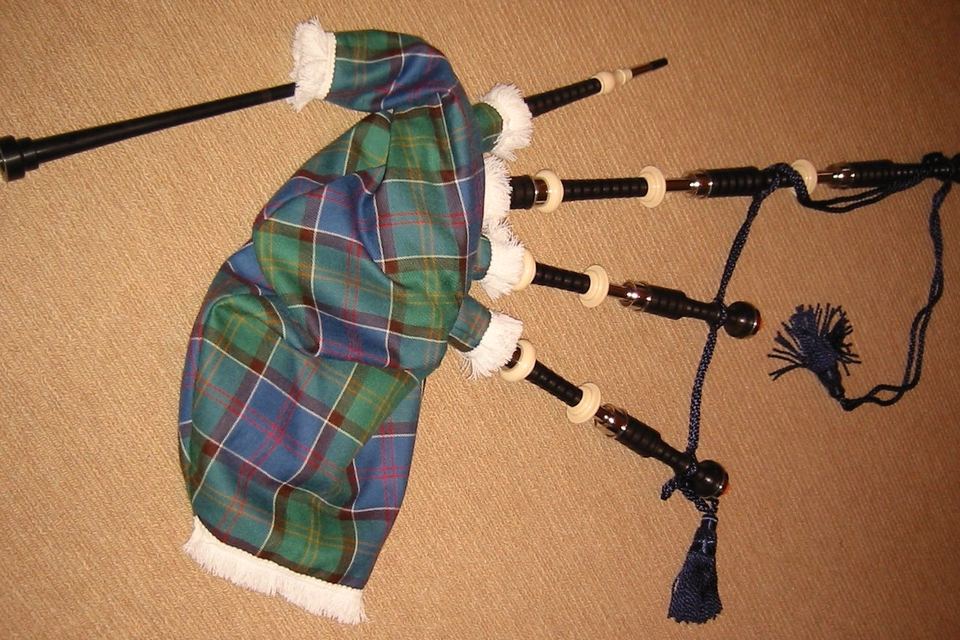
The bag holds the air and keeps the pressure steady. Bags were made of animal hide, such as sheepskin or cowhide, and many bags today are synthetic. A cover of cloth, often tartan, protects the bag. The blowpipe carries the breath into the bag, and a valve at its end stops the air from coming back.
The Great Highland bagpipe has four reeds, and all of them are enclosed inside the pipes. The chanter has a double reed of cane, which gives its bright, piercing tone. A double reed is two thin blades of cane that vibrate against one another. The drones have single reeds, which give a steadier and darker sound. A single reed is one blade that vibrates against a tube. The player cannot touch the reeds with the lips, so the tone cannot be shaped with the mouth.
The chanter has a conical bore and eight finger holes, seven on the front and one for the thumb. The drones are cylindrical and are made in sections. The player slides the sections in or out to tune the drones to the chanter. The A of a Highland chanter sounds well above the A of most other instruments. It vibrates about four hundred seventy to four hundred eighty times a second. The pipes therefore rarely play with other instruments.
Old Highland pipes were turned from hard tropical woods such as cocuswood. Most fine sets are now made of African blackwood. Their rings and caps, called mounts, are of ivory, horn, nickel, silver or imitation ivory.
How the bagpipe is played
The piper blows into the blowpipe to fill the bag. The arm squeezes the bag to keep the pressure steady while the piper takes a breath. The fingers play the chanter. On the Highland pipes it has nine notes, and they run from low G to high A.
The tone never stops, so the piper shapes the music with ornaments. Single grace notes on G, D and E are the most common. Groups of grace notes form doublings, throws, grips and birls. A piper also stretches some notes and shortens others within a phrase, and this gives the music its swing.
Pipers begin on a practice chanter, which is a quiet pipe with no bag or drones. It has the same fingering as the full chanter. The grace notes take many years to master.
What makes a fine bagpipe
A fine bagpipe starts with its wood. Dense, oily woods resist splitting under the moisture of the breath. For this reason makers turned to cocuswood and then to African blackwood. The wood is seasoned before it is turned. The maker bores the chanter and the drones with great precision. The shape of the bore sets the pitch of the notes and the blend of the drones.
The reeds shape the tone more than any other part. A chanter reed must be strong enough for a steady, bright tone and easy enough for the piper to hold through a long tune. Drone reeds must hold their pitch as the pipes warm up. Pipers test many reeds to find a set that suits their instrument.
A well-made set holds its tune. The drones lock into tune with the chanter, so that the steady A and the melody sound as one bright chord. The bag must be airtight, so the piper does not tire.
Choosing a bagpipe
A practice chanter costs much less than a full set of pipes, and it lets you learn the fingering quietly.
When you move to a full set, ask a teacher to try it with you. Check that the drones hold their tune and that the bag is airtight. Clean the bag of a full set regularly. A synthetic bag can still hold the spores of fungus.
Who keeps these instruments
The National Piping Centre in Glasgow is the home of piping in Scotland. It teaches the Highland pipes, the Scottish smallpipes and the uilleann pipes. Its Museum of Piping shows Scottish bagpipes from the eighteenth century onward. Pipes from other parts of Europe stand beside them. The College of Piping, another old Glasgow school, has joined it.
Museums abroad also keep bagpipes. The Metropolitan Museum of Art in New York holds a Highland bagpipe. Its collection also includes the small pipes of Northumberland and the court musette of France. In Phoenix, the Musical Instrument Museum displays bagpipes from many lands. They include the Maltese żaqq. In Brittany, pipe bands called bagadoù follow the Scottish model. They play Breton music in a tradition of their own.
First steps on the bagpipe
Begin on a practice chanter. Learn the nine notes of the scale. They run from low G to high A. Keep the fingers flat over the holes, so that the holes close fully.
Then learn the three single grace notes on G, D and E. Play a slow scale and put G grace notes before all the notes. Play with the metronome at a slow tempo, and keep the grace notes short and clean. A teacher or a local pipe band can tell you when you are ready for the full pipes.
A short check
Choose one answer per question.
What does the chanter of a bagpipe do?
The chanter is the melody pipe, and it has finger holes. The drones hold steady notes beneath it.
Why do pipers play grace notes?
The bag keeps the reeds sounding without a break. Quick grace notes from other fingers separate one note of the melody from the next.
What is the ground of a piobaireachd?
The ground, in Gaelic ùrlar, is a slow theme. A set of variations grows more elaborate, and the piece ends with a return to the ground.
Sources

Common questions
Where do bagpipes come from?
No one knows where bagpipes began. Roman writers mention a bag pipe, and bagpipes appear in European pictures and writings of the thirteenth century. Today many cultures play them.
How many drones does a Highland bagpipe have?
A modern Great Highland bagpipe has three drones. It has two tenor drones and one bass drone, and all three sound the note A.
What is a practice chanter?
A practice chanter is a quiet pipe with a reed but no bag or drones. Pipers learn the fingering and the grace notes on it.
How many notes can a bagpipe play?
The Highland chanter plays nine notes. The lowest is low G, which lies a whole step below the tonic. The highest is high A.
What is piobaireachd?
Piobaireachd, or pibroch, is the classical solo music of the Highland bagpipe. A slow theme called the ground is followed by variations of growing difficulty.
Why do pipers play grace notes?
The air flows to the chanter without a break, so a piper cannot stop between notes. Quick grace notes separate one note from the next.
World MusicHurdy-gurdyTunerUilleann pipesShawm