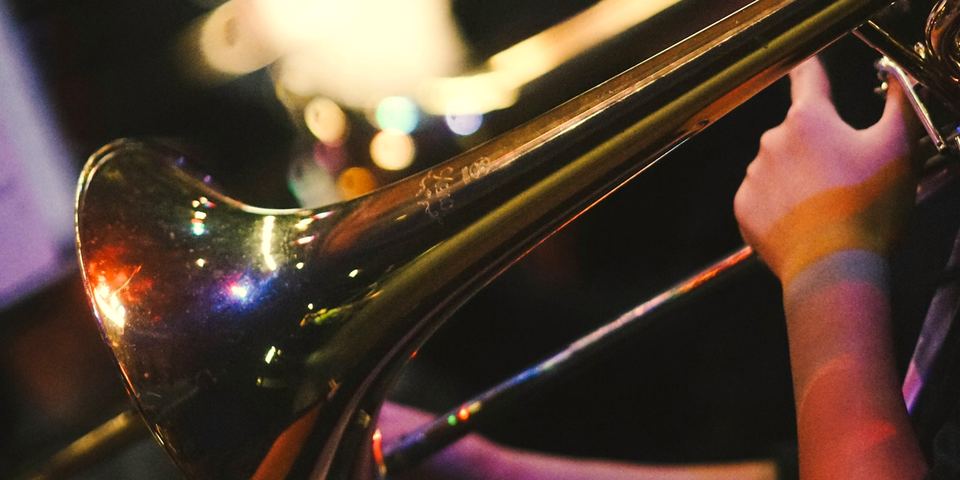
The trombone
The trombone is a brass instrument with a slide in place of valves. Moving the slide out makes the tube longer and the note lower. The player buzzes the lips into a cup-shaped mouthpiece. The tenor trombone is the usual size, and its music is written in the bass clef.
A trombone plays this waltz with a band on an early disc. Listen to how the slide joins the notes of the melody.
The sound of the trombone
A trombone soloist leads a band in this waltz from an early American disc. Listen for the smooth line of the melody. The player moves the slide between notes and keeps the air flowing, so the notes join without a break. The disc is old, so a soft hiss sounds under the music.
Below, trombones slide between the notes in an early ragtime record for military band. Next you hear three B♭ notes in first position, where the slide is closed. The notes step down an octave at a time. The lowest is a pedal tone. A pedal tone is a deep note below the usual range of the trombone. Flutter tonguing comes next. The player rolls the tongue while blowing, and the note rattles. The last recording is a held note with vibrato.
Names of the trombone
The word trombone comes from Italian, and it means "large trumpet." In German the instrument is the Posaune. In Renaissance England it was called the sackbut. That name probably comes from the French saqueboute. Its two parts come from words that mean "pull" and "push."
When musicians say trombone alone, they usually mean the tenor trombone. The bass trombone has a wider tube and extra valves for low notes. The alto trombone is smaller and higher, and it plays some parts in older orchestral and church music.
History of the trombone
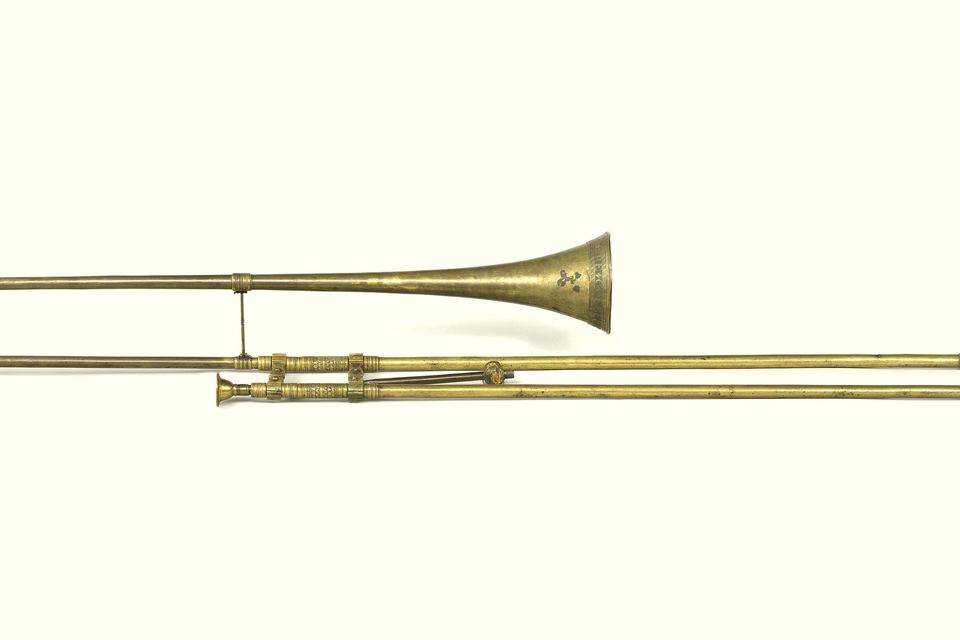
Players in Burgundy used a trumpet with a slide early in the fifteenth century. By the end of that century the true trombone, with its U-shaped slide, had appeared. The English called it the sackbut. Its tube was narrow and its bell small, so it sounded softer than a modern trombone. It blended well with voices and with the shawm.
In the sixteenth century the sackbut played in town bands, at courts and in churches. It doubled the voices of the choir in sacred music. In Venice Giovanni Gabrieli wrote music for cornetts and sackbuts for the great church of Saint Mark. Monteverdi called for trombones in his opera Orfeo and in his Vespers. The finest sackbuts of the age came from Nuremberg. The Neuschel, Ehe and Hainlein families made them there.
For a long time the trombone was heard mostly in church and in opera. Mozart used three trombones in his Requiem. A solo tenor trombone accompanies the bass soloist in the section called Tuba mirum. Beethoven brought trombones into the last movement of his Fifth Symphony. After him the trombones took a regular place in the orchestras of Schubert, Berlioz, Brahms and Wagner.
The bore is the inside of the tube. In the nineteenth century makers widened the bore and the bell, and the sound grew larger. Late in that century trombone soloists became stars of the American wind bands. Arthur Pryor played solos with the band of John Philip Sousa. Early jazz bands in New Orleans used the trombone for bass lines and for sliding phrases called tailgate playing. In the swing era the trombone became a solo voice of the big bands.
The role of the trombone in music
An orchestra usually has two tenor trombones and a bass trombone. They play chords and melodies in the brass section, and the bass trombone takes the lowest notes. Their soft chorales and loud climaxes stand out in orchestral music. A chorale is a slow passage in the style of a hymn.
In a jazz big band the trombones form a section of their own, beside the trumpets and the saxophones. A trombone player can also improvise solos. The trombone plays in concert bands, brass bands and brass quintets. It is also heard in salsa, ska, rhythm and blues, and the brass bands of New Orleans.
Music for the trombone
Ragtime bands made the glissando famous. In a glissando the player moves the slide while blowing, and the note glides smoothly up or down. Composers of the time wrote whole pieces around this sound.
Brahms saved the trombones in his First Symphony for the last movement, where they enter softly with a chorale. Ravel wrote a high solo for the trombone in Boléro. Berlioz wrote a long trombone solo in his Grande symphonie funèbre et triomphale. The Concertino for trombone by Ferdinand David became a favorite of soloists in the nineteenth century.
In the twentieth century composers wrote for new sounds on the trombone. Berio wrote Sequenza V for trombone alone. In jazz, players of the swing era gave the trombone a smooth tone in slow ballads. Bebop was a later style of jazz. It was fast and complex, and its trombonists played rapid lines on the slide.
How the trombone is made
The trombone is a brass tube bent into a long loop. Most of its length is cylindrical, and it widens only in the last part before the bell. The slide is a U-shaped outer tube that moves along two fixed inner tubes. The ends of the inner tubes are slightly wider. These short sleeves, called stockings, carry the slide and reduce friction.
The bell section joins the slide at the mouthpiece end with a threaded collar. A short tuning slide sits in the bend behind the player's head. A water key on the slide lets out the water that gathers from the breath.
Many tenor trombones add a valve called the F attachment. A thumb trigger sends the air through an extra loop of tube, which lowers the pitch by a fourth. This gives more low notes and easier slide positions. Bass trombones often add a second valve.
How the trombone is played
The slide has seven positions. In first position the slide is closed. With the slide one position farther out, the note falls by a half step. The slide in seventh position needs a long reach of the right arm.
A slide position gives a set of notes from low to high. The player reaches the higher notes of the set with a tighter buzz of the lips and faster air. Because the slide moves, the tongue must start the notes cleanly, or the notes will smear together. Players call this soft tonguing legato tonguing.
Trombone music is written in the bass clef. Higher passages use the tenor clef. This C clef places middle C on the fourth line of the staff. In British brass bands the tenor trombone reads the treble clef as a transposing instrument in B♭. The written notes sound a major ninth lower.
What makes a fine trombone
The width of the bore sets the character of a trombone. A small bore is about half an inch wide. It gives a bright, light sound for jazz. A large bore is a little wider, and it gives the broad sound of the orchestra. Medium bores fall between. Different kinds of music suit different bores, so many professional players keep more than one trombone.
The bell shapes the color of the tone. Most bells are yellow brass, which is copper with about thirty percent zinc. Bells of rose brass or red brass hold more copper, and their sound is warmer. Tenor trombone bells usually measure seven and a half to eight and a half inches across. Some makers still shape fine bells by hand.
The slide is the most important part of a trombone. On a fine trombone the inner tubes are light and straight, and they are chrome-plated or made of nickel silver. The outer slide runs smoothly and quietly from first to seventh position with only a light touch. A slide that sticks or bends ruins the playing, so makers fit and align their slides with great care.
The valve of an F attachment should turn freely and let the air pass with little resistance. A beginner needs only a well-made student trombone with a good slide. The player can choose a larger or more specialized trombone later.
Choosing a trombone
Most beginners start on a tenor trombone without an F attachment. It is lighter, and it is simpler to care for.
Check that the slide moves freely and smoothly from first to seventh position. A young player with short arms may need some time to reach seventh position.
Who keeps these instruments
The Rijksmuseum in Amsterdam holds a bass trombone from the end of the sixteenth century. Pierre Colbert made it in Reims. The Bate Collection at the University of Oxford keeps brass instruments from the Renaissance to the present. The Metropolitan Museum of Art in New York holds trombones from several centuries and many countries.
Some of the great makers of the modern trombone worked in the United States. C. G. Conn built brass instruments in Elkhart, Indiana. Vincent Bach, a trumpeter born in Austria, made mouthpieces and brass instruments in New York. Conservatories in many countries train trombonists for orchestras, bands and jazz groups.
First steps on the trombone
Hold the trombone with the left hand, and rest the weight on the left shoulder. Hold the slide lightly with the fingertips of the right hand.
Play a long B♭ in first position with the slide closed. Then move to the next positions slowly, and listen as the pitch falls a half step at a time. A tuner shows whether a position is in tune.
Keep the air flowing while the slide moves. Start the notes with a soft "doo" from the tongue. Then play the first notes of a B♭ major scale slowly with the metronome.
A short check
Choose one answer per question.
How does a trombone player change the note?
The slide changes the length of the tube. The buzz of the lips sets which of its notes sounds.
How many slide positions does the trombone have?
The slide has seven positions. A position lowers the note by a half step more than the one before.
What is a glissando on the trombone?
When the slide moves while the player keeps blowing, the pitch glides smoothly. This sound is a glissando.
What was the trombone called in Renaissance England?
The sackbut was the English name for the early trombone. It played with shawms and voices.
Sources
Common questions
Is the trombone hard to learn?
The slide has no marks, so the player learns the positions by ear. Many students make clear notes within the first few lessons.
What is the difference between a trombone and a trumpet?
The trombone plays an octave lower than the trumpet, and it uses a slide. The trumpet uses three valves.
What is a pedal tone?
A pedal tone is a deep note below the usual range. It sounds when the whole length of the tube vibrates at its lowest natural note.
What is an F attachment?
It is an extra loop of tube with a valve. The left thumb works the valve. It gives the trombone more low notes and other ways to play some notes.
What is flutter tonguing?
The player rolls the tongue, as in a rolled R, while blowing. The note gets a buzzing, rattling sound.
Which clef does the trombone read?
Most trombone music uses the bass clef. Higher passages use the tenor clef. In British brass bands the tenor trombone reads a treble-clef part in B♭, which sounds a major ninth lower than written.
What is a sackbut?
Sackbut is the old English name for the early trombone. It has a narrower tube and a smaller bell than a modern trombone, and its sound is softer.