The zurna
The zurna is a wind instrument of West Asia, the Caucasus, the Balkans and North Africa. The player blows through a double reed, which is two thin blades of cane that vibrate together. Its tone is loud and piercing. A large drum called the davul usually plays beside it at weddings and dances.
A zurna plays the melody over a darbuka. Listen for its piercing tone above the drum.
Music: Envato (soundroll)
The sound of the zurna
The first recording is a march played on a zurna. In the second, the same player sounds the notes of the instrument one after another.
Both were recorded on discs for the Library of Congress in an Armenian community in California. The discs are old, so a hiss lies under the sound.
Names of the zurna
A popular explanation traces the name to the Persian surnāy. It joins two Persian words. Sūr means feast, and nāy means reed pipe. A Turkic word book of the Middle Ages, the Codex Cumanicus, records the name as suruna.
Related instruments have other names. They include the zamr of Syria, the zmar of Tunisia and Morocco and the suona of China.
Where the zurna is played
The zurna is played in Turkey, Armenia, Azerbaijan, Iran, Iraq and Syria. It is also heard in Greece, Bulgaria, North Macedonia, Albania, Serbia and Bosnia, and in North Africa. Turkish, Armenian, Kurdish, Azerbaijani and Assyrian communities use it in their folk music.
The role of the zurna in music
The zurna plays the melody of folk dances. Its sound is loud and steady, so it cannot stress the beat by itself. The davul gives the rhythm and the low notes. Low notes carry farther than the high tone of the zurna.
Because it is so loud, the zurna has usually been played outdoors. It was once used to gather crowds for public announcements. That use led to its place in the mehter. The mehter was the military band of the Ottoman Empire.
Music for the zurna
In Turkey, zurna and davul lead the circle and line dances called halay. Halay dances are held at weddings and other celebrations. They usually begin slowly and grow faster.
The zurna is also central to Armenian and Kurdish dance music. Its music is learned by ear, and players pass on dance tunes from one generation to the next.
How the zurna is made
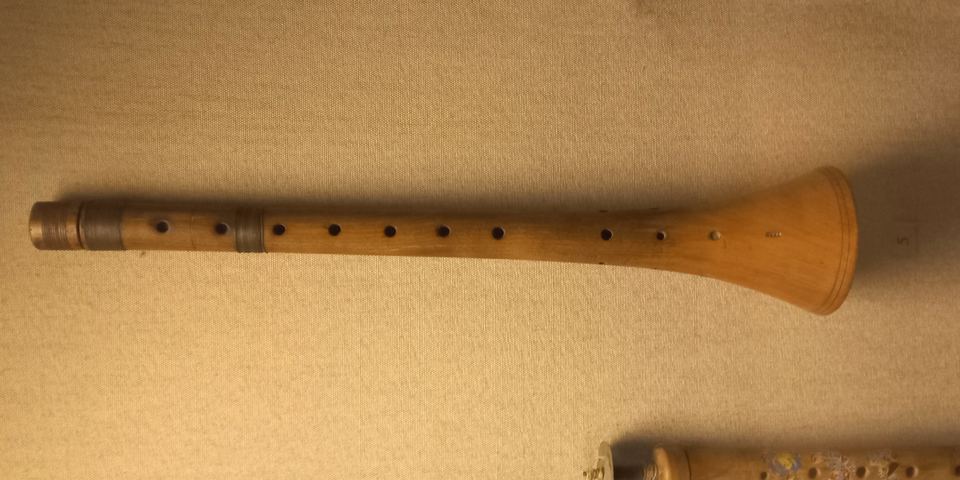
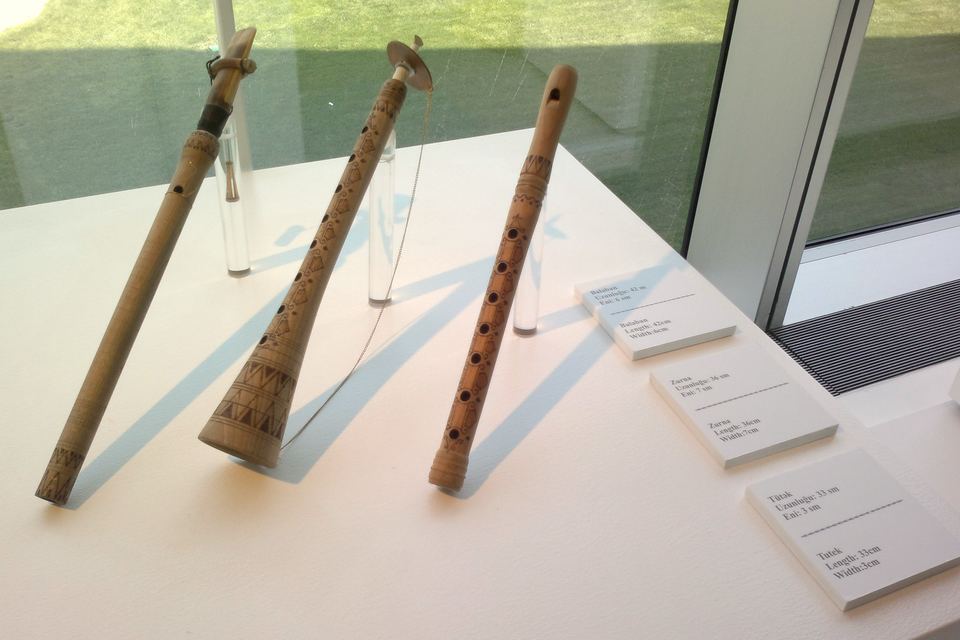
The body is turned from the hardwood of fruit trees such as plum or apricot. It has seven finger holes on the front and one thumb hole at the back. Its range is a little more than an octave. The bell opens in a curve that sends the sound straight ahead.
The reed is short and is tied to a small brass tube that fits into the top of the body. Around the tube sits a small disc. The lips lean against it, so the muscles of the lips can rest during long performances.
Sizes differ from region to region. The kaba zurna of Bulgaria is the longest and lowest. The shortest zurnas, from villages in western Greece, can be made of bone.
How the zurna is played
The zurna needs high breath pressure before it makes any sound. Many players use circular breathing. They draw air in through the nose while the cheeks push stored air into the reed, so the tone never stops.
The fingers of both hands cover the finger holes, and a thumb covers the hole at the back. The player lifts fingers in turn to raise the pitch.
How the zurna has changed
Scholars point to pictures of similar pipes in the art of the Hittites of ancient Anatolia. The zurna was known in Persia by the sixth century. It later spread with the Ottoman Empire into the Balkans and Hungary.
The zurna is probably the direct ancestor of the European shawm. It is also related to the suona, which is still played at Chinese weddings and funerals.
Choosing a zurna
Zurnas are made in several sizes and keys. Ask your teacher which size suits the music you will study, especially if you will play with other zurnas.
Reeds wear out with use, so keep several spares that fit your zurna. Check that the body has no cracks and that the brass tube sits firmly in the top.
First steps on the zurna
Begin with the reed alone. Put it between your lips, let the lips rest on the disc and blow until a tone sounds. Hold the tone steady for a few seconds.
Next, cover all the holes and lift one finger at a time from the bottom. Learn circular breathing away from the instrument first. Blow through a straw into a glass of water, and keep the bubbles going while you draw air in through the nose.
A short check
Choose one answer per question. The explanation appears below the correct answer.
What is a double reed?
The zurna, the oboe and the shawm all sound through a double reed.
Why does the davul play with the zurna?
The zurna is loud and steady, so it cannot stress the beat. The drum gives the rhythm and the low notes, which carry far.
What does circular breathing let a zurna player do?
The player draws air in through the nose while the cheeks push air into the reed, so the tone does not stop.
Sources
Common questions
Is the zurna the same as the shawm?
The zurna is probably the ancestor of the European shawm. Both are loud double-reed instruments with a flared bell.
Why is the zurna so loud?
It needs high breath pressure, and its bell sends the sound forward. It was made for celebrations in the open air.
What is the davul?
The davul is a large drum with two heads. Its player strikes one head with a heavy beater for the bass and the other with a thin stick for the treble.
What is the difference between the zurna and the duduk?
Both are double-reed instruments of Armenia and its neighbors. The duduk has a large reed and a soft, warm tone. The zurna is loud and bright.
How many holes does a zurna have?
It has seven finger holes on the front and one thumb hole at the back.
What is the disc on a zurna for?
It gives the lips a place to rest. Players can then hold the high air pressure through long dances.