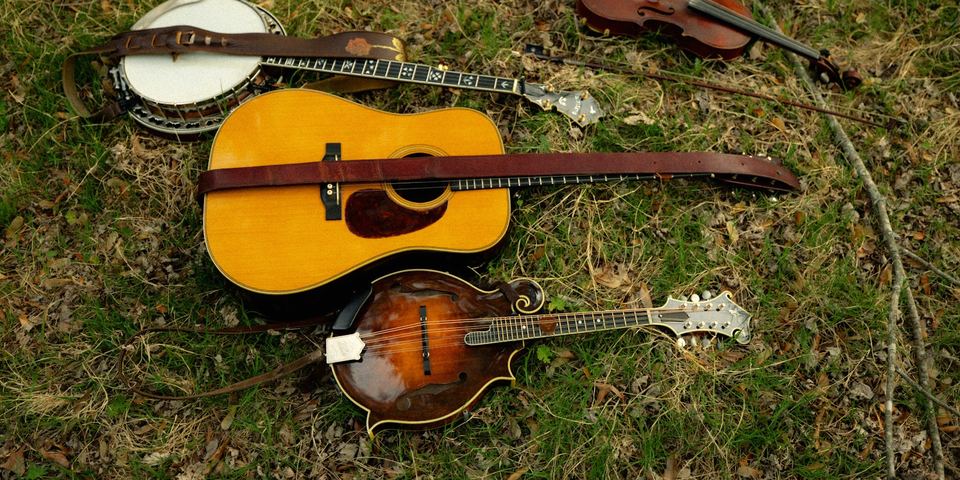
The mandolin
The mandolin is a plucked string instrument of the lute family. It has eight metal strings in four pairs, and the player strikes them with a pick. The pairs are tuned G, D, A and E. These are the open strings of the violin. The mandolin plays in Italian music, mandolin orchestras, bluegrass and the folk music of many countries.
A mandolin plays the melody of Angel's Serenade by Gaetano Braga. The recording comes from a wax cylinder. Cylinders were an early kind of record.
The sound of the mandolin
Angel's Serenade is a song by the Italian composer Gaetano Braga. In the original song, a girl hears an angel calling her. A violin or a cello plays the voice of the angel. On this cylinder the mandolin takes that melody. Listen to the long notes. The pick strikes the two strings of a pair in rapid turns, so the long notes sound as a shimmer. This is tremolo. The short notes are picked once, so you hear the two kinds of stroke side by side. You can hear the hiss of the old cylinder.
The first button below plays the opening of a concerto for two mandolins by Vivaldi. Strings and a keyboard play with them. Listen for the quick repeated notes of the two soloists. The second button plays the Estudiantina waltz by Émile Waldteufel. A mandolin quartet recorded it on an early disc. Count three beats to a bar, and listen for the tremolo of the mandolins on the long notes of the tune.
The shorter recordings follow. The first melody of the serenade has its own button. A waltz then pairs the mandolin with a guitar. A modern mandolin plays a C major scale and strums a G major chord. On the last button a recorded grand piano sounds the open strings. It plays one pitch per pair.
Names of the mandolin
The Italian word mandolino means "small mandola." The mandola was a larger instrument of the lute family. A person who plays the mandolin is a mandolinist. In Brazil the instrument is called the bandolim. In Japan, where mandolin orchestras are common, its name is written マンドリン (mandorin).
The mandolin is the soprano of its own family, as the violin is the soprano of the violin family. The mandola is tuned a fifth lower, like the viola. The octave mandolin sounds an octave below the mandolin. The mandocello is tuned like the cello. The mandobass plays the bass line in some mandolin orchestras.
History of the mandolin
The mandolin descends from the lutes of Europe. Its forerunners include the gittern and a small lute called the mandore, or mandola. Italian cities developed their own kinds of mandolin. The Lombard mandolin of Milan had six strings tuned in fourths. The Neapolitan mandolin of Naples had four pairs of strings. Like the strings of the violin, they were tuned in fifths. The Neapolitan model is the mandolin that most people know today.
In Naples the Vinaccia family made mandolins for generations. A Neapolitan mandolin has a deep round back glued from strips of wood, and its top is bent below the bridge. Early mandolins had gut strings, which players plucked with the fingers or with a quill. Later makers fitted metal strings, which press harder on the top. They built stronger tops to carry the load, and the mandolin grew louder.
Late in the nineteenth century, a wave of interest in the mandolin swept Europe and the Americas. Makers such as Vinaccia and Calace in Naples and Embergher in Rome built fine bowlback mandolins. Mandolin orchestras formed in many cities, and they were often called estudiantinas. In Germany they were called Zupforchester, which means plucked orchestras. Traveling players carried the instrument to the Americas and to Japan. The Neapolitan virtuoso Raffaele Calace gave concerts across Europe and in Japan, and he wrote about two hundred works for the mandolin.
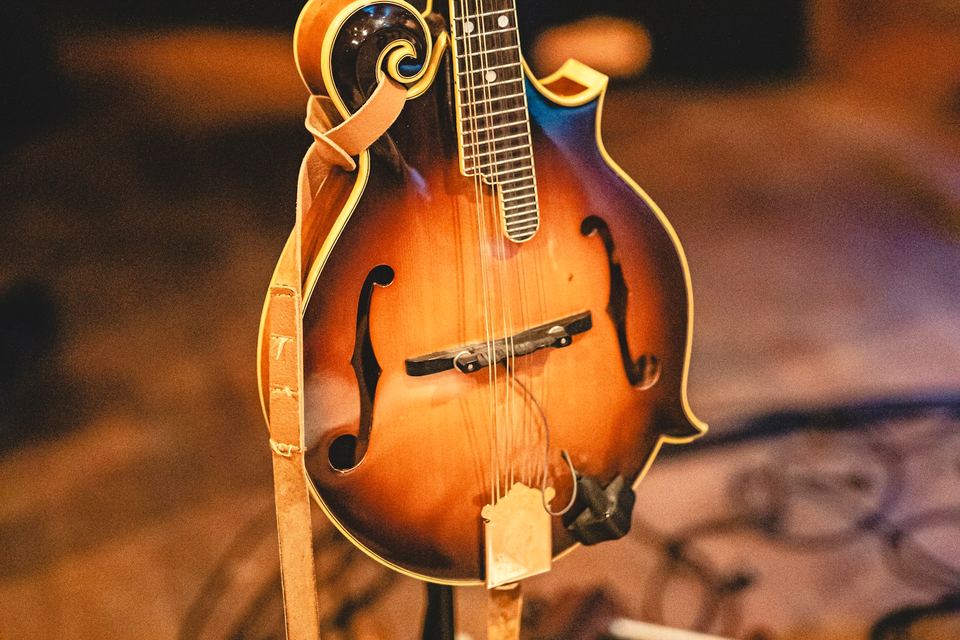
In the United States a new design appeared near the end of the nineteenth century. Orville Gibson made mandolins in Kalamazoo, Michigan. He carved their tops and backs into arches like those of a violin. His company built two main shapes. The A-style mandolin is shaped like a pear. The F-style has a scroll near the neck and two points on the lower body. The acoustician Lloyd Loar later supervised the F-5 model, which has two f-holes like a violin. A carved top projects well, and the F-5 became the mandolin of bluegrass. Many makers still copy it.
The craze for the mandolin faded within a few decades. The instrument then found a lasting home in country, bluegrass and folk music. Flat-backed mandolins are played in Irish, British and Brazilian folk music. In Brazil the bandolim leads choro. Choro is a lively instrumental music of Rio de Janeiro. The mandolin has also entered Carnatic music, which is the classical music of South India.
The role of the mandolin in music
In a bluegrass band the mandolin plays melodies and short solos. Between solos it plays short chords on the off-beats. These chords fall between the beats. Players call this stroke the chop. A bluegrass band usually has no drums, so the chop of the mandolin marks the beat. The mandolinist Bill Monroe is often called the father of bluegrass.
Mandolin orchestras are still popular in Japan and Germany. They are laid out like the string section of a symphony orchestra. First and second mandolins play the parts of the violins, and the mandolas and mandocellos play the lower parts. Guitars and a bass complete the group. Mandolin quartets of two mandolins, a mandola and a mandocello also play.
Music for the mandolin
Vivaldi wrote a concerto for one mandolin and a concerto for two. Beethoven wrote four short pieces for mandolin and keyboard. In the opera Don Giovanni by Mozart, a mandolin accompanies the serenade "Deh vieni alla finestra."
Mahler used the mandolin in his Seventh and Eighth Symphonies. Prokofiev gave it a part in the ballet Romeo and Juliet. Mandolin orchestras also play many arrangements of orchestral music.
The mandolinists of Italy wrote much of their own concert music. Raffaele Calace composed solo pieces for the mandolin, duets with piano, quartets and a book of lessons for students. Carlo Munier wrote chamber music for mandolin ensembles. Players also perform violin music on the mandolin, since the two instruments share their tuning.
How the mandolin is made
There are three main kinds. The Neapolitan mandolin has a deep round back glued from strips of wood. The strips often alternate in color. Americans gave it the nickname "tater bug" for this look. The archtop mandolin has a top and back carved into arches, like a violin. The flatback mandolin is built from thin sheets of wood and braced inside, like a guitar.
The top is usually spruce, and the back is often maple. The strings run from the tuners on the headstock, over a floating bridge, to a tailpiece. The pressure of the strings holds the bridge on the top. The fingerboard has metal frets. When a string sounds, the bridge passes its vibration to the top, and the top sounds through the sound hole or the f-holes.
How the mandolin is played
The player holds a pick between the thumb and the first finger. The left-hand fingers press the strings against the frets.
A plucked note fades quickly on the mandolin. Players therefore use tremolo. The pick strikes the two strings of a pair in rapid turns, and a long note keeps sounding. Players call a pair of strings a course.
Mandolin music is written in the treble clef. Violin music suits the mandolin well because the open strings are the same. Many players also read tablature, which shows the string and the fret for the notes.
What makes a fine mandolin
The top does most of the work. On a fine archtop mandolin the top is carved from solid spruce to an exact thickness. A carved top of the right thickness responds quickly and gives a full tone that carries. Many cheaper mandolins have a pressed top. It is made of laminated wood or thin sheets of wood pressed into an arch. A pressed top looks like a carved one, but it does not sound the same.
Under the top, braces shape the tone. Most F-style mandolins have two parallel tone bars. They work like the bass bar inside a violin. Some makers join two bars in the shape of an X. The maker carves the braces as carefully as the top, because they control how the top vibrates.
The shape of the body changes the voice. A flat-backed mandolin has a mellow tone, which suits folk music and small rooms. A carved archtop sounds stronger and stands out in a band. The Neapolitan bowlback is the classical mandolin of the orchestras and of the Italian repertoire.
A good setup is as important as good wood. The floating bridge must stand exactly where the notes on the frets are in tune. The strings should sit low over the frets, so that both strings of a pair press down easily. The tuners must turn smoothly and hold their pitch, because the two strings of a pair must stay in tune with one another.
Choosing a mandolin
A carved solid top usually sounds fuller than a pressed top of laminated wood. Check that the bridge sits straight and that the strings are not too high above the frets.
Steel strings are the usual choice. A tuner that clips onto the headstock makes it easier to tune a pair of strings to the same note.
Who keeps these instruments
In New York the Metropolitan Museum of Art holds two Neapolitan mandolins by members of the Vinaccia family. Both were made in the eighteenth century, and they are decorated with tortoiseshell and mother-of-pearl. The museum also keeps a mandolin built by Orville Gibson himself. Its back is made of walnut. Beside it stand Gibson factory instruments of the whole mandolin family. Among them are a mandola and a mandobass.
Mandolin orchestras still play the old repertoire. After the First World War their number fell in the United States. They continued in Japan, Germany and Italy. When folk music returned to favor, new mandolin orchestras formed in American cities. Many of them keep libraries of hundreds of scores. These include concert music by Calace and Munier. The Library of Congress keeps early mandolin records in its National Jukebox, and the Estudiantina waltz on this page comes from that collection.
First steps on the mandolin
Tune the pairs of strings with the tuner. From the lowest pair the notes are G, D, A and E. Both strings of a pair must match exactly, or the note sounds sour.
Hold the pick loosely, and play the open D pair with even down strokes at a slow metronome tempo. Then play down and up strokes in turn.
On the D pair, the second fret gives E and the fourth fret gives F♯. Play D, E and F♯ slowly, and listen for a clear note from both strings.
A short check
Choose one answer per question. The explanation appears below the correct answer.
How is the mandolin usually tuned?
From the lowest pair of strings, the mandolin is tuned G, D, A and E. The violin uses the same four open strings.
What is a course on a mandolin?
The mandolin has four courses. A course is a pair of strings tuned in unison, so the mandolin has eight strings.
Why do mandolin players use tremolo?
In tremolo the pick strikes the two strings of a course in rapid turns. A long note then keeps sounding.
Which kind of mandolin has a round back built from strips of wood?
The Neapolitan mandolin has a deep bowl glued from strips of wood. It is also called the bowlback.
Sources
- Wikipedia: Mandolin
- Wikipedia: Mandolin orchestra
- Wikipedia: Raffaele Calace
- Wikipedia: Gaetano Braga
- Wikipedia: Émile Waldteufel
- Metropolitan Museum of Art: mandolin by Antonius Vinaccia
- Metropolitan Museum of Art: mandolin by Vincentius Vinaccia
- Metropolitan Museum of Art: mandolin by Orville Gibson
- Wikimedia Commons: Angel's Serenade on a cylinder
- Internet Archive: Estudiantina waltz from the National Jukebox
Common questions
Is the mandolin hard to learn?
The paired strings need firm pressure from the left-hand fingers, and the fingertips are sore at first. The frets are close together, so small hands reach the notes easily.
Is a mandolin tuned like a violin?
Yes. Its four pairs of strings are tuned G, D, A and E, which are the open strings of the violin. Violin fingerings and violin music carry over to the mandolin.
How many strings does a mandolin have?
A standard mandolin has eight strings in four pairs. Some regional mandolins have six or twelve strings.
What is the difference between a mandolin and a ukulele?
The mandolin has eight steel strings in pairs and is played with a pick. The ukulele has four nylon strings, and the player usually strums them with the fingers.
Can a guitarist learn the mandolin?
Yes. Frets, picking and chords are familiar, but the strings are tuned in fifths. A guitarist must learn new chord shapes and new scale patterns.
What music is played on the mandolin?
It plays Italian folk songs and Baroque concertos, bluegrass and old-time music, Irish dance tunes and Brazilian choro. It also plays in mandolin orchestras.
What is the difference between an A-style and an F-style mandolin?
The A-style mandolin has a simple pear shape. The F-style adds a scroll near the neck and two points on the lower body. The carving of the F-style takes more work, so it usually costs more.
Why does a mandolin have pairs of strings?
A pair of strings tuned to the same note sounds fuller than a single string. The pairs also make tremolo easier, since the pick can strike the two strings in turn.