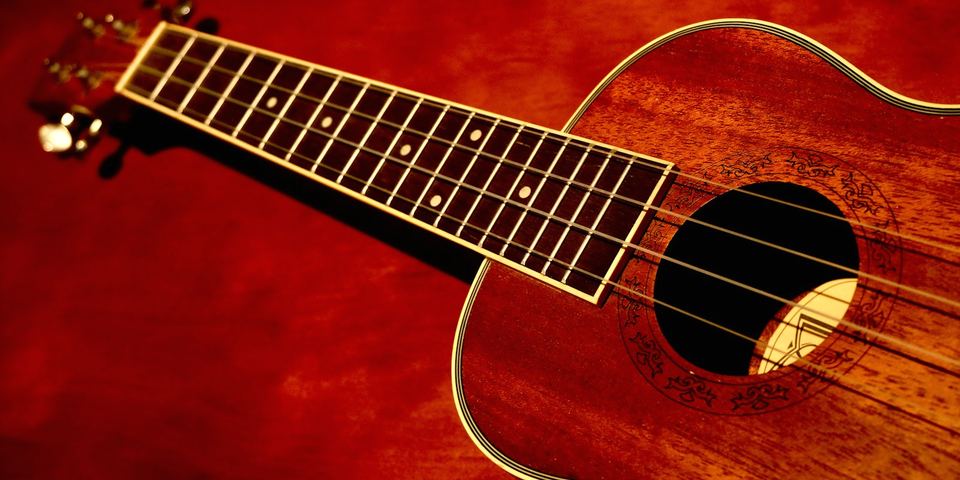
The ukulele
The ukulele is a small guitar-like instrument with four nylon strings. It took shape in Hawaii from small guitars that Portuguese immigrants brought from Madeira and the Azores. Its four common sizes are soprano, concert, tenor and baritone. The first three are tuned G, C, E and A. The G string is higher than the C string.
In this pop piece for ukulele, notice how quickly the plucked notes fade.
Music: Envato (PremiumBeat)
The sound of the ukulele
The first button below plays a tenor ukulele strummed slowly. Listen to how the four strings blend into one soft chord. The other buttons play the notes of a soprano ukulele. First come the open strings G, C, E and A. The C string sounds below the G string, so the line of open strings falls and then rises. Then you hear the chord of C major and the four chords C, A minor, F and G. Many songs in C major use only these four chords.
Names of the ukulele
In Hawaiian the name is written ʻukulele. The mark before the first letter is the ʻokina. It stands for a glottal stop, which is a short catch in the voice. The word roughly means "jumping flea." One story links the name to the quick fingers of a player at the court of King Kalākaua.
Many players call the instrument a uke for short. Its Portuguese ancestors still have their own names. The small four-string guitar of Madeira is the machete, also called the braguinha. Its cousin on the mainland is the cavaquinho, and the larger five-string rajão comes from Madeira too.

History of the ukulele
In the late nineteenth century, families from Madeira and the Azores sailed to Hawaii to work there. They brought their small guitars with them. Soon after one ship arrived in Honolulu, a Hawaiian newspaper reported that the islanders from Madeira delighted the people with nightly street concerts.
In Honolulu, three cabinetmakers from Madeira opened shops. They were Manuel Nunes, José do Espírito Santo and Augusto Dias, and they are generally credited as the first makers of the ukulele. They built the new instrument from koa, which is a Hawaiian wood.
King Kalākaua played the ukulele and gave it a place at royal gatherings, beside the hula and Hawaiian song. His support made it a Hawaiian instrument. His sister, Queen Liliʻuokalani, wrote many songs. Her song Aloha ʻOe became one of the best-known songs of Hawaii.
Early in the twentieth century, visitors to the Panama-Pacific International Exposition in San Francisco heard the ukulele. It became a favorite instrument of the jazz age, and sheet music for popular songs printed ukulele chord boxes above the melody. Its popularity fell after the rise of rock and roll. Late in the twentieth century it rose again. School programs in Canada taught whole classes on the ukulele, and the Hawaiian singer Israel Kamakawiwoʻole brought its sound to listeners around the world.
The role of the ukulele in music
The ukulele usually accompanies singing. Players strum chords while they or others sing the melody. It can also play a melody alone, and many players pick out tunes on the high strings. In Hawaiian music the ukulele keeps a light, steady strum under the voice. It often plays beside the slack-key guitar and the steel guitar. Slack-key players tune the guitar to an open chord. The steel guitar lies flat, and the player slides a metal bar along its strings.
In schools, a whole class can play chords on it together. The ukulele has long been a classroom instrument in Canada. Some schools now teach it as a first instrument in place of the recorder. Its four strings and short neck let young players form chords with small hands.
Music for the ukulele
The ukulele repertoire grew from Hawaiian song. Aloha ʻOe and other songs of the Hawaiian royal family are still sung to the ukulele. In Britain the comedian George Formby made the banjolele famous in films. A banjolele has the neck of a ukulele and the round body of a banjo.
Solo players arrange folk songs, jazz standards and classical pieces for the ukulele. Ukulele orchestras play music written for full ensembles. Soprano, tenor and baritone instruments take the different parts.
The piece at the top of the page shows how quickly a ukulele note fades. Players keep the sound alive with a steady strum or with notes that ring on separate strings.
How the ukulele is made
A ukulele is built like a small acoustic guitar. It has a hollow wooden body with a sound hole, a neck with metal frets and four strings. The bridge is glued to the top and holds the ends of the strings. The strings pass their vibration through the saddle into the top, and the top moves the air inside the body. Thin wooden braces under the top keep it strong. Most ukuleles have a figure-eight body. The pineapple ukulele has an oval body. Samuel Kamaka of Honolulu designed it.
The traditional wood is koa, an acacia that grows only in Hawaii. It gives a warm, bright tone. Makers also use mahogany for a softer, rounder sound, and tops of spruce or cedar for a clearer one. Low-cost ukuleles are usually made of laminated wood, which is thin layers glued together. More costly ones use solid wood.
Modern strings are nylon, synthetic gut or fluorocarbon. Fluorocarbon sounds brighter and holds its pitch well. The low tension of these strings makes them easy to press, and it gives the ukulele its soft, bright sound.
How the ukulele is played
The player holds the ukulele against the chest. The right forearm rests lightly on the body. The left hand presses the strings on the frets. The right hand strums or plucks the strings over the place where the neck meets the body. Many players strum with the index finger. The nail brushes down across the strings, and the pad of the finger brushes up. A common first pattern across four beats is down, down, up, up, down, up.
In fingerstyle playing, the thumb and the fingers pluck the strings one at a time. Because the G string sounds higher than the C string, the four strings sound close together. Players can let the notes of a scale ring on different strings, which gives a harp-like effect called campanella. Some tenor players tune the G an octave lower for a fuller bass.
The baritone ukulele is tuned D, G, B and E. These are the notes of the four highest strings of a guitar. Most beginners learn C, A minor, F and G first. These four chords fit many songs in C major.
What makes a fine ukulele
A solid top of koa, spruce or cedar gives a full tone even when the player strums lightly. A laminated top is sturdy and stands up well to heat and damp air.
Workmanship determines whether the ukulele plays in tune. The frets must be level, with smooth ends that do not catch the hand. The nut and the saddle must be cut so the strings lie low over the frets. Then the notes stay true as the hand moves up the neck. Geared tuners hold the pitch more firmly than simple friction pegs.
Fine Hawaiian ukuleles are still built by hand in small workshops. A maker fits the braces to the top by ear and touch. A thin finish seals the wood and lets it vibrate freely.
Choosing a ukulele
The four sizes differ in the length of the vibrating string. The soprano has the shortest strings, about thirty-three centimeters long. The concert has about thirty-eight centimeters, the tenor about forty-three and the baritone about forty-eight.
A soprano or a concert ukulele suits most children and many adult beginners. The tenor has more room between the frets for larger hands. The baritone uses a different tuning, so most first lessons do not use it.
A soprano ukulele of solid or laminated mahogany with nylon strings is a common first choice. Check that the strings lie low over the frets and that all the strings stay in tune.
| Size | String length | Tuning |
|---|---|---|
| Soprano | about 33 cm (13 in) | G, C, E and A |
| Concert | about 38 cm (15 in) | G, C, E and A |
| Tenor | about 43 cm (17 in) | G, C, E and A |
| Baritone | about 48 cm (19 in) | D, G, B and E |
Who keeps these instruments
Some Hawaiian workshops go back to the first makers. Samuel Kamaka learned to build ukuleles as an apprentice of Manuel Nunes. He then opened his own shop in Honolulu. The Kamaka workshop is still owned by his family. It made the first pineapple ukulele, and it still builds ukuleles of koa.
On the mainland, the Martin guitar company of Nazareth in Pennsylvania built ukuleles in great numbers in the jazz age. The ukulele kept the firm profitable through that decade.
The ukulele is a common teaching instrument. A Canadian school program used it to teach music reading to tens of thousands of students. A revised version of the program is still widely used in Canadian schools.
First steps on the ukulele
Use the tuner to set the strings to G, C, E and A. Hold the ukulele against the chest, and keep the left thumb behind the neck.
The C chord needs only one finger, so it comes first. The third finger presses the third fret of the A string. Strum down four times with the index finger. Then learn A minor, which also needs one finger, on the second fret of the G string. Practice the change from C to A minor slowly with the metronome. Add F and G when the change feels easy.
A short check
Choose one answer per question.
Which notes are the open strings of a soprano, concert or tenor ukulele?
From the string nearest the chin, the ukulele is tuned G, C, E and A. The G string sounds higher than the C string.
Where did the ukulele take shape?
Makers from Madeira built the first ukuleles in Honolulu. They worked from the small guitars of Portugal and its islands.
What is koa?
Koa is an acacia that grows only in Hawaii. It is the traditional wood of the ukulele.
Which size of ukulele uses a different tuning?
The baritone is tuned D, G, B and E, like the four highest strings of a guitar.
Sources
Common questions
How do you tune a ukulele?
Tune the four strings to G, C, E and A. Start from the string nearest your chin. Use the tuner page. It plays a reference note for any string and shows how many cents sharp or flat the string sounds. A cent is one hundredth of a half step.
Which ukulele size is best for a beginner?
Most beginners start on a soprano or a concert ukulele. Both use the same tuning as the tenor. Players with large hands often prefer the wider frets of a concert or a tenor ukulele.
Is the ukulele easier than the guitar?
For most beginners, yes. The ukulele has four nylon strings in place of six, and the first chords C and A minor need one finger apiece.
What are the first ukulele chords to learn?
Learn C, A minor, F and G. With these chords you can play the progression I, vi, IV and V in C major, which many songs use. Roman numerals give the places of the chords in the key.
Why is the G string higher than the C string?
Standard ukulele tuning is re-entrant. The G string is tuned to the G above middle C, so the strings do not run from low to high. Some tenor players tune the G an octave lower.
Where does the ukulele come from?
The ukulele was developed in Hawaii from small Portuguese guitars, such as the machete, the cavaquinho and the rajão. Portuguese immigrants brought them to the islands.
What wood is best for a ukulele?
Koa is the traditional Hawaiian wood, and it gives a warm, bright tone. Mahogany sounds softer, and spruce or cedar tops sound clearer. A solid top sounds fuller than a laminated one.
How long does it take to learn the ukulele?
With short daily practice, many beginners play their first songs with three or four chords within a few weeks. Smooth chord changes and fingerstyle pieces take months of steady work.