The banjo
The banjo is a plucked string instrument. Its thin head is stretched across a round frame, as on a drum. The bridge stands on the head, which gives the banjo its bright, ringing tone. Its ancestors are lutes of West Africa. The five-string banjo leads bluegrass and old-time music, which are string-band styles of the rural United States.
Fred Van Eps plays A Rag-Time Episode on the five-string banjo. He recorded it in 1911. The surface noise of the old disc remains.
The sound of the banjo
The first three buttons play early banjo records at full length. The ragtime piece from the top of the page comes first. In ragtime the melody is syncopated, so its accents fall between the beats. The bass notes keep a steady pulse beneath it. The second record opens with a spoken announcement, as many early records did. A banjo solo follows.
The third record was recorded in 1917. It is a set of variations on the Carnival of Venice. The tune is heard first in a plain form. The variations then decorate it with faster and more difficult notes.
Listen for the sharp attack and the quick fade of the notes. The head works like the skin of a drum, so a plucked note sounds at once and soon dies away. Players fill the gaps with fast runs of notes. The fourth button plays a few phrases on a modern banjo. The last button plays the open G tuning on a recorded grand piano. You hear the four long strings from the lowest up: D, G, B and D. The high G of the short fifth string comes last.
Names of the banjo
The name may come from a West African word. Some scholars link it to the akonting. The akonting is a lute of the Jola people of Senegambia. Others link it to the Kimbundu word mbanza. Early writers spelled it banza, bangie, banjer or banjar. In Haiti the gourd lute was called the banza. In Suriname a related instrument was called the creole bania.
A person who plays the banjo is a banjoist or a banjo player. The five-string banjo, the tenor banjo and the plectrum banjo are the main types today. The shamisen of Japan is another lute with a skin head.
History of the banjo
Africans enslaved in the Caribbean and North America built the first banjos. They cut a large gourd in half and stretched a skin across it. Then they fixed a wooden neck to it. Writers described such instruments in the Caribbean as early as the seventeenth century. Related lutes with gourd bodies are still played in West Africa. The akonting of the Jola people is one of them. The oldest banjo that survives is the creole bania. It was made in Suriname in the eighteenth century, and a museum in Leiden now keeps it.
In the early nineteenth century white performers took up the banjo from Black musicians. Joel Sweeney was a white performer in minstrel shows. A minstrel show was a stage show of songs, dances and comic scenes. Sweeney made the five-string banjo popular. Later writers credited him with the wooden rim and the short fifth string. Modern scholars doubt both claims. Traveling minstrel shows carried the banjo across the United States and to Britain. These shows mocked Black Americans in blackface, and that history still marks the instrument.
Factories in Baltimore, Philadelphia and Boston then made banjos in large numbers. Makers added metal rims, tension hooks and raised frets. Early banjos had no frets, and frets became standard late in the nineteenth century. The banjo became an instrument of parlors and colleges. Players of the classic style plucked the strings with bare fingers and read printed music.
Ragtime and early jazz bands needed a loud rhythm instrument. Players turned to four-string banjos with steel strings and a pick. Later the guitar took over that role. The five-string banjo rose again with bluegrass after the Second World War and with the folk revival that followed.
The role of the banjo in music
In bluegrass the five-string banjo plays fast rolls behind the singers and takes solos between the verses. In old-time music it plays the tune together with the fiddle, and the two instruments drive the dance.
In early jazz and Dixieland bands, four-string banjos strum the chords. In Irish traditional music the tenor banjo plays the melody of jigs and reels. The banjo is also heard in Caribbean styles such as calypso and mento. Country, folk and rock musicians use it for its bright, driving tone.
Banjo music on early records
The first banjo stars were also among the first recording artists. Vess Ossman made many early records. Fred Van Eps learned from Ossman's cylinder records and made some of the earliest ragtime records of any kind. Ruby Brooks won a banjo championship in New York and recorded many solos. These three players recorded the ragtime pieces, marches and showpieces that people bought for the new phonograph.
Alfred Farland played the banjo in evening dress and arranged classical works for it. He arranged violin sonatas by Bach and Beethoven, and Chopin's nocturnes and waltzes. The variations on the Carnival of Venice above are his own recording.
Bluegrass grew up after the Second World War. The banjo player Earl Scruggs gave his name to its three-finger style. Composers have written for the banjo too, and Gershwin included it in the opera Porgy and Bess.
How the banjo is made
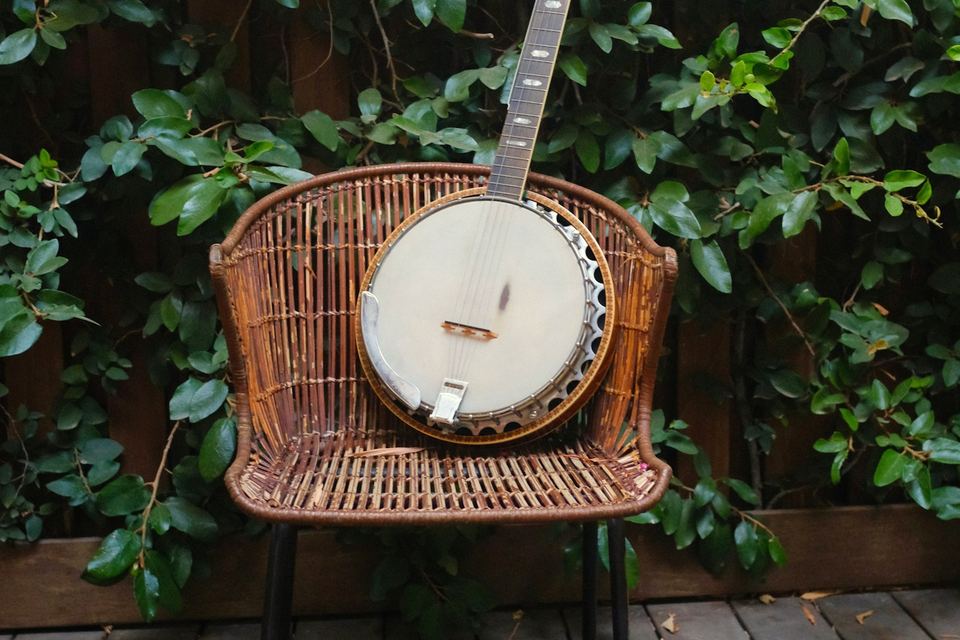
The body is called the pot. It is a round rim, which is usually made of wood. A head is stretched over the rim. Early heads were animal skin, often goatskin. Most modern heads are a thin plastic film. Tension hooks around the rim tighten the head, as on a drum.
Many banjos have a metal tone ring between the rim and the head. A resonator is a wooden back plate that throws the sound forward. Banjos without one are called open-back banjos, and they sound softer.
The neck carries the fingerboard and the frets. A thin bridge of wood stands on the head. The pressure of the strings holds it in place. A tailpiece at the edge of the rim anchors the strings. The fifth string starts at a peg on the side of the neck at the fifth fret. It is three-quarters as long as the other strings, so it can be tuned higher than them.
How the banjo is played
The five-string banjo is usually tuned to open G. From the lowest string the four long strings sound D, G, B and D, and the short fifth string sounds a high G. The open strings form a G major chord. This is a re-entrant tuning, because the fifth string sounds higher than the string beside it.
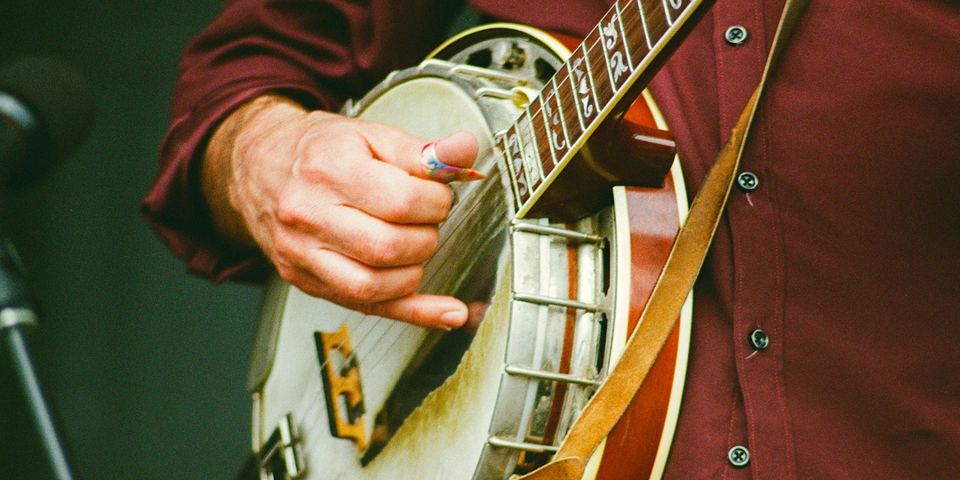
Clawhammer, or frailing, is the old style of play. The hand strikes down on the strings with a fingernail, and the thumb catches the fifth string. In Scruggs style, three fingers with fingerpicks play rolls. A roll is a repeating pattern of picked notes in steady eighth notes.
The classic style of the early records uses bare fingers. The thumb and two fingers pick the strings, and the little finger often rests on the head near the bridge. Tenor and plectrum banjos have four strings, and players strike them with a pick.
What makes a fine banjo
On a bluegrass banjo, the rim and the tone ring set the volume and the color of the tone. Fine rims are made of several layers of hard maple. The maker glues the layers and turns the rim perfectly round. A heavy tone ring of bronze or brass sits on top of the rim under the head. Bell bronze gives a loud, powerful tone with a long ring. Rolled brass gives a bright tone that is less heavy. Open-back banjos for old-time music often have a light ring or none, so their sound is softer and woodier.
The head must be even and correctly tight. Players set its tension with the hooks around the rim, as a drummer tunes a drum. A tighter head gives a brighter, more piercing tone, and a looser head gives a mellower one. Skin heads sound warm but change with damp weather. Plastic heads keep their sound in any weather.
The bridge passes the vibration of the strings to the head. Many fine bridges are maple with an ebony top, which gives a sharp, clear tone. The neck must be straight, and its frets must be level and smooth. The fifth-string peg must hold its pitch.
Choosing a banjo
For bluegrass, players choose a five-string banjo with a resonator. For clawhammer and old-time music, an open-back banjo is lighter and softer. For Irish music, a tenor banjo is the usual choice.
Check that the head is firm and that the bridge stands straight. Pick the strings in turn near the fifth fret and listen for buzzing. The fifth-string peg should hold its tuning. Ask the shop to set the height of the strings before you take the banjo home. A banjo that is set up well is easier to play and sounds clearer.
Who keeps these instruments
The Museum of Ethnology in Leiden holds the creole bania from Suriname. The Musée de la Musique in Paris holds a banza that the French abolitionist Victor Schoelcher collected in Haiti. The Metropolitan Museum of Art in New York holds banjos by William Boucher of Baltimore. Boucher was one of the first makers to sell banjos professionally. He tightened the head with metal screws. Earlier makers fixed the head with tacks.
The American Banjo Museum in Oklahoma City holds one of the largest collections of banjos in the world. Its four-string banjos of the jazz age come from the major makers of that period. S. S. Stewart of Philadelphia ran one of the largest banjo factories of the late nineteenth century. He also published a journal for banjo players. Fred Van Eps built a banjo of his own design for recording.
First steps on the banjo
Tune the banjo to open G with the tuner. From the lowest long string the notes are D, G, B and D. The short fifth string is the high G.
Strum all five open strings to hear the G major chord. Then pick the strings one at a time with the thumb, the first finger and the second finger.
Start with the forward roll. The thumb picks the third string, and the first finger picks the second string. The second finger picks the first string, and the thumb ends on the fifth string. Repeat the roll slowly with the metronome. Play the ragtime record above and listen for the way the thumb keeps the bass steady.
A short check
Choose one answer per question. The explanation appears below the correct answer.
What makes the banjo different from a guitar?
The head of a banjo is stretched like the head of a drum. The bridge stands on it, and the head carries the sound.
Which string of the five-string banjo is the short one?
The fifth string runs from a peg at the fifth fret. In open G tuning it sounds a high G above all the other open strings.
What is a roll in Scruggs style?
The thumb and two fingers wear fingerpicks and pick the strings in a repeating pattern. The pattern keeps a steady flow of eighth notes.
In clawhammer playing, what does the thumb do?
The hand strikes down on the strings with a fingernail. The thumb then sounds the short fifth string, often on the offbeat.
What does a tone ring do?
The tone ring is a heavy metal ring between the rim and the head. Bluegrass players prize it for a loud, clear tone.
Sources
- Wikipedia: Banjo
- Wikipedia: Akonting
- Duke University Banjology: the Haitian banza
- Birthplace of Country Music: the creole bania
- Metropolitan Museum of Art: banjo by William Boucher
- Metropolitan Museum of Art: an early American banjo
- Wikipedia: American Banjo Museum
- Wikipedia: S. S. Stewart
- Wikipedia: Fred Van Eps
- Wikipedia: Alfred A. Farland
- Wikipedia: Ruby Brooks
- Deering Banjos: how banjos work
- Internet Archive: A Rag-Time Episode (Library of Congress National Jukebox)
- Wikimedia Commons: Happy Days in Dixie, a banjo solo by Ruby Brooks
- Wikimedia Commons: Carnival of Venice played by Alfred A. Farland
Common questions
Is the banjo hard to learn?
A first roll over an open G chord comes within days. Keeping the roll even at speed takes months, and so does changing chords without a break in the rhythm.
What is the difference between a banjo and a guitar?
The banjo has a drum-like head under its bridge, which gives a sharp tone that fades quickly. The guitar has a wooden top and a hollow body, and its notes ring longer.
Why does the banjo have a short string?
The short fifth string can be tuned higher than the long strings. Players use it as a drone. A drone is a repeated open note heard between the melody notes.
What is a tenor banjo?
It is a four-string banjo with a shorter neck. Players strike its strings with a pick. It is usually tuned C, G, D and A like the viola, and many Irish players tune it G, D, A and E.
Where did the banjo come from?
It descends from gourd lutes made by enslaved Africans in the Caribbean and North America. Those instruments followed lutes of West Africa.
What is bluegrass?
It is a style of American country music for acoustic string band. The banjo, the mandolin, the fiddle, the guitar and the double bass play fast tunes and songs with close vocal harmony.
What is the oldest surviving banjo?
It is the creole bania. It was made in Suriname in the eighteenth century, and the Museum of Ethnology in Leiden keeps it.
What is the difference between an open-back banjo and a resonator banjo?
A resonator banjo has a wooden back plate that throws the sound forward, so it is louder. An open-back banjo is lighter, and its tone is softer.