The balalaika
The balalaika is a Russian stringed instrument with a triangular wooden body, a fretted neck and three strings. The two lower strings are tuned to the same E, and the third string sounds the A above it. Its sound dies away quickly, so players strum fast or repeat notes. It is the instrument of Russian folk songs and dances.
A balalaika and a bayan, the Russian button accordion, play this Russian folk piece. The notes of the balalaika fade quickly, so listen for the fast strokes that keep them sounding.
Music: Envato
The sound of the balalaika
The balalaika has a bright, dry tone and a short sustain. The notes fade soon after they are struck. For this reason players strum quickly, or they repeat a note in a fast tremolo when the melody needs a long tone.
The button below plays an early disc of a Russian balalaika orchestra. The orchestra plays the folk song Svetit mesyats. Its English title is Bright Shines the Moon. Listen for the melody in the higher balalaikas and for the large bass balalaikas beneath it. The old disc adds some surface noise.
Names of the balalaika
In Russian the instrument is the балалайка (balalaika). The origin of the word is uncertain, and some Russian dictionaries trace it to Turkic roots. Ukrainian documents of the eighteenth century spell it balabaika. That form is also found in the dialects of southern Russia and in Belarusian.
The oldest known mention of the balalaika is in a Moscow document of the late seventeenth century. It records that two commoners were stopped from playing the balalaika while drunk. A register signed by Peter the Great lists four balalaikas among the instruments carried at a mock wedding in Saint Petersburg. In the late eighteenth century the word entered Russian poetry.
History of the balalaika
The balalaika may descend from the domra of the East Slavs. Related lutes are played to the south and east. They include the panduri of Georgia, the topshur of Kalmykia and the dombra of Kazakhstan. For centuries the balalaika was a village instrument. Wandering entertainers called skomorokhs played it, and their songs often mocked the powerful.
Early balalaikas had from two to six strings. Their frets were made of gut tied around the neck, so the player could move them. Many village balalaikas of the early nineteenth century still had only two strings, and some had a round body made from a gourd. Over that century the body became triangular, and the neck grew shorter.
Vasily Andreyev was a violinist of Saint Petersburg. In the late nineteenth century he made the balalaika a concert instrument. With the violin maker V. Ivanov he built a standard model. The Saint Petersburg craftsman Franz Paserbsky added frets for all the half steps and made the orchestral sizes. Semyon Nalimov was a cabinetmaker of Komi origin. He built instruments for Andreyev for more than twenty years.
The role of the balalaika in music
The balalaika family has six sizes: piccolo, prima, secunda, alto, bass and contrabass. The prima is the most common, and it plays melody and chords. The piccolo is rare. The secunda and the alto fill in the harmony with chords. The bass and the contrabass play the lowest part. They are so large that they rest on the floor.
In a Russian folk orchestra the balalaikas play beside the domra, which has a round body. The gusli and the bayan often join them. The gusli is a plucked zither, and the bayan is a Russian button accordion.
Music for the balalaika
Balalaikas accompany Russian folk songs and dancing. A village player strums chords for a singer or plays a dance tune alone.
Andreyev's circle of balalaika players gave its first public concert in Saint Petersburg. It grew into the Great Russian Orchestra, with balalaikas of several sizes, domras and gusli. Andreyev arranged many folk melodies for it and composed concert pieces of his own. Its tours of Western Europe made the balalaika known far beyond Russia.
In the Soviet Union the state supported folk orchestras and the formal study of the balalaika. The Red Army Choir replaced the violins, violas and cellos of its orchestra with balalaikas and domras. Many listeners hear the long tremolo on one string as typically Russian. Andreyev in fact borrowed it from the Neapolitan mandolin orchestra.
How the balalaika is made
A balalaika has a three-sided body. The top is spruce, and the back is built from five to seven separate wooden sections. Andreyev asked for a spruce top and a back of beech. He also shortened the instrument to a length of sixty to seventy centimeters.
The strings were once gut, and the thin melody string was steel. Today nylon strings often take the place of gut. Souvenir balalaikas usually have sixteen frets, and orchestral instruments have up to twenty-four. The bass and the contrabass stand on a pin of wood or metal set into one corner of the body.
How the balalaika is played
The two lower strings of the prima are tuned to the same E, and the third string sounds the A a fourth above it. The player strums the prima with the side of the right index finger. The larger balalaikas are played with a plectrum. Contrabass players often cut theirs from leather.
A strum sweeps down and up across all three strings. In the tremolo the index finger strikes the strings again and again so fast that a note seems to last. Single strings may also be plucked. The left thumb frets notes on the lowest string. Players use the thumb most often in chords. Folk players also use older tunings, such as G, B and D or D, F♯ and A.
What makes a fine balalaika
The top is the main source of the sound. Makers of concert balalaikas use straight-grained spruce. They cut it thin so that it vibrates freely. The strips of the hardwood back are called staves, and they must meet closely. A well-built body gives a clear tone that carries across a hall.
How well the instrument plays depends on the neck and the frets. A concert prima is fretted in half steps and has up to twenty-four frets in all. The frets must be level, so that no string buzzes. The strings must sit low above the frets for fast playing.
Semyon Nalimov set the standard for fine balalaikas. A professor of the Saint Petersburg Conservatory called him the Stradivarius of the Russian balalaika. Makers still build balalaikas and domras after the models of his instruments.
Choosing a balalaika
Most players start on the prima. Check that there are frets for all the half steps, as on professional instruments.
Factory-made primas with six strings in three pairs also exist. They often use a guitar-style tuning, so check which kind you are buying. Ask whether the top is solid spruce. Play the frets in turn along the lowest string and listen for buzzing. If you plan to join a balalaika orchestra, ask which size it needs before you buy.
How to listen to the balalaika
Play the piece below and follow the line of the balalaika. Listen for the change between long tones played in tremolo and short, single strokes. The tremolo makes a held note shimmer. The single strokes make the melody sound crisp and light.
Next, listen beneath the melody for strummed chords. Count the beats, and notice whether the piece keeps one tempo or gathers speed as it goes. Then play the early orchestra disc in the sound section and compare the two recordings.
Music: Envato
Who keeps these instruments
The ensembles that grew from Andreyev's work still play today. His own orchestra continues in Saint Petersburg as the Andreyev Russian Orchestra. In Moscow, the Osipov National Academic Orchestra of Folk Instruments of Russia was founded by a balalaika soloist from Andreyev's orchestra.
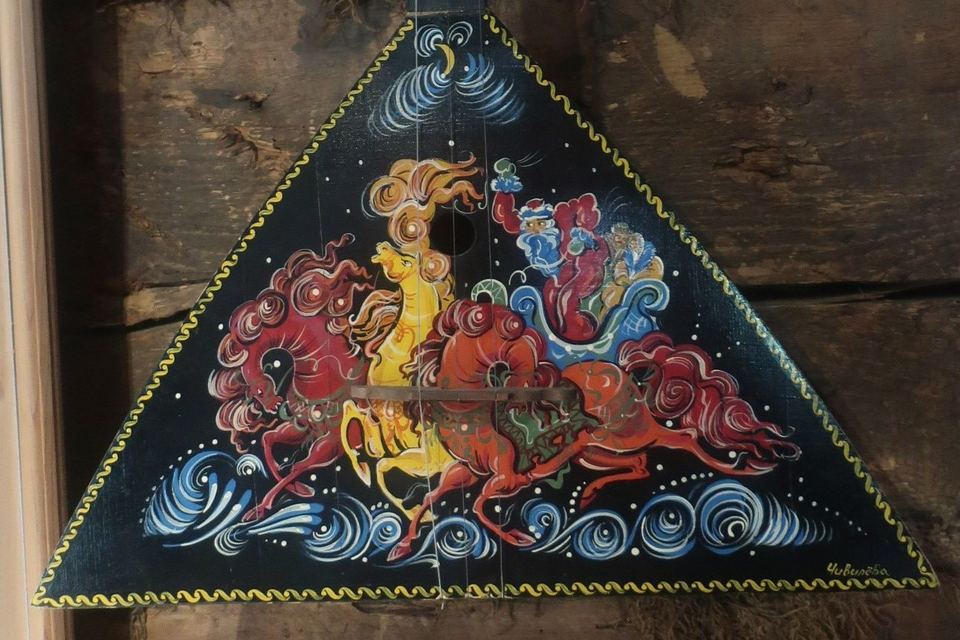
Conservatories train professional players. The Gnessin Russian Academy of Music in Moscow opened the first faculty of folk instruments in Russia. Its department of folk instruments teaches the balalaika and the domra. Museums keep historical instruments. The Russian National Museum of Music in Moscow holds about three thousand instruments. Among them are the folk instruments of the peoples of Russia. Alaska was once part of Russian America, and the Kodiak History Museum in Alaska displays a painted balalaika.
First steps on the balalaika
Tune the two lower strings to E and the third string to A with the tuner. Strum all three strings with the side of your right index finger. Keep the wrist loose, and let the finger brush down and up. Then fret a chord with your left thumb on the lowest string.
Next, play a slow scale on the highest string with the fingers of the left hand. Pluck the notes once and listen to how quickly they fade. When the scale is even, try a slow tremolo on one note. Build its speed over many weeks.
A short check
Choose one answer per question.
How is a prima balalaika usually tuned?
The two lower strings are tuned to the same E, and the third string sounds A, which is a fourth higher.
What does a player usually strum the prima balalaika with?
The prima is traditionally played with the side of the right index finger. The larger balalaikas use a plectrum.
Sources
- Wikipedia: Balalaika
- Wikipedia: Vasily Andreyev
- Wikipedia: Domra
- Wikipedia (Russian): Балалайка
- Wikipedia (Russian): Semyon Nalimov
- Wikipedia (Russian): The Andreyev Russian Orchestra
- Wikipedia: Osipov State Russian Folk Orchestra
- Wikipedia (Russian): Gnessin Russian Academy of Music
- Wikipedia (Russian): Russian National Museum of Music
- Wikimedia Commons: a balalaika in the Kodiak History Museum

Common questions
How many strings does a balalaika have?
A standard balalaika has three strings. Some factory-made primas have six strings in three pairs. Their stringing is like that of a mandolin.
How is a balalaika tuned?
The prima is tuned E, E and A. Folk players also use other tunings, which include G, B and D.
What sizes of balalaika are there?
From highest to lowest, the sizes are piccolo, prima, secunda, alto, bass and contrabass. The piccolo is rare.
What is a balalaika orchestra?
It is an ensemble of balalaikas of several sizes. Such orchestras play folk tunes and arrangements of classical music.
What is the difference between a balalaika and a domra?
The domra is an older cousin of the balalaika. Some players tune a balalaika E, A and D, like the domra, to make the change between them easier.
Where does the balalaika come from?
It comes from Russia, where it was a village instrument for centuries. Written records of it go back to the seventeenth century.
Who made the balalaika a concert instrument?
Vasily Andreyev did so in the late nineteenth century. He was a violinist of Saint Petersburg. He worked with instrument makers on a standard balalaika and founded the first balalaika orchestra.