
The bouzouki
The bouzouki is a long-necked lute of Greece with a round back and paired steel strings. Players pluck it with a pick. It sounds like a mandolin pitched lower. It is the main instrument of rebetiko and laïko. Rebetiko is the urban song of Greece, and laïko is its later popular style. The Irish bouzouki is a flatter relative.
A bouzouki leads this Greek dance tune over accordion and drums. The bouzouki's strings come in pairs called courses. The pick strikes both strings of a pair at once. Listen for the doubled ring of the notes.
Music: Envato (PremiumBeat)
The sound of the bouzouki
You can hear a single note on a bouzouki.
Names of the bouzouki
The name comes from the Turkish word bozuk, which means broken or modified. In Greek it is written μπουζούκι. The baglamas is a smaller bouzouki with a higher pitch.
Where the bouzouki is played
The bouzouki was known in Greece by the middle of the nineteenth century. Refugees from Anatolia settled in port cities such as Piraeus, Thessaloniki and Volos in the early twentieth century. In these cities the bouzouki became popular with rebetiko in the nineteen-thirties. Irish folk musicians adopted it later in the twentieth century.
The role of the bouzouki in music
The classic group of rebetiko was the bouzouki, the baglamas and the guitar. The songs follow traditional Greek and Anatolian dance rhythms. These include the zeibekiko, the hasapiko and the tsifteteli.
Music for the bouzouki
Rebetiko is the urban song of poor Greek communities. It flourished from the late nineteenth century to the middle of the twentieth. UNESCO lists it among the living traditions that it protects. Laïko, the popular style of modern Greece, also centers on the bouzouki.
How the bouzouki is made
The back is built from narrow strips of wood called staves. A mandola has the same kind of back. The staved back lets the bouzouki carry thick steel strings. Most bouzoukis have twenty-seven metal frets. The frets are set for equal temperament, which is the tuning of the piano.
How the bouzouki is played
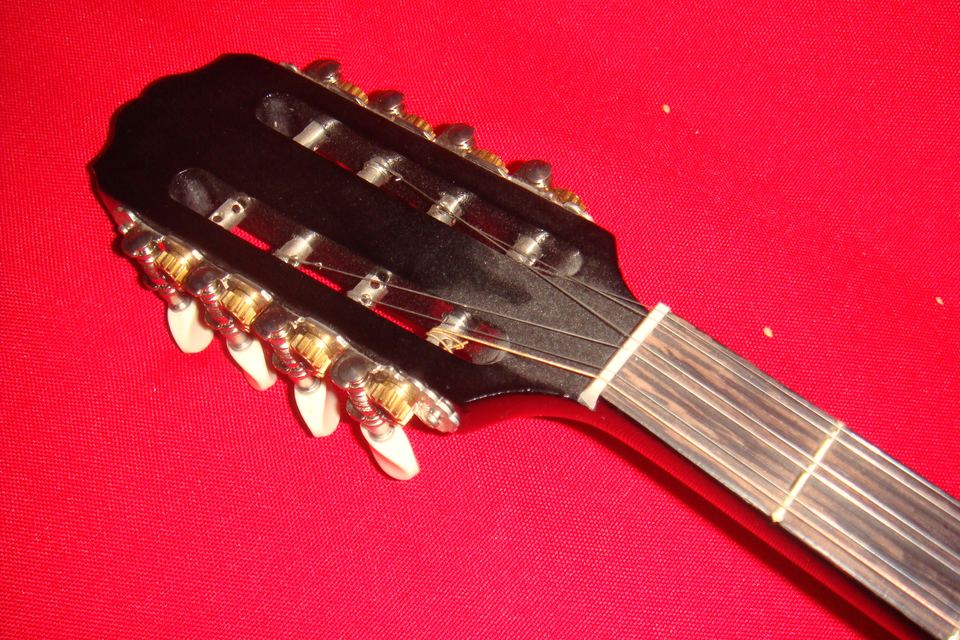
The strings are set in pairs called courses, and both strings of a course are played together. Some courses pair a string with another string an octave lower.
The three-course bouzouki, or trichordo, has six strings and is tuned D, A and D. It is the classic instrument of rebetiko. The four-course tetrachordo has eight strings tuned C, F, A and D.
The Irish bouzouki has a flatter back and four courses. Most players tune it G, D, A and D. This open tuning suits accompaniment with drones.
How the bouzouki has changed
The four-course model came after the three-course model. Later, Irish folk musicians tuned a Greek bouzouki to G, D, A and D. Makers then built flat-backed models for Irish music.
Choosing a bouzouki
Choose the three-course trichordo for older rebetiko. Choose the four-course tetrachordo for later Greek popular music. For Irish music, choose an Irish bouzouki.
Check that the neck is straight and that the notes stay in tune all the way up the neck. A tuner shows whether the fretted notes sound true.
Sources
Common questions
How is a bouzouki tuned?
A four-course Greek bouzouki is tuned C, F, A and D. A three-course bouzouki is tuned D, A and D. A course is a pair of strings.
What is an Irish bouzouki?
The Irish bouzouki is a four-course relative of the Greek instrument with a flatter back. Irish folk musicians usually tune it G, D, A and D.
What is the difference between a bouzouki and a baglamas?
The baglamas is a smaller bouzouki with a higher sound. In rebetiko it plays beside the bouzouki and the guitar.
What music is the bouzouki used for?
The bouzouki is the main instrument of rebetiko and of laïko, which is the popular music of modern Greece. It is also heard in Irish folk music.
Where does the bouzouki come from?
Its name comes from Turkish. The bouzouki was known in Greece by the middle of the nineteenth century, and it became popular with rebetiko in the nineteen-thirties.
What is the difference between a bouzouki and a mandolin?
Both have paired steel strings and a rounded back. The bouzouki has a much longer neck, and it sounds lower.