The lyre
The lyre is a string instrument with two arms that rise from a sound box. A crossbar called the yoke joins the arms, and the strings run from the yoke to the body. Players pluck or strum the strings. Lyres were played in Mesopotamia, the land that is now Iraq, about four and a half thousand years ago.
Strings and percussion play this new composition, which is inspired by the music of ancient Greece. Only a few written fragments of that music survive, so its sound must be rebuilt from other evidence.
Music: Envato
The sound of the lyre
No recording of ancient music exists. Musicians today study instruments found in tombs and pictures on vases. They also read a few pieces written in Greek notation. From this evidence they try to rebuild the sound.
The button below plays a lyre built in the style of the Iron Age. Its player plucks the strings one at a time. Listen to how a string rings on under the next, since nothing stops it. On a Greek lyre the fingers of the left hand silenced the strings that were not wanted, so only the chosen notes sounded.
Names of the lyre
The English word comes through Latin from the Greek λύρα (lyra). Its earliest written form comes from the oldest known Greek writing. The Greeks had several kinds of lyre. The chelys (χέλυς) was the common lyre. Its body was made from the shell of a tortoise. The kithara (κιθάρα) was the large wooden lyre of professional singers. The barbitos (βάρβιτος) was a bass instrument of the same family.
Other lyres have names of their own. The kinnor (כִּנּוֹר) of ancient Israel is the first instrument of the lyre family named in the Hebrew Bible. In Ethiopia and Eritrea the krar (ክራር) and the begena (በገና) are played today. The nyatiti belongs to the Luo people of Kenya. The crwth of Wales and the jouhikko of Finland are lyres played with a bow.
History of the lyre
The oldest lyres come from Mesopotamia. In the Royal Cemetery of Ur, in present-day Iraq, archaeologists found three lyres and one harp. They are about four and a half thousand years old, and they are the oldest surviving string instruments in the world. The finest have the head of a bull on the front of the sound box. These heads are decorated with gold and with a deep blue stone called lapis lazuli. A woman buried beside one lyre lay with her hand where the strings had been.
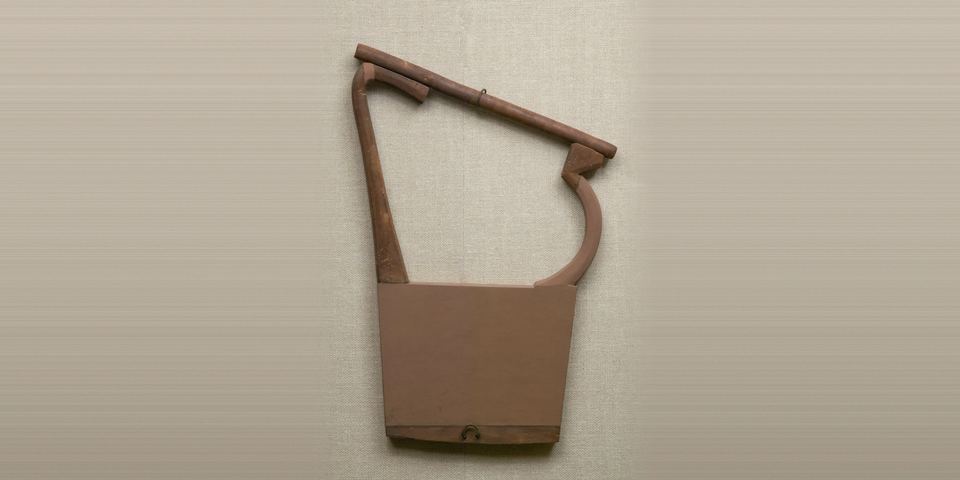
Lyres spread from Mesopotamia across the eastern Mediterranean. The Egyptian lyre in the photo on this page has one arm longer than the other, so its yoke slants across the top. It was found at Thebes in Egypt and was made about three and a half thousand years ago.
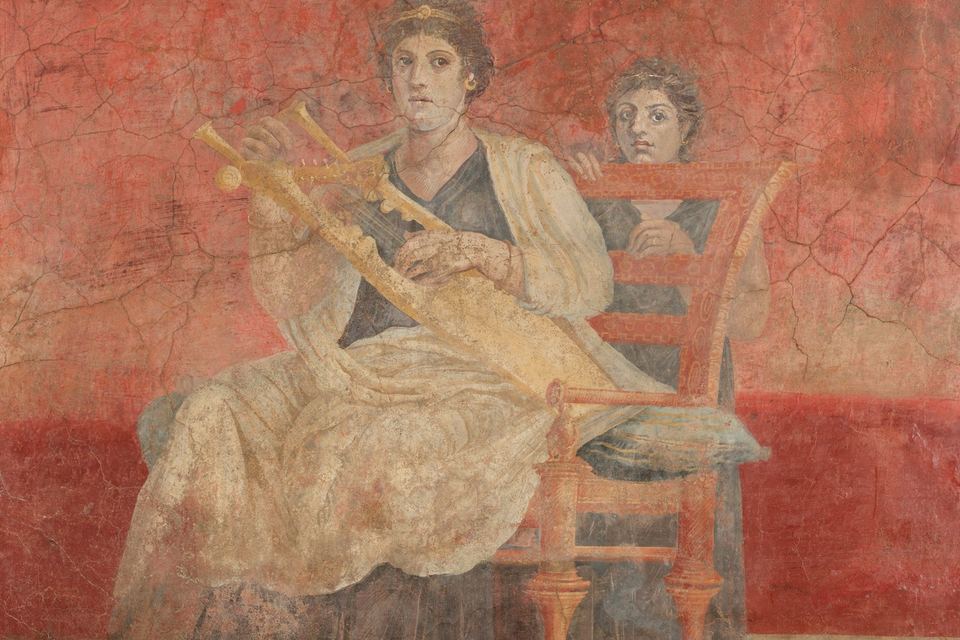
In ancient Greece the lyre belonged to education and poetry. Boys learned to play it at school. Singers accompanied the recitation of lyric poetry on it, and the word lyric comes from the lyre. Professional singers called kitharodes performed at festivals and contests on the kithara. It had a deep wooden box and usually seven strings. In Greek myth the young god Hermes made the first lyre from a tortoise shell. He gave it to Apollo in exchange for a herd of cattle.
The Romans took over the Greek lyre and kithara. In northern Europe the lyre appears in rich graves of the first millennium. A lyre lay in the ship burial at Sutton Hoo in England. A lyre from a waterlogged grave at Trossingen in Germany is the best-preserved example found so far. Later, some lyres were played with a bow. The crwth of Wales was the last bowed lyre with a fingerboard.
Lyres are still played in East Africa. The begena of Ethiopia is a large box lyre with ten strings. Its name comes from a word that means to buzz or to pluck. The krar is a smaller bowl lyre with six strings. Players tune it to a pentatonic scale, which has five notes. The nyatiti of the Luo people of Kenya has eight strings.
The role of the lyre in music
A lyre usually accompanies a voice. In ancient Greece the singer was often the player as well. The begena of Ethiopia is the one melodic instrument devoted to spiritual song. It accompanies meditation and prayer, and it is heard especially during Lent. Lent is the season of fasting before Easter. The krar accompanies love songs and other songs outside the church.
Among the Luo people of western Kenya, the nyatiti player usually sings and plays alone. An iron ring on the right big toe strikes the instrument to keep the beat, so one musician supplies melody, rhythm and song.
Music for the lyre
The Seikilos epitaph is the oldest complete piece of music that survives. It is a short song carved with its notation on a marble column from Tralles, in present-day Turkey. The column dates from the first or second century. Greek letters above the words give the pitches, and other signs give the lengths of the notes. The words tell the listener to shine while alive and to grieve for nothing, since life is short.
Older pieces with notation survive only in fragments. Among them are two hymns carved in stone at Delphi. Scholars and players rebuild the sound of the Greek lyre from these fragments and from the instruments and pictures that remain.
In the Philippines, a marching drum and lyre corps uses no brass instruments. Its melodies come from bell lyres, which are glockenspiels held upright in a lyre-shaped frame.
How the lyre is made
A lyre has five main parts. The sound box gives the strings a body to sound through. The two arms rise from the box and carry the yoke. A bridge on the sound box carries the vibration of the strings into the box. The other ends of the strings are fastened to a tailpiece at the bottom.
A Greek lyre of the chelys type had a sound box made from the shell of a tortoise. The kithara had a deep wooden box built from two boards joined by sides. At the top, the strings were knotted around the yoke, tied to rings threaded over it or wound around pegs. The player tuned a string by turning its ring or its peg.
The nyatiti has a bowl of carved wood covered in cow skin. Its strings were once made of cattle tendon, and modern players use nylon or fishing line. On the begena, small U-shaped pieces of leather sit between the strings and the bridge. When the string is plucked, it vibrates against the leather and gives the begena its buzzing tone.
How the lyre is played
The Greek player strummed the strings with a plectrum held in the right hand. The plectrum was a small, stiff pick of dried leather. The straightened fingers of the left hand silenced the strings that were not wanted. A strum across all the strings then sounded only the free ones.
The nyatiti player alternates the thumb and the middle finger of both hands in a circling, repeated pattern. The begena player plucks the strings with the fingers of the left hand or with a plectrum of horn or wood. The only other sound is the singing voice.
What makes a fine lyre
A fine lyre starts with a light and stiff sound box. The soundboard must be thin enough to vibrate freely. It must also be strong enough to bear the pull of the strings. On a copy of the Greek chelys the maker stretches skin over a shell or a carved wooden bowl. On a kithara the whole box is wood.
The arms and the yoke must stay rigid. If they bend under the pull of the strings, the lyre goes out of tune as it is played. The pegs or pins must turn smoothly and hold their place. Gut strings give the soft tone of early lyres. Nylon is cheaper and holds its pitch better in changing weather.
Makers of historical copies study the instruments in museums and the pictures on vases. A good copy follows the measured shape of one original. Its maker can tell you which instrument it follows and which tuning suits it.
Choosing a lyre
Before you buy a lyre, check that all the tuning pegs turn smoothly and hold their strings at pitch. Ask which notes the strings are tuned to, so that you can find music that fits them.
Ask whether the lyre copies a historical instrument or follows a modern design. A copy of a Greek or an early medieval lyre suits early music. A modern lyre with more strings and a full scale suits songs and folk tunes.
Who keeps these instruments
The lyres of Ur were divided among three museums. The Iraq Museum in Baghdad keeps the Golden Lyre, which is the finest of them. The British Museum in London keeps the Queen's Lyre and the Silver Lyre. The Penn Museum in Philadelphia keeps the Bull-Headed Lyre.
The Metropolitan Museum in New York keeps the Egyptian lyre shown on this page. It also holds Greek vases and Cypriot figures of lyre and kithara players. The British Museum keeps the treasure of the Sutton Hoo ship burial, which included a lyre. The National Museum of Denmark in Copenhagen keeps the marble column of the Seikilos song.
In East Africa, players and teachers pass the lyre on to students. In Ethiopia, the Yared Music School in Addis Ababa gives formal lessons on the begena.
First steps on the lyre
Tune the strings with the tuner. Start with the lowest string. Rest the lyre on your lap with the sound box against your body.
Pluck the strings one at a time from low to high. Then play a short tune by ear on three or four strings.
Next, try the Greek way of playing. Rest the fingers of one hand on the strings that you do not want. Strum across all the strings with the other hand. Only the free strings sound, so a single strum gives a chosen note or chord.
A short check
Choose one answer per question.
What joins the two arms of a lyre?
The yoke runs across the top of the two arms. The strings run from the yoke to the body.
Where were the oldest surviving string instruments found?
The lyres of Ur are the oldest surviving string instruments in the world.
What is a bell lyre?
Marching bands, such as the drum and lyre corps of the Philippines, carry bell lyres.
Which lyre do the Luo people of Kenya play?
The nyatiti is the lyre of the Luo people of western Kenya. The krar comes from Ethiopia and Eritrea.
Sources
Common questions
What is the difference between a lyre and a harp?
On a lyre, the strings run over the sound box to a crossbar held by two arms. On a harp, the strings run at an angle to the soundboard.
Where does the lyre come from?
The oldest known lyres come from Mesopotamia. Pictures of lyres there are about four thousand seven hundred years old.
Is the lyre still played today?
Yes. The krar and the begena of Ethiopia and Eritrea and the nyatiti of Kenya are living traditions. Makers also build copies of ancient lyres.
Who made the first lyre in Greek myth?
In Greek myth the young god Hermes made the first lyre from a tortoise shell. He gave it to Apollo in exchange for a herd of cattle.
What is a drum and lyre corps?
It is a marching band of the Philippines whose musicians play only percussion instruments. Its lyre section plays the melodies on bell lyres.
What is the difference between a lyre and a kithara?
The kithara was a large lyre with a deep wooden box. Professional singers played it. The common lyre was smaller and lighter, and Greek boys learned it at school.
What is the oldest song with music that survives?
The Seikilos epitaph is the oldest complete song that survives with its notation. It was carved on a marble column in the first or second century.