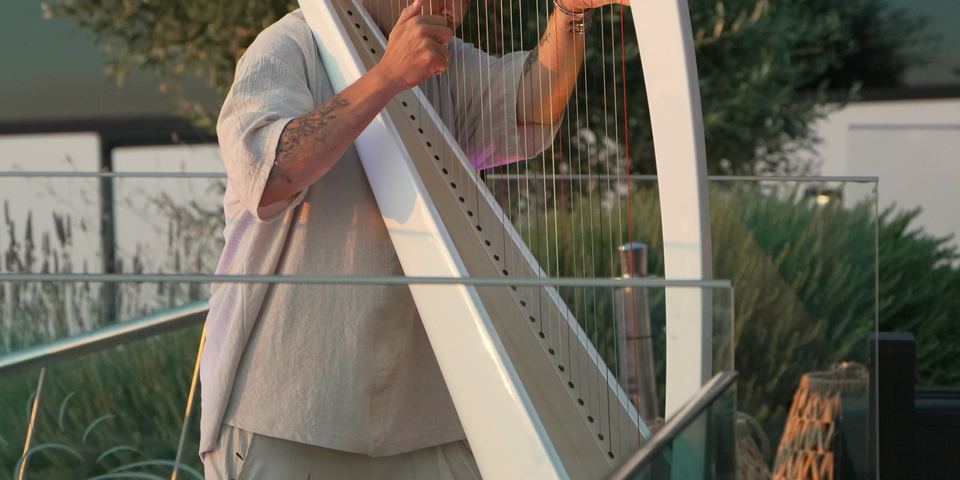
The Celtic harp
The Celtic harp is a small triangular frame harp of Ireland, Scotland, Wales and Brittany. Its Irish name is cláirseach. The old Gaelic harp had strings of brass wire that the player plucked with the fingernails. The modern Celtic harp, often called a lever harp, has gut or nylon strings and small levers that raise the pitch of a string.
A harp plays this piece of Celtic music. The strings of the harp ring on after a pluck, so listen for the notes that blend into one another.
Music: Envato (Orchestralis)
Listening to the Celtic harp
The two hands have different jobs. The right hand plays the melody on the higher strings. The left hand plays a bass note or a chord below it. The strings ring on after they are plucked, so the notes of a chord blend into a soft cloud of sound.
Listen also to the shape of the chords. Harpers often roll a chord from the lowest note upward, so its notes sound one after another in a quick spread. In a calm piece like this one, notice the space around the notes. The harper lets a phrase ring before the next one begins.
Names of the Celtic harp
The Irish word for the harp is cláirseach, and the Scottish Gaelic word is clàrsach. The Welsh call the harp telyn, and the Bretons call it telenn. The word clàrsach may come from clàr, which means a board. The older Gaelic word cruit may first have meant a different string instrument.
Players today speak of two instruments. The wire-strung harp, or early Gaelic harp, follows the old instruments with metal strings. The lever harp, or folk harp, has gut or nylon strings and levers on all the strings. Small harps of either kind are often called Celtic harps or Irish harps.
History of the Celtic harp
The earliest pictures of a triangular frame harp in Europe are carved on stones in Scotland from the eighth and ninth centuries. The Picts were an early people of Scotland, and they carved these stones. Early Irish law gave players of the cruit a seat with the nobles at banquets. The cruit was an older string instrument, and it may not have been a harp. The triangular harp reached Ireland later and took over this place of honor. It became the instrument of the Gaelic nobility. Gerald of Wales was a writer of the twelfth century. He wrote that the Irish played their instruments more skillfully than any other people he had seen.
Europe keeps four harps from before the sixteenth century, and three of them are Gaelic. The Brian Boru harp is in Trinity College Dublin. The Queen Mary harp and the Lamont harp are in the National Museum of Scotland in Edinburgh. All three probably date from the fifteenth century. Their strings were brass, and the player plucked them with long fingernails.
The Gaelic society that supported the harpers broke up in the seventeenth and eighteenth centuries. The fiddle then took the harp's place in many houses. Turlough O'Carolan was a blind traveling harper, and he composed more than two hundred tunes. In July 1792 ten Irish harpers gathered at the Belfast Harp Festival. A young organist, Edward Bunting, wrote down the tunes they played. His books saved much of the old music.
New Irish harps with gut strings followed in the nineteenth century. Revivals in Ireland, Scotland, Wales and Brittany made the small harp popular again in the twentieth century. Harpers now play both the lever harp and copies of the wire-strung harp.
The role of the Celtic harp in music
The Celtic harp plays dance tunes, slow airs and songs. Jigs and reels are the quick dance tunes of Irish traditional music, and airs are its slow melodies. The harp often plays them alone, and it sometimes joins fiddles, flutes and pipes. It also accompanies singers. A harper today plays the melody with the right hand and chords or a bass line with the left. On the old wire harp the hands worked the other way around. The left hand played the treble, and the right hand played the bass.
Music for the Celtic harp
The music of Turlough O'Carolan is the core of the Irish harp repertoire. Many of his tunes are planxties, which are tunes written in honor of a patron. Planxty Irwin is one of them. Tradition holds that Sí Bheag, Sí Mhór was his first tune. Harpers still play it often, and they also play the old airs that Bunting collected.
In Wales the harp accompanies penillion singing, in which the singer sets the words of a poem against a melody on the harp. In Scotland the clàrsach plays the old airs and dance tunes of the Highlands. In Brittany the harp revival grew together with the folk music of the region.
How the Celtic harp works
A harp has three main parts. The soundbox runs from the top of the instrument down to the base and rests against the player. The neck runs across the top and holds the tuning pins. The pillar joins the neck to the base and takes the pull of the strings. The soundboard is the thin top of the soundbox. The strings run from the soundboard up to the neck.
On the old Gaelic harp, the soundbox was carved from a single block of willow. Brass strips along the neck held the tuning pins, and small brass shoes kept the wire from cutting into the wood. The wire rang for a long time. The player therefore stopped the notes with a finger while other fingers played the next ones.
A modern lever harp has strings of gut or nylon, often with wound bass strings. It is tuned to a scale of seven notes, like the white keys of the piano. A small lever near the top of a string can be flipped to touch the string and shorten it. The note then rises by a half step. With the levers the harper sets the key before a tune.
Many harpers mark the strings with colors. The C strings are red, and the F strings are black or dark blue. The colors help the eye find a place among the many strings.
How the Celtic harp is played
The harper sits with the harp between the knees and rests the soundbox against the right shoulder. The fingers pluck the strings with their pads. The thumb and the first three fingers play, and the little finger rests.
Harpers set the fingers on the strings ahead of time. This habit, called placing, makes the playing smooth and secure. Chords are often rolled from the lowest note upward. Grace notes and quick turns give Irish airs their shape. The harper also stops ringing notes with the palm when the harmony changes.
What makes a fine Celtic harp
The soundboard has the greatest effect on the tone. A thin board of spruce or cedar, braced under the strings, lets the harp ring freely. A board that is too thick gives a dull sound. A board that is too thin can pull up under the tension of the strings.
The neck and the pillar must stay straight under the pull of the strings. Makers use strong hardwoods such as maple, cherry or walnut. The levers must sit at exactly the right place on the strings, so that the raised notes are in tune. Good levers flip quietly and grip the string without buzzing.
A wire-strung harp needs even more strength, because its metal strings pull harder. Makers of these harps often carve the soundbox from one piece of willow or alder, as the old makers did. The wire gives a long, bell-like ring.
Choosing a Celtic harp
Most players begin on a lever harp with gut or nylon strings. A wire-strung harp is the other choice. A harp of about thirty-four strings covers most Irish music. A smaller harp is lighter and easier to carry, and it has fewer bass notes.
Choose a harp with a full set of levers, so that you can play in several keys. Many makers and harp societies rent harps to beginners. Renting lets you try the instrument before you buy one.
Who keeps these instruments
Trinity College Dublin shows the Brian Boru harp in its Old Library. The harp is a symbol of Ireland, and its form appears on Irish coins and on the arms of the state. The National Museum of Scotland in Edinburgh holds the Queen Mary harp and the Lamont harp.
Several societies teach and support harpers. The Historical Harp Society of Ireland studies and teaches the wire-strung harp. The Clàrsach Society in Scotland supports players of both kinds of harp. The Edinburgh International Harp Festival holds concerts and classes yearly. In Wales the harp has a place at the eisteddfod, which is the Welsh festival of music and poetry.
First steps on the Celtic harp
Start with a scale. Sit with the harp resting on the right shoulder and play the C scale from one red string to the next. Use the thumb and the first three fingers. Place the fingers on their strings before you pluck.
Then learn a slow air with the right hand alone, and add single bass notes with the left hand. A tune by O'Carolan is a good first piece.
A short check
Choose one answer per question.
What does a lever on a Celtic harp do?
A lever presses against its string and shortens the part that sounds. The note rises by a half step.
What were the strings of the old Gaelic harp made of?
The old Gaelic harp had strings of brass wire. The player plucked them with long fingernails.
Who wrote down the tunes of the harpers at Belfast?
Edward Bunting, a young organist, wrote down the tunes. His books saved much of the old music.
Sources
Common questions
What is a Celtic harp?
It is a small triangular harp of Ireland, Scotland, Wales and Brittany. Most are lever harps with gut or nylon strings.
What is the difference between a Celtic harp and a pedal harp?
A Celtic harp changes key with levers on its strings. A pedal harp is larger and changes key with seven pedals for the feet.
How many strings does a Celtic harp have?
Most have from about twenty-two to thirty-eight strings. A harp of about thirty-four strings covers most Irish music.
What is a cláirseach?
Cláirseach is the Irish name of the harp. It often means the old harp strung with brass wire.
Is the Celtic harp hard to learn?
A first tune comes fairly quickly, because the strings are laid out like the white keys of the piano. Playing with both hands at once takes longer.
Who was Turlough O'Carolan?
He was a blind Irish harper and composer of the seventeenth and eighteenth centuries. More than two hundred of his tunes survive.
World MusicLyreBodhránUilleann pipesTuner