The daf
A daf is a large frame drum from Iran. A thin skin is stretched over a round wooden frame, and rows of small metal rings hang inside it. The rings rattle with the strokes. In Persian the name is written دف. It is played across Iran, Kurdistan, Turkey and Central Asia, and Sufi musicians use it in ceremonies.
A duduk and a flute play over hand drums in this piece. The duduk is a double-reed wind instrument of Armenia. The recordings lower on the page are of the daf.
Music: Envato (MatthewPablo)
Listening to the daf
A stroke of the daf has two layers. The skin gives a low tone or a dry slap. The rings add a bright rattle that lasts a moment after the stroke. A stroke in the center of the skin gives the deepest tone. Strokes near the rim are higher and sharper.
The first recording is a slow rhythm with four beats in a bar. Count the beats aloud and notice which strokes are low and which are high. The second recording has five beats in a bar. The third is an improvisation in four beats. In it, listen for quick runs of light finger strokes and for the loud snapping stroke that marks the start of a phrase.
Names of the daf
Daf is the Persian name, and it is written دف. Arabic uses the same word with the same letters, and it is pronounced daff. The Middle Persian form was dap, and the frame drum of Uyghur music has the similar name dap. The daf is also called dayereh. A smaller daf used in India is called the dafli.
The daf belongs to a large family of frame drums. A frame drum has a head much wider than the depth of its frame. The family includes the riq of Arab music. The riq is a small frame drum with pairs of small cymbals set in its frame. It also includes the bendir of North Africa, the tar of the Middle East and the bodhrán of Ireland. The rings hung inside the frame set the daf apart from most of its relatives.
History of the daf
Frame drums are among the oldest drums known. They were played in the ancient Middle East, Greece and Rome. Pictures of the daf survive from before the Common Era. The rock carvings of the Sasanian kings at Taq-e Bostan, near Kermanshah in western Iran, include a square frame drum. Under the Sasanian kings, the daf accompanied Nowruz, the Iranian New Year, and it was probably played at the royal court.
In the Islamic world the daf held a special place. Many Muslim scholars allowed it where they questioned other instruments, and women played it at weddings and other celebrations. Sufi orders took it into their gatherings of remembrance. These gatherings are called dhikr. Frame drums of this kind reached Spain with the Arabs and spread from there into medieval Europe.
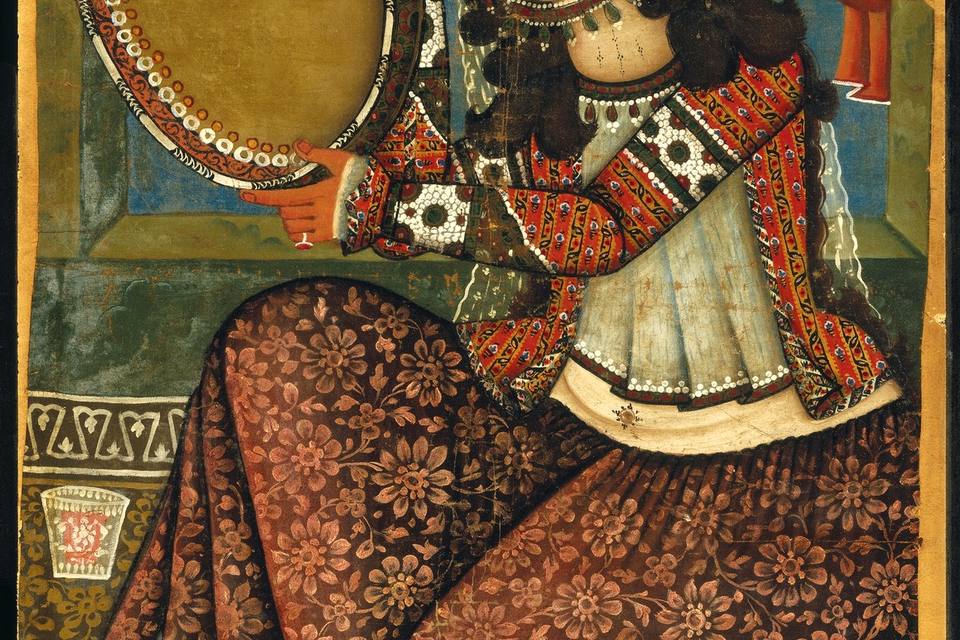
Persian painters often showed women musicians with a daf. A wall painting in the Chehel Sotoun palace in Isfahan shows one. The painting on this page comes from Qajar Iran and is kept in the Brooklyn Museum. The daf remained the drum of the Sufi gatherings of Kurdistan. Today it also plays in Iranian classical ensembles, and many young Iranians learn it.
The role of the daf in music
The daf keeps the rhythm and drives it forward. In Sufi gatherings the players repeat a short pattern many times while the singers repeat a sacred phrase. The tempo rises slowly, and the strokes grow louder and denser. Players and listeners describe this rising rhythm as a path toward ecstasy.
In classical and folk ensembles the daf supports the melody instruments and the singer. The low center strokes mark the main beats of the rhythmic cycle. The edge strokes and the rattle of the rings fill the space between them. A single player thus gives both the beat and a steady texture of sound.
Music for the daf
The daf plays in three worlds of music. In Sufi music it accompanies the dhikr and the sung poetry of the mystics. Much of this poetry is in Persian and Kurdish. In folk music it plays for dancing and for festive songs. In Iranian classical music it joins the instruments that perform the radif. The radif is the body of melodies in the modes called dastgah. Masters pass it on to their students.
In India the daf and the smaller dafli became popular folk instruments, and they are often heard in Hindi films.
How the daf works
The frame is a strip of wood about forty-five to fifty centimeters across and five to seven centimeters deep. The maker softens the strip in water and bends it around a hot metal cylinder. The ends are glued to close the ring. The maker cuts three or four rectangular openings in the frame, and metal hooks cross the openings.
Small metal rings hang from the hooks inside the frame. On some dafs the rings run around the whole inner edge. Some of these dafs have several rows of rings. When the skin is struck, the frame shakes, and the rings strike one another and the wood. Their rattle adds a bright shimmer above the drum tone.
The head is a thin skin of goat or fish, or a synthetic material. It is fixed to the frame with a second wooden frame or with nails. A thin skin sounds at the lightest touch of the fingers. A natural skin reacts to damp air and heat, so its tone changes with the weather.
How the daf is played
The player holds the daf upright, and the skin faces outward. The left hand both holds the frame and plays it. Its fingers strike near the edge of the skin. The right hand strikes the center for the deep tone and the area near the rim for higher strokes.
For a loud, sharp stroke, the player presses the fingers of the right hand against one another and releases them suddenly. The motion is like a snap of the fingers. Players also let the fingers fall one after another in a quick run of light strokes. A shake of the frame makes the rings sound without any stroke at all.
What makes a fine daf
The frame sets much of the quality of a daf. The wood must be well seasoned and even in thickness. The frame then stays round and does not twist under the pull of the skin. A light frame is easier to hold through a long ceremony. A heavier frame gives a deeper, fuller tone.
The skin shapes the voice of the drum. Goatskin and fish skin give different tones, and a synthetic head keeps its tension in any weather. A good skin is even in thickness, so the drum sounds the same at any point of the rim.
The rings must move freely on their hooks. On a well-made daf even a soft stroke makes them rattle clearly, and they fall quiet soon after a loud one. Rings that are too few give a thin sound. Rings that are crowded together blur the tone of the skin.
Choosing a daf
Most dafs are forty-five to fifty centimeters across. The left hand both holds the drum and plays it, so try the weight before you buy. A smaller or lighter daf suits a young player.
Choose between a skin head and a synthetic head. A skin head has a warmer tone but changes with the weather. A synthetic head stays steady. Listen to the rings as well. They should rattle freely when you strike the skin.
Who keeps these instruments
Museums show the daf and its ancestors beside the other instruments of Iran. The National Museum of Iran in Tehran holds an engraved bronze cup from Lorestan. It shows a daf with a double reed pipe and a harp in a procession. Frame drums of Iran and its neighbors stand in the galleries of world instruments at the Musical Instrument Museum in Phoenix. The Brooklyn Museum keeps the Qajar painting of a woman with a daf shown on this page.
Players and makers carry the tradition today. In Kurdistan the daf still sounds in the Sufi gatherings. Music schools in Iran now teach the daf beside the other instruments of Persian music. Makers in Iran and Kurdistan still bend the frames and fix the skins by hand.
First steps on the daf
Hold the daf upright in the left hand, and let the frame rest against the fingers. Strike near the edge with the fingers of that hand. Then strike the center with the right hand. Play the two strokes in turn with the metronome at a slow tempo.
When the two strokes are even, count four beats in a bar. Play the center stroke on the first beat and edge strokes on the others. Then add the snapping stroke of the right hand on the first beat of the bar. Practice the snap slowly, because it needs a relaxed hand.
A short check
Choose one answer per question.
What hangs inside the frame of a daf?
Small metal rings hang from hooks inside the frame. They rattle with the strokes.
Which hand holds the daf?
The left hand holds the daf and strikes near the edge. The right hand strikes the center.
What is a frame drum?
A frame drum has a head much wider than the depth of its frame. The daf, the riq and the bodhrán are frame drums.
Sources


Common questions
What is a daf made of?
A daf has a bent wooden frame and a thin head of goatskin, fish skin or synthetic material. Metal rings hang inside the frame.
What is the difference between a daf and a tambourine?
Both are frame drums with metal jingles. The daf is much larger, and its rings hang inside the frame. A tambourine has small cymbals set into slots around its frame.
Where is the daf from?
The daf comes from Iran, where it has been played since ancient times. It is also played in Kurdistan, Central Asia, the Caucasus, Turkey and South Asia.
What is a dafli?
A dafli is a smaller daf used in the folk music of India. It is often heard in Hindi film songs.
Is the daf used in Sufi music?
Yes. Sufi musicians play the daf in their gatherings, and its repeating rhythms accompany the singing.
How big is a daf?
A typical frame is forty-five to fifty centimeters across. Its depth is five to seven centimeters.
World MusicDarbukaBodhránOudTambourine