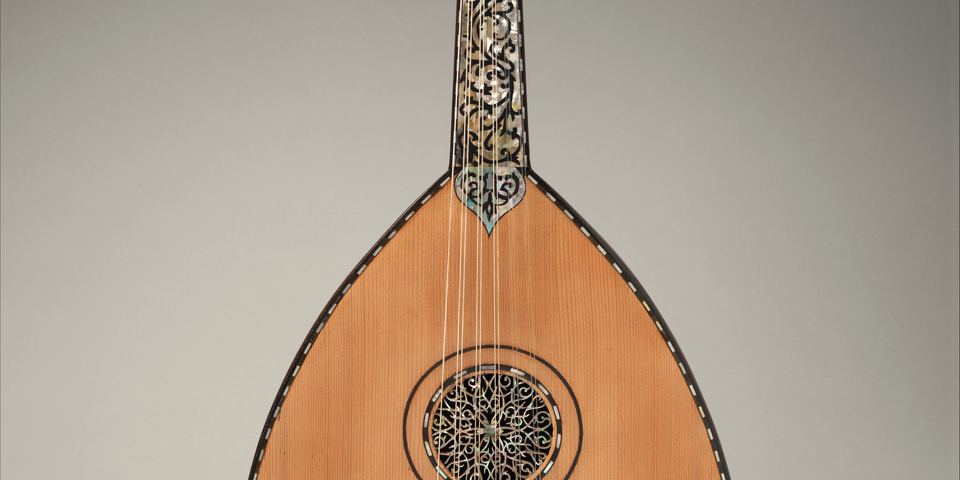
The oud
The oud is a fretless lute of the Middle East with a short neck and a pear-shaped body. Its name in Arabic script is عود. It usually has eleven strings in six courses, and a course is a pair of strings tuned together. The player plucks them with a long plectrum called a risha.
An oud plays this simple piece. The neck of the oud has no frets, so the player can slide from one note to the next.
Music: Envato (Orchestralis)
Listening to the oud
Listen first to the start of the notes. The risha strikes the string sharply, and the tone fades within a second or two. Because the sound dies so quickly, players repeat a note with fast strokes of the risha, down and up, to hold a long tone. This rapid repetition is called tremolo.
Then listen for slides. The neck has no frets, so the left hand can glide from one note to the next. Players use the slide to color a note and to reach the notes between the piano keys that belong to a maqam. A maqam is a mode of Arabic and Turkish music. It has its own scale and its own typical turns of melody. A solo improvisation on the oud is called a taqsim. It begins in the low part of the maqam and climbs step by step before it moves farther. The buttons below play three single notes of an oud in its low range. They are G, A and C.
Names of the oud
The Arabic word al-ʿūd, written العود, means a thin piece of wood. Scholars disagree about why the instrument has this name. Some link it to the wooden top, which set the oud apart from older lutes covered with skin. Others link it to the thin strips of wood in its back, or to a wooden plectrum.
The name passed into many languages. In Turkish the instrument is the ud or ut. In Greek it is the outi, written ούτι, and in Armenian it is the ud, written ուդ. The English word lute probably comes from al-ʿūd as well. The Persian barbat, written بربط, is a related lute with a smaller body and a longer neck.
History of the oud
The oud descends from the barbat, a short-necked lute of Persia. Its earlier ancestors came from Central Asia, where carvings from ancient Bactria show a lute of this kind more than two thousand years ago. Under the Sasanian kings of Persia, the barbat was an instrument of the court. Arab musicians took up a form of it with a wooden top and called it the ʿūd.
In the courts of Baghdad the oud became the chief instrument of art music. The philosopher al-Kindi gave the first complete description of its measurements and construction in the ninth century. In his time it had four courses tuned a fourth apart. A fifth course was added to complete a range of two octaves.
The oud reached Spain with the Umayyad conquest early in the eighth century. In Córdoba the musician Ziryab founded one of the first schools of music. He had trained in Baghdad. Writers credit him with the fifth course. Muslim Spain became a center of instrument making. From there the oud passed into Provence and the rest of Europe, where it grew into the European lute.
In the Ottoman Empire the oud stayed at the center of court and city music. In Istanbul the maker Manol, a Greek luthier of the Beyoğlu quarter, developed a smaller oud tuned higher than the Arabic one. This form became the Turkish oud.
The role of the oud in music
The oud plays melody. It accompanies singers, leads small ensembles and plays alone. The classical ensemble of Egypt, Syria and Lebanon is called the takht. In it the oud plays beside the qanun, the violin, the ney flute and the riq. The riq is a small frame drum with jingles. The instruments play the same melody together with their own small ornaments, and they take turns with solos.
The taqsim is the art in which the oud stands out most. A taqsim is a free improvisation on one maqam, and it often comes before a composed piece. The player begins on the tonic in the low range and sets out the lowest group of notes of the maqam. The melody then rises, may pass into a neighboring maqam, and returns to the first maqam at the end.
Music for the oud
Arabic and Turkish music are built on maqamat. Maqamat is the plural of maqam. A maqam is made of small groups of notes called ajnas. Some of their notes lie between the keys of the piano. Such a note is about a quarter tone away from the nearest key. Maqam rast, for example, has a third and a seventh that lie a quarter tone below those of the major scale. A fretless instrument such as the oud can place these notes exactly.
Much of the repertoire for the oud comes from Ottoman art music. The peşrev is a prelude in long rhythmic cycles, and its name means that which comes first. The saz semai, called the sama'i in Arabic, is a piece in several sections with a returning refrain. Both forms entered Arabic music and became popular in Egypt. Oud players also learn the songs of the great singers of Cairo, Aleppo and Baghdad.
How the oud works
The back of the oud is a deep, rounded bowl. The maker bends thin strips of wood, called ribs, over a mold and glues them edge to edge. The bowl encloses the air that resonates when the strings sound, and its depth gives the oud its low, round tone.
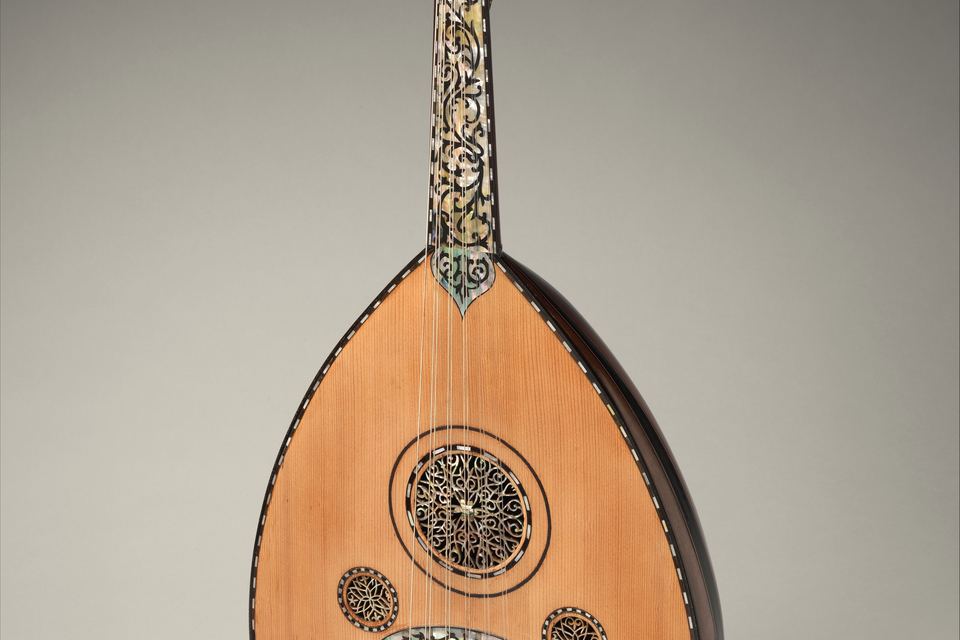
The soundboard is a thin plate of soft wood such as spruce. Thin wooden bars glued inside brace it, and their placement shapes how the top vibrates. Most ouds have one large sound hole called the rose, and a carved grille covers it. Many also have two smaller roses beside it. The strings are tied to a bridge glued to the soundboard, so their pull acts directly on the top.
The neck is short, and its smooth fingerboard has no frets. At the end of the neck, the pegbox bends sharply back. The strings run over a nut and wind onto pegs set in the sides of the pegbox. The two strings of a pair are tuned to one note.
Strings were once made of animal gut. Modern strings are made of nylon or silk, and the lower strings are wound with copper or silver wire. The risha was traditionally an eagle feather. Today it is usually plastic.
How the oud is played
The player sits and rests the oud on the right thigh. The bowl rests against the body. The right forearm lies over the edge of the bowl. The right hand holds the risha between the thumb and the first finger and strikes the strings with down strokes and up strokes. Fast strokes in both directions on one note make the tremolo that holds long tones.
The left hand stops the strings on the smooth fingerboard. The player can slide between notes, add vibrato and stop a string a quarter tone away from a piano key. A common Arabic tuning, from low to high, is C, F, A, D, G and C. Many Turkish players use a tuning called Bolahenk. Its notes are C♯, F♯, B, E, A and D.
What makes a fine oud
The quality of an oud starts with the soundboard. Makers choose spruce with straight, close grain and plane it thin. They place the braces so that the top is light but strong enough to resist the pull of the strings. A heavy top sounds dull, and a weak one sags over time.
The bowl must be light and true. Fine makers cut the ribs so precisely that the joints close without gaps. They often set thin strips of a contrasting wood between the ribs. Some old ouds have bowls of many narrow ribs in alternating light and dark woods.
The neck and the fingerboard need the same care as the body. With no frets, the fingerboard must be perfectly even, so that the strings lie low and do not buzz. The pegs must turn smoothly and hold their pitch. Fine ouds also carry inlay of mother-of-pearl or bone around the roses and along the fingerboard. The oud by Manol shown on this page has a spruce top and a mulberry back. Mother-of-pearl decorates its soundboard and its fingerboard.
Choosing an oud
Choose between an Arabic oud and a Turkish oud first. The string length is the length of string that vibrates. On an Arabic oud it is sixty to sixty-two centimeters, and on a Turkish oud it is about fifty-eight and a half centimeters. The Arabic oud is the larger of the two and has the deeper sound. The Turkish oud is lighter and brighter. Players with small hands can try a zenne oud. Its string length is fifty-five to fifty-seven centimeters.
Try the instrument in person first. Check that the neck is straight and that the strings lie low without buzzing. Pluck the courses one at a time and listen for a full tone in the low courses. A teacher or an experienced player can check a first instrument for you.
Who keeps these instruments
The Metropolitan Museum of Art in New York holds an oud made in Istanbul by Manol. It is the instrument in the photos on this page. The Musical Instruments Museum in Brussels holds an oud that scholars think is the oldest to survive. The National Museum of Natural History in Washington shows an oud from Tangier in Morocco. It has a carved rose and inlay of ivory.
Makers in the great cities of the Ottoman world set the forms that players use today. The Istanbul workshop of Manol shaped the Turkish oud. In Damascus, Abdo Nahat was among the leading makers of the Arabic oud. The Arabic Oud House in Cairo was the first school given wholly to the oud as a solo instrument. It later opened branches in other Arab countries.
First steps on the oud
Tune the courses in turn with the tuner, and pluck them with the risha so that both strings ring as one note. Hold the risha loosely and let the wrist make the stroke. Play slow down strokes on one course. Then alternate down strokes and up strokes until the two sound alike.
Next, play the scale of maqam ajam on two courses. Its notes match the major scale. The fingerboard has no marks, so check the notes against the tuner. When the scale is even, learn maqam rast. Its third and seventh notes lie a quarter tone below those of the major scale. The tuner shows how far to move the finger.
A short check
Choose one answer per question.
Why can the oud play notes between the keys of the piano?
With no frets, the left hand can stop a string at any point. The player can then place a note a quarter tone away from the piano keys.
What is a risha?
The risha is the plectrum. Its name means feather, because it was once made from an eagle feather.
What is a course on the oud?
A course is a pair of strings tuned to the same note. An oud with eleven strings has five pairs and one single string.
What is a taqsim?
A taqsim is an improvisation on one maqam. It begins on the tonic in the low range and returns to the first maqam at the end.
Sources

Common questions
How many strings does an oud have?
Most ouds have eleven strings. They are grouped in five pairs and one single low string. Some ouds have ten or thirteen strings.
What is the difference between an oud and a guitar?
The oud has no frets, a short neck and a rounded back. The guitar has frets, a longer neck and a flat back.
Is the oud related to the lute?
Yes. The lute of medieval Europe grew out of the oud of the Islamic world. The European lute has frets, while the oud has none.
How is an oud tuned?
Tunings differ by tradition. Many Arab players tune C, F, A, D, G and C from low to high.
Where does the oud come from?
It descends from the barbat, a short-necked lute of Persia. Its earlier ancestors may lie in Central Asia.
What is the oud made of?
The body and neck are wood, and the back is built from thin strips. Modern strings are nylon or silk, and the low strings are wound with metal.
What is the difference between an Arabic oud and a Turkish oud?
The Arabic oud is larger. It has a longer string length and a deeper tone. The Turkish oud is lighter and brighter, and it is tuned higher.