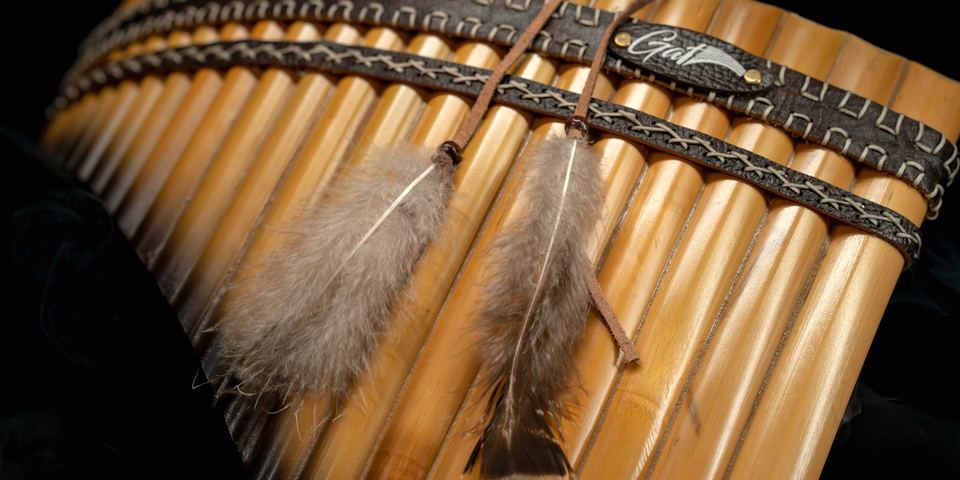
The pan flute
A pan flute is a row of pipes of different lengths. The pipes are closed at the bottom. The player blows across the open top of a pipe, and longer pipes give lower notes. Pan flutes, also called panpipes, are played in many cultures. The siku of the Andes and the curved pan flute of Romania are two well-known kinds.
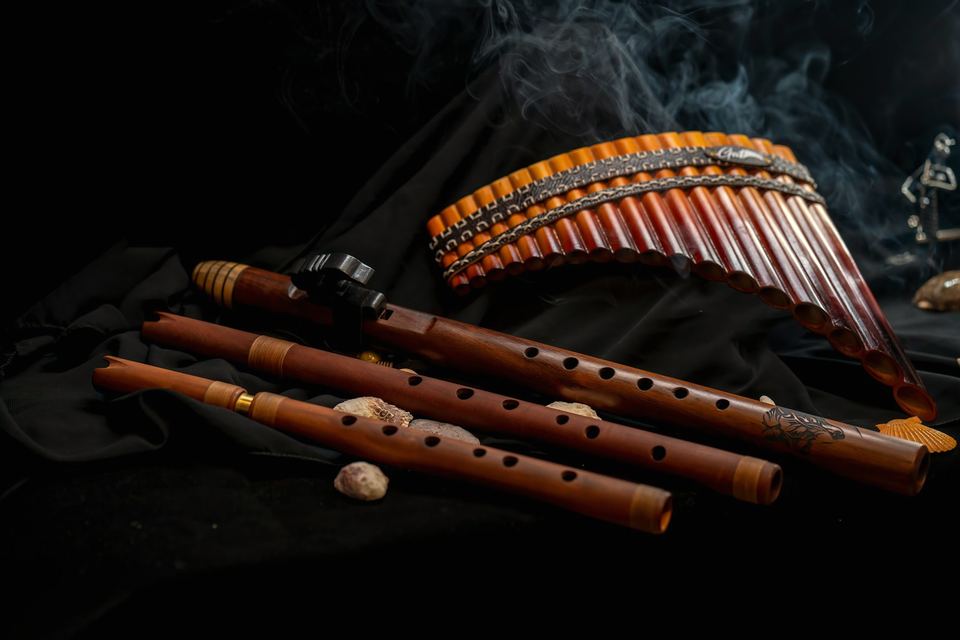
A kena and other Andean flutes play this piece with a ronroco, which is a large charango. The kena is a notched flute with finger holes. Listen for the breathy start of the flute notes. On the kena and on the pan flute, the breath strikes a sharp edge, and part of it escapes as a soft hiss.
Music: Envato (-MARiAN-)
The sound of the pan flute
The first recording is a short phrase recorded in a studio. The second is a siku played in an open-air theater in the Andes of Argentina. The rocks around it give a natural echo.
Names of the pan flute
The ancient Greeks called the instrument the syrinx. Its English name comes from Pan. In Greek myth, Pan is the god of shepherds. In the Andes it is called the siku or the zampoña. Other forms include the paixiao of China and the wot of Laos and Thailand.
Where the pan flute is played
Pan flutes are played around the world. The siku belongs to the Aymara-speaking communities around Lake Titicaca in Peru and Bolivia, and it is heard across the Andes. Romania has its own curved pan flute. Pan flutes are also played in the Solomon Islands, Zimbabwe and Malawi.
The role of the pan flute in music
In the Andes the siku is the main instrument of sikuri music. The siku has two rows of pipes. They are called ira and arka. Traditionally two players share one melody. They play one row apiece, and they take turns note by note. A large group divides into ira players and arka players in the same way. Today one player more often plays both rows.
Music for the pan flute
Sikuri music is played by groups of siku players. In ancient Greece the syrinx was an instrument of shepherds. The Romans played pan flutes at banquets, festivals and processions.
How the pan flute is made
Pipes are usually made of bamboo, cane or local reeds. Wood, plastic, metal and clay are used as well. The length of a pipe sets its pitch.
Makers fine-tune a pipe by adding a stopper, wax or pebbles at the bottom. The common siku ch'alla has thirteen pipes. The ira row has six pipes, and the arka row has seven.
How the pan flute is played
The player blows across the open end of a pipe, and the air strikes its sharp inner edge. A slight tilt of the pipe and a move of the jaw cover part of the opening. This lowers the pitch, so a player can sound notes between the pipes.
Players of the curved Romanian pan flute turn the head or move the instrument to reach the pipes. Players make vibrato in two ways. A gentle movement of the hand makes the pitch waver, and the breath makes the loudness swell.
Choosing a pan flute
For Andean music, choose a siku. The notes of the siku ch'alla are those of G major, which are also the notes of E minor.
Play all the pipes with a tuner before you buy. A pipe that sounds sharp or flat can be adjusted at the bottom.
Sources
Common questions
How does a pan flute make its sound?
Breath blown across the top of a closed pipe makes the air inside vibrate. A longer pipe gives a lower note.
What is an Andean pan flute called?
In the Andes the pan flute is called the siku or the zampoña. The name antara is also used.
Why does the siku have two rows?
The notes of the scale alternate between the two rows, ira and arka. A pair of players can share a melody. A player plays one row.
How do you play a sharp or a flat on a pan flute?
Tilt the pipe and move your jaw so that your lip covers part of the opening. The pitch then falls. For a sharp, play the pipe above the note and lower it in this way.
What is a pan flute made of?
Most pan flutes are made of bamboo or cane. Others are made of wood, plastic, metal or clay.
Where does the pan flute come from?
Pan flutes come from many parts of the world. The ancient Greeks played the syrinx, and the siku comes from the Aymara of Peru and Bolivia.