The kaval
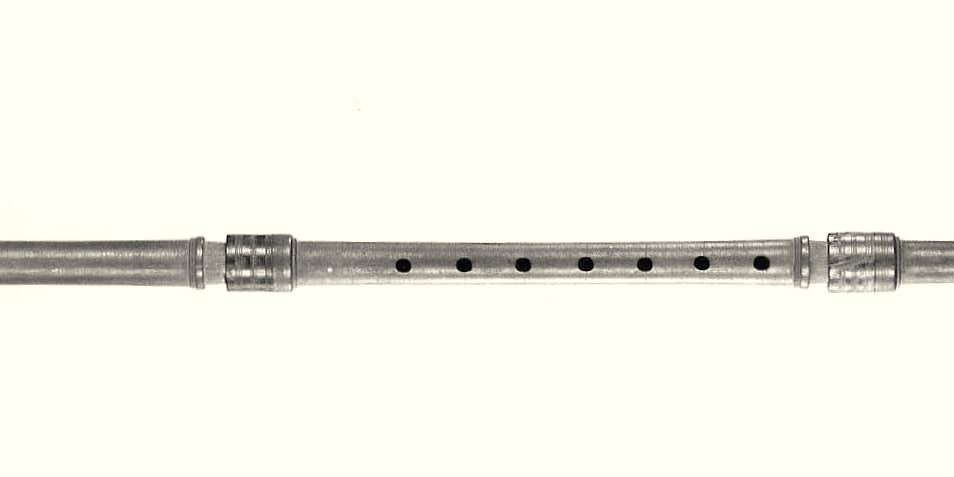
The kaval is a long wooden flute of the Balkans and Anatolia. It is open at both ends, and the player blows across the sharp edge of the upper end. It has seven finger holes and one thumb hole. Shepherds in the mountains played it for centuries, and folk ensembles play it today.
The sound of the kaval
Both recordings come from a kaval of North Macedonia. The first is a longer solo. Listen for the breath inside the tone.
The second is a short improvised passage. An improvised passage is made up while it is played.
Names of the kaval
Kaval is the usual name in Bulgaria, North Macedonia, Serbia and Turkey. In Romania and Moldova it is spelled caval. Albanian players call their instrument the kavall or the fyell.
In Turkey the word kaval covers many kinds of shepherd’s pipe. A dilsiz kaval has no duct. A duct is a narrow channel that guides the air, as on a recorder.
Where the kaval is played
The kaval belongs to the Balkans and to Anatolia. Players in Bulgaria, North Macedonia, Serbia, Albania, Kosovo, Greece, Romania and Moldova all use it. In Turkey and Armenia related flutes keep the same shape. Mountain shepherds of these regions are its oldest players.
The role of the kaval in music
For centuries the kaval was a shepherd’s instrument. A shepherd played it alone in the hills. Folk tales also tell of shepherds who sent messages to one another with it.
Today it plays folk songs and dances. It joins village ensembles and stage ensembles, and soloists play it as well.
Music for the kaval
Many kaval melodies are slow and free, and the player shapes the phrases with the breath. Dance tunes move at a steady beat. In Albania, slow tunes called kaba and vaj have a mournful tone.
In the Rhodope Mountains of Bulgaria, two players can share one tune on a matched pair of kavals called chifte kavali. The first plays the melody, and the second holds a drone. A drone is a long note held under the melody.
How the kaval is made
The Bulgarian kaval is made in three joints of cornel, plum, walnut or boxwood. Together they measure sixty to ninety centimeters. Rings of bone cover the joints so that the wood does not crack.
The middle joint holds the seven finger holes and the thumb hole. The foot joint has four more holes that stay open. Bulgarian players call them the devil’s holes. They set the pitch of the lowest note.
A folk tale explains the name. While a shepherd slept, the devil drilled the holes to spoil his kaval. The kaval sounded better than before, and the shepherd won their contest.
How the kaval is played
The player holds the kaval at an angle of about forty-five degrees and covers about three quarters of the open end with the lips. The breath strikes the thin edge of the wood.
A change of breath moves the kaval into another register. A register is a part of the range with its own tone. The Bulgarian kaval has four registers and a range of about two octaves and a fifth. Skilled players also use circular breathing. They breathe in through the nose while the tone goes on.
How the kaval has changed
The old kaval was carved from a single piece of wood. The kaval in three joints is the usual form today. Makers also use horn, cane, metal and plastic. Circular breathing was once a rare skill. Today more and more young players use it.
Choosing a kaval
Kavals are made in several keys. The kaval in D is the most common in Bulgaria, and it suits most folk tunes. A lower kaval in C has a darker tone.
Ask whether the joints fit firmly and whether the bore has been oiled. Play the lowest note. It should sound clear before you try the higher registers.
First steps on the kaval
Rest the upper end against the lips, and hold the kaval at about forty-five degrees to one side. Cover about three quarters of the opening with the lips. Blow a thin stream of air across the edge until a low note sounds.
Next, cover all the holes and play the lowest note softly. Lift the fingers of the lower hand one at a time, and listen to the new note. Check the notes with the tuner. Then blow a little harder to reach the next register.
A short check
Choose one answer per question. The explanation appears below the correct answer.
How does the player make a sound on the kaval?
The kaval has no reed and no duct. The breath strikes the thin edge of the open end, as on the shakuhachi.
What are the devil’s holes?
The four holes stay open. They set the pitch of the lowest note and help the tone.
What does a player change to move into a higher register?
Stronger breath sends the kaval into a higher register. Softer breath gives the lowest register.
Sources
Common questions
Is the kaval hard to play?
The first sound takes patience, because the kaval has no duct to guide the air. Most learners find the low register first. The higher registers come later.
What is the difference between a kaval and a ney?
Both are rim-blown flutes open at both ends. The ney is usually cut from reed and is played in Turkish and Persian classical music. The kaval is usually wooden and belongs to folk music.
What key is a kaval in?
Kavals come in several keys. In Bulgaria the most common kaval is in D, and the kaval in C is also popular.
How long is a kaval?
A Bulgarian kaval measures from about sixty to about ninety centimeters. A lower key needs a longer kaval.
Why does the kaval sound so soft?
The air strikes an open edge, and part of the breath sounds in the tone. That gives the kaval its warm, breathy color.
Is the kaval related to the shakuhachi?
The two are not related by history. Both are end-blown flutes, and on both the player blows across the edge of the open top.
World MusicShakuhachiBansuriPan fluteLevel 3 course