The khaen
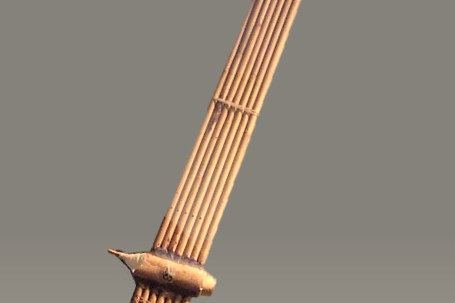
The khaen is a mouth organ of Laos and northeast Thailand. Its long bamboo pipes stand in two rows and pass through a wooden wind chest, into which the player blows. The pipes hold a small metal reed apiece. A pipe sounds only while a finger covers its hole, so the player can sound chords and melody together.
The sound of the khaen
In this passage the sound of the khaen continues without a break. Its reeds sound when the player blows out and also when the player draws air in.
Names of the khaen
In English the name is spelled khaen, khene, kaen or ken. Sizes take their names from the number of pipes in a row. The khaen hok has twelve pipes in two rows of six, and hok means six.
The khaen paet has sixteen pipes in two rows of eight. It is the size most players use.
Where the khaen is played
The khaen is the national instrument of Laos. The Lao people of the Isan region in northeast Thailand play it too. Tai communities and the Muong people of northern Vietnam use it. In Cambodia a dance drama called lakhon ken uses the khaen as its main instrument.
The role of the khaen in music
The khaen plays solo music and music for ensembles. It is often heard with the phin. The phin is a plucked lute with frets.
It also accompanies the singers of mor lam. Mor lam is a Lao style of song. There the khaen supports the voice. The player follows the changes of mode and adds harmony under the singer.
Music for the khaen
Khaen music uses five modes called lai. A lai is a set of notes with its own drone pipes. A drone is a note held under the melody. The player improvises within the notes of the lai, and a lai has its own closing patterns.
Lai po sai is thought to be the oldest of the five. Lai sutsanaen is called the father of the lai. Khaen music of the Lao people is on the UNESCO list of intangible cultural heritage.
How the khaen is made
The pipes are cut from a thin-walled bamboo. A pipe has one finger hole, which is burned in with a hot iron. While the hole is open, the pipe cannot sound.
The reeds are thin tongues of metal. It sits a quarter of the way along its pipe. Makers have often cut the reeds from old coins. The pipes are fixed into the wind chest with kisoot. Kisoot is a sticky black wax made by an insect.
These reeds are free reeds. A free reed swings back and forth through a close-fitting slot when air passes it.
How the khaen is played
The player cradles the wind chest in both hands and holds the pipes upright. The lips rest against the wind chest. The fingers and thumbs of both hands close the holes. Several holes closed at once sound a chord.
The reeds are the same on both faces, so they sound in both directions of the breath. The player blows out until the breath runs short. The player then draws air in through the instrument. Players often plug one or two holes with kisoot, and those pipes sound all the time as drones.
How the khaen has changed
The khaen is related to the sheng of China. A sheng carried to Saint Petersburg in the eighteenth century brought the free reed to Europe. European makers then built the harmonium, the concertina and the accordion.
Composers outside Asia have written notated music for the khaen. In Laos, associations of khaen players teach young people in many villages, and festivals promote the art.
Choosing a khaen
A khaen cannot be retuned once its reeds are set and its pipes are cut. Choose an instrument made in the key you need.
Most players use the khaen paet. The small khaen hok is often used by children and beginners, and it is also sold to visitors as a souvenir. Before you buy, ask a player to test the instrument. All the pipes should sound on both breaths.
First steps on the khaen
Hold the khaen upright and rest your lips against the wind chest. Close one finger hole and blow gently. Then draw air in through the instrument, and the same pipe sounds again.
Next, close two holes at once to sound two notes together. Practice slow, even breaths in both directions. Players learn the fingering of a lai from a teacher and keep it in memory.
A short check
Choose one answer per question. The explanation appears below the correct answer.
When does a pipe of the khaen sound?
The open hole stops the pipe from sounding. When a finger closes it, the reed in that pipe sounds.
What is a lai?
A lai is a mode: a set of notes with its own drone pipes. Khaen music uses five lai.
Which instrument also makes its sound with free reeds?
The harmonium, the accordion and the harmonica all use free reeds. The oboe uses a double reed of cane.
Sources
Common questions
What is a khaen made of?
Its pipes are bamboo, its wind chest is hardwood and its reeds are metal. A black insect wax called kisoot seals the pipes into the wind chest.
How many pipes does a khaen have?
The common khaen paet has sixteen. Other sizes have twelve, fourteen, eighteen or twenty pipes.
Is the khaen the same as the sheng?
They belong to the same family of mouth organs with free reeds. The sheng is the Chinese member of the family.
Can you play chords on the khaen?
Yes. Closing several finger holes at once sounds several pipes together.
What is mor lam?
Mor lam is a style of singing of Laos and the Isan region of Thailand. A khaen usually accompanies the singer.
How is the khaen learned?
Families and village associations pass it on. A student memorizes the fingerings and practices the lai until they flow.