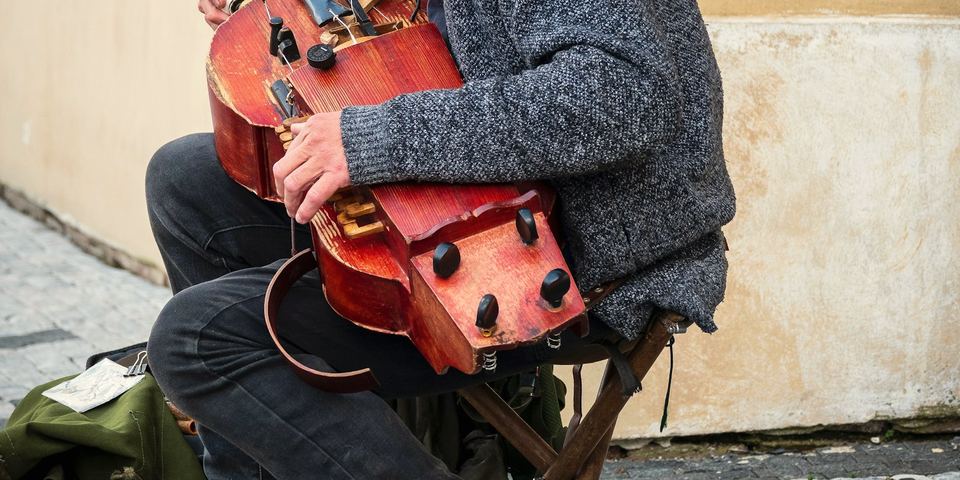
The hurdy-gurdy
The hurdy-gurdy is a string instrument played by a wheel. The player turns a crank, and a rosined wheel rubs the strings as a bow does. Keys press small wedges against the melody strings to change the pitch. Drone strings sound steady notes beneath the tune, so the sound recalls the bagpipe.
In this folk tune, the hurdy-gurdy plays with a guitar, a harp, a recorder and soft percussion.
Music: Envato (SCOREWIZARDS)
The sound of the hurdy-gurdy
The buttons below play single strings of a hurdy-gurdy. The first is a drone string, called the bourdon, under the turning wheel. It holds one low note for as long as the wheel turns. The second is a melody string, called the chanterelle, which the keys stop to play the tune.
The third is a drone string plucked by hand, so you hear the string without the wheel. On a full instrument these sounds join. The melody moves above the steady drones. A small loose bridge, called the dog, buzzes to mark the beat.
Names of the hurdy-gurdy
In French the instrument is the vielle à roue, the wheel fiddle. Other names include the zanfona of Spain, the ghironda of Italy and the Drehleier of Germany. In Hungary it is called the tekerőlant, the turning lute. In Ukraine it is called the lira. In the eighteenth century the English name hurdy-gurdy was also given to small street organs turned by a crank.
The hurdy-gurdy is still played in Hungary, in Galicia and above all in central France. In Ukraine, blind traveling musicians called lirnyky once played the lira. They sang religious songs and epic songs called dumy. They also played dance tunes.
History of the hurdy-gurdy
The hurdy-gurdy began in the churches of medieval Europe. Its first form, the organistrum, was a large instrument with a long neck. It needed a pair of players. The first turned the crank, and the second pulled up the keys. A stone carving of the twelfth century on the cathedral of Santiago de Compostela shows two musicians with an organistrum between them. The organistrum played the seven notes of one octave with no sharps or flats. It accompanied singing in monasteries and churches.
In the thirteenth century the instrument grew small enough for one player. This box-shaped form was called the symphonia. It had three strings and a short keyboard. Keys pushed in by the fingers later replaced keys pulled from above. By the Renaissance the hurdy-gurdy had gained a buzzing bridge, the dog. The first known picture of it is in a painting by Hieronymus Bosch.
Musical taste then turned to music in many parts, which the steady drones could not follow. In the seventeenth century the hurdy-gurdy passed to peasants and street musicians, and people called it the peasant's lyre.
In the eighteenth century the French nobility took it up again. A fashion for pastoral life brought two country instruments to court: the vielle and the small bagpipe called the musette. Paris workshops built richly decorated vielles. Admirers called the maker Pierre Louvet the Stradivari of the hurdy-gurdy. Boismortier, Corrette and the Chédeville brothers wrote sonatas, suites and concertos for the vielle. A set of sonatas by Nicolas Chédeville, Il pastor fido, was published under the name of Vivaldi.
The fashion reached beyond France. Haydn wrote concertos and night pieces, called notturni, for the King of Naples. The king played the lira organizzata, which is a hurdy-gurdy with small organ pipes. In France the fashion for the hurdy-gurdy faded at the end of the century. In Schubert's song Der Leiermann, an old hurdy-gurdy player turns his wheel barefoot on the ice. The instrument lived on in folk music, and a revival in the twentieth century brought it back across Europe.
The role of the hurdy-gurdy in music
The hurdy-gurdy plays a melody and its own accompaniment at once. The melody strings carry the tune, and the drones hold steady notes beneath it. A drone string called the trompette rests on a loose bridge called the dog. Its buzz adds the rhythm, so one player can carry the music for a whole dance. In central France it plays for folk dances. Early music ensembles use it in songs and dances of the Middle Ages and the Renaissance. Folk bands and composers today also write new music for it.
How the hurdy-gurdy works
The wheel is a wooden disk inside the body. The crank turns it, and its rim rubs the strings from below. The player coats the rim with rosin, a tree resin that helps it grip. The wheel works as an endless bow. As long as it turns, the strings sound without a break.
The melody strings, called chanterelles, run through the keybox along the neck. The keys carry small wedges called tangents. When the player presses a key, its tangent touches the string and shortens the part that sounds, so the pitch rises. On release the key falls back by its own weight. Most instruments made today have two chromatic octaves of keys.
The drone strings run outside the keybox, so the keys never touch them. They sound open notes for as long as the wheel turns. The common French vielle à roue has six strings, which are two melody strings and four drones. The player can lift a drone off the wheel to silence it, and this lets the instrument play in more than one key.
The drone called the trompette rests on a loose bridge called the chien, the dog. When the wheel turns evenly, the dog stays still. When the player gives the crank a sharp push, the string pulls harder, and the dog lifts and buzzes against the top. A peg in the tailpiece, the tirant, sets how easily it buzzes.
How the hurdy-gurdy is played
Most players hold the hurdy-gurdy on the lap with a strap. The keybox tilts away from the body, so the keys can fall back after a note. The right hand turns the crank, and the left hand plays the keys. A steady, even turn gives a smooth tone. A faster turn makes the sound louder.
The rhythm comes from a stroke of the wrist called the coup de poignet. The player gives the crank a quick push at a chosen point of its turn, and the dog sounds a short buzz. Strokes placed at one, two or more points of the turn make different dance rhythms. In this way the crank also serves as the drum of the instrument.
What makes a fine hurdy-gurdy
A fine hurdy-gurdy begins with a true wheel. The wheel must be perfectly round and centered on its axle. Its rim must be smooth. A wheel that wobbles makes the tone swell and fade as it turns. A warped wheel makes the strings screech.
The cotton on the strings shapes the tone. Players wrap a thin layer of cotton around the strings where they meet the wheel. Too little cotton gives a harsh, scratchy sound, and too much gives a dull one. Thin paper shims under the strings set their height on the wheel. Setting the cotton takes practice, and players renew it when the tone changes.
The dog must respond exactly to the wrist. On a well-made instrument it buzzes at a light stroke and falls silent at once, and the tirant lets the player set that balance. The keys must slide freely and fall back without noise. The maker sets the tangents so that their notes are in tune.
Makers use two common body shapes. The vielle en guitare has a flat back and the outline of a guitar. The vielle en luth has a rounded back made of thin staves, like a lute. The court vielles of eighteenth-century Paris had carved heads and inlaid keybox lids. Their trim was ebony and ivory.
Choosing a hurdy-gurdy
Try an instrument before you buy it. Turn the crank slowly and listen for a tone that neither swells nor screeches. Press the keys one at a time and check that they fall back by themselves.
Ask how the wheel is rosined and how the strings are wrapped with cotton. Both shape the sound. Poor copies of known designs are sold too, so ask experienced players for advice. A maker or a teacher can show you how to set the cotton and adjust the dog.
Who keeps these instruments
Museums keep the vielles of the French court. The Victoria and Albert Museum in London holds a vielle made in Paris by Pierre Louvet. Its keybox is carved with leaves and shells, and a woman's head crowns the pegbox. The Rijksmuseum in Amsterdam holds another Louvet vielle. The Metropolitan Museum of Art in New York holds a guitar-shaped vielle from a Paris workshop.
Folk makers kept the craft alive in the village of Jenzat in central France. Families such as the Pajots built vielles there for generations. The house of one Pajot maker is now a museum called the Maison du Luthier. It keeps a working luthier's workshop. Some French music conservatories, such as the one in Vierzon, teach the hurdy-gurdy beside other traditional instruments.
First steps on the hurdy-gurdy
Begin with the drones. Turn the crank slowly and evenly, and listen for a tone that neither swells nor fades within a turn. Tune the drones with the tuner.
Next, play a slow scale on the keys with the left hand. Let a key fall back before you press the next one. Learn the coup de poignet last. Begin with one stroke per turn of the crank. A teacher can set the cotton and the dog for you, so the instrument responds well from the start.
A short check
Choose one answer per question.
What is a tangent on a hurdy-gurdy?
When the player presses a key, its tangent touches the melody string. The sounding part of the string grows shorter, and the pitch rises.
What makes the dog buzz?
A quick push on the crank, the coup de poignet, makes the wheel pull harder on the trompette string. The loose bridge called the dog then lifts and buzzes.
How many players did the organistrum need?
The first player turned the crank, and the second pulled up the keys. Later forms were small enough for one player.
Sources
- Wikipedia: Hurdy-gurdy
- Encyclopaedia Britannica, eleventh edition: Hurdy-gurdy
- Victoria and Albert Museum: hurdy-gurdy by Pierre Louvet
- Rijksmuseum: hurdy-gurdy by Pierre Louvet
- Metropolitan Museum of Art: vielle à roue
- Calenda: the musette at the French court
- Wikipedia: Michel Corrette
- Wikipedia: concertos by Haydn
- Wikipedia: Winterreise
- Cirkwi: Maison du Luthier in Jenzat
Common questions
What is a hurdy-gurdy?
It is a string instrument sounded by a wheel, which the player turns with a crank. Keys change the notes of the melody strings, and drones play beneath them.
What does vielle à roue mean?
Vielle à roue is the French name of the hurdy-gurdy. It means wheel fiddle.
Where does the hurdy-gurdy come from?
The hurdy-gurdy comes from medieval Europe. Its first form, the organistrum, appears in church carvings of the twelfth century.
What makes the buzzing sound of a hurdy-gurdy?
The buzz comes from a loose bridge called the dog. A sharp stroke on the crank makes it buzz, which marks the beat.
What is a tekerőlant?
Tekerőlant is the Hungarian name of the hurdy-gurdy. It means turning lute.
How many strings does a hurdy-gurdy have?
The common French vielle à roue has six strings. It has two melody strings and four drones, and some players add more.
Is the hurdy-gurdy hard to play?
The keys are easy to find, because they give one fixed note apiece. A steady tone and a clean buzz from the dog take months of work at the crank.
World MusicBagpipeTunerNyckelharpa