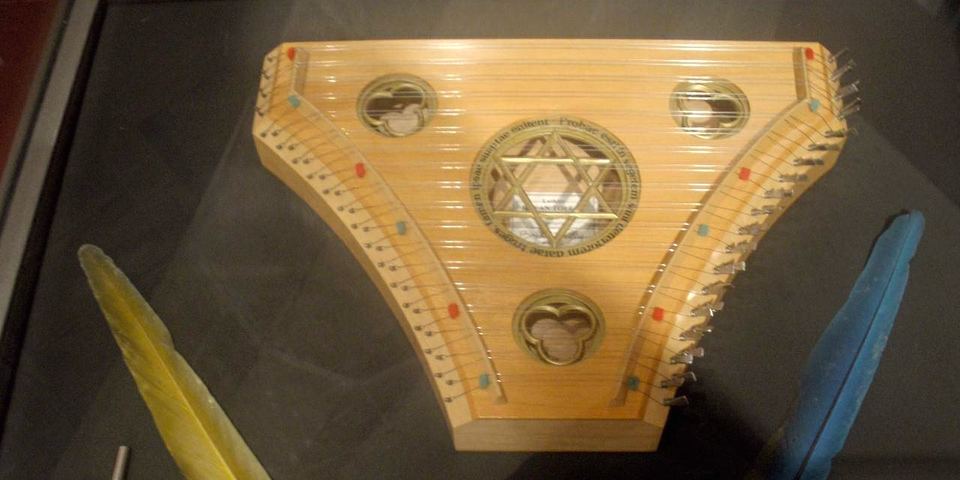
The psaltery
The psaltery is a string instrument with strings stretched across a flat wooden sound box and no fingerboard. The strings sound one note apiece. Medieval players plucked it with the fingers or a quill. The modern bowed psaltery is triangular, so the player can bow any string on its own. The psaltery is an ancestor of the zither.
A singer performs the song "Santa Maria, strela do dia" from the Cantigas de Santa Maria. The Cantigas are more than four hundred songs about the Virgin Mary from the court of King Alfonso X of Castile. Paintings in their manuscripts show musicians playing psalteries. Listen for the refrain, which returns between the verses.
The sound of the psaltery
In the first recording, a bowed psaltery plays one long stroke on C. A stroke on the C an octave higher follows. The note swells under the bow and keeps ringing after the bow leaves the string.
The same instrument then plucks a C and plays a short bounced stroke on D. Bowed and plucked notes give two different colors.
Names of the psaltery
The name comes from the Greek psaltērion, from a verb that means "to pluck." An old English form of the name is sawtry. The King James Bible uses the word psaltery for Hebrew instruments whose exact form is unknown.
The psaltery in history
Psalteries of many shapes appear in the paintings, sculptures and manuscripts of medieval Europe. They were common from the twelfth to the fifteenth century. Shapes include the trapezoid, the triangle, the wing and the "pig's head."
In Europe the psaltery had mostly died out by the nineteenth century. In Mexico the salterio stayed in use well into the twentieth century, and some regional styles still play it.
The role of the psaltery in music
In medieval music the psaltery played melodies and accompanied singing. Its strings were usually made of metal.
Today the bowed psaltery is popular with folk players, early-music groups and schools. It plays melodies one note at a time, and its long ringing notes blend into soft harmonies.
How the psaltery is made
A psaltery is a wooden sound box with strings stretched over the soundboard. A rose or sound hole sits in the center. Tuning pins at one end set the tension of the strings.
The bowed psaltery is triangular. A string ends a little farther out than the one before it, so the bow reaches one string at a time. On a chromatic psaltery the natural notes run up one side, and the sharps and flats run up the other.
How the psaltery is played
Hold the bowed psaltery in one hand or rest it on the lap, and bow with the other hand. Draw the bow across the ends of the strings. Some players lay the instrument down and use a bow in the left hand and another in the right.
The strings can also be plucked at the bowing end or strummed. In the United States players use a small arched bow. In Europe a short violin bow is common.
How the psaltery has changed
The psaltery inspired other instruments. Plucked keyboard instruments such as the harpsichord drew on it. Striking the strings with hammers gives the hammered dulcimer, the santoor and the cimbalom.
The bowed psaltery is a modern form. It was developed in Germany in the twentieth century, and an elementary school teacher in Germany made it popular after the Second World War.
Choosing a psaltery
Bowed psalteries come in diatonic and chromatic forms. A chromatic psaltery plays in all keys, and a diatonic one is smaller and simpler.
Check that the tuning pins hold firmly. Rosin the bow before playing, as for a violin bow.
First steps on the bowed psaltery
Check the pitch of all the strings on the tuner. Start with the lowest string and work upward. Rub rosin along the bow.
Hold the psaltery with the point away from you. Draw the bow slowly across the end of the lowest natural string. Then bow the natural strings in turn to hear the scale.
Play a simple tune at a slow tempo. Let the notes ring as you move the bow to the next string.
A short check
Choose one answer per question. The explanation appears below the correct answer.
What kind of instrument is the psaltery?
The strings stretch across a flat wooden box. A string sounds one note, because there is no fingerboard to stop it.
Why is a bowed psaltery shaped like a triangle?
A string ends a little farther out than the one before it. The bow can then touch one string at a time.
How does a hammered dulcimer differ from a psaltery?
A psaltery is played with the fingers or a bow. The hammered dulcimer and the santoor are struck with hammers.
On a chromatic bowed psaltery, where are the sharps and flats?
The natural notes run up one side and the sharps and flats up the other. The layout is like the white and black keys of a piano.
Sources
Common questions
Is the psaltery hard to learn?
The strings give one note apiece, so a beginner plays a scale on the first day. Moving the bow cleanly from string to string in a quick tune takes practice.
What is the difference between a psaltery and a zither?
Both have strings over a sound box. Many zithers add a fretted fingerboard for the melody. The psaltery has open strings only.
What is the difference between a psaltery and a dulcimer?
Players pluck or bow a psaltery. The hammered dulcimer has stronger strings, which the player strikes with small hammers.
Is the psaltery in the Bible?
The word appears in English translations of the Bible. It stands for Hebrew instruments whose exact form is not known.
How many strings does a bowed psaltery have?
It depends on its range and on whether it is chromatic. A chromatic psaltery has strings for all the sharps and flats as well as for the natural notes.
What does a bowed psaltery sound like?
It sounds clear and sweet. The tone is a little like a violin with the ring of a bell. The notes keep sounding after the bow moves on.