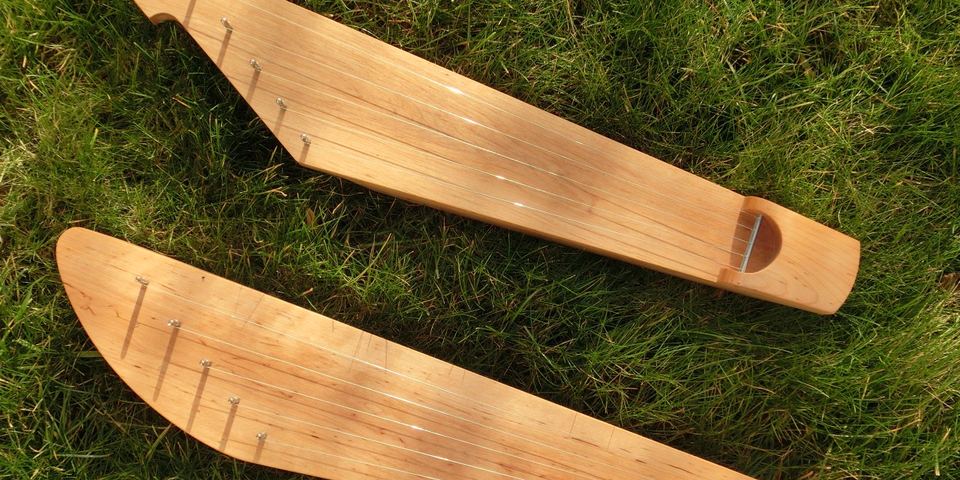
The kantele
The kantele is a plucked string instrument of Finland and Karelia. It is a box zither. Its strings stretch across a hollow wooden box, and the player plucks them with the fingers. The oldest forms have five or six strings. Concert instruments have up to forty. Its ringing sound resembles soft bells.
The sound of the kantele
A self-taught player plucks a homemade kantele with five strings. The piece begins with an arrangement of a traditional song about Väinämöinen.
Listen for the long ring of the strings. The strings are left open, so the notes overlap.
Names of the kantele
Kantele is the Finnish name. The kantele belongs to a family of Baltic box zithers. Its relatives are the kannel of Estonia, the kokles of Latvia, the kanklės of Lithuania and the gusli of Russia.
Finnish players speak of the small kantele, which has fifteen strings or fewer. They call the large modern instrument the concert kantele.
Where the kantele is played
The kantele is played across Finland and in Karelia. Karelia is a region that lies partly in Finland and partly in Russia.
The role of the kantele in music
The kantele plays alone, and it also joins folk ensembles.
The kantele appears in the Kalevala. The Kalevala is the national epic of Finland. It is a long poem gathered from folk songs.
Music for the kantele
In the Kalevala, the sage Väinämöinen makes the first kantele from the jawbone of a giant pike. He strings it with hair from a horse. Its music draws the forest animals near to listen.
The small kantele plays folk tunes. The concert kantele has a repertoire of its own, which is related to the folk music.
How the kantele is made
The oldest kanteles were carved from one piece of wood and strung with horsehair. Modern instruments have metal strings, and the body is built from several pieces.
The traditional kantele has no bridge and no nut. The strings run from the tuning pegs straight to a metal bar called the varras. This build is part of its ringing sound.
How the kantele is played
The player holds the kantele in the lap or rests it on a small table. On a small kantele the longest strings lie farthest from the player. A five-string kantele is often tuned to D, E, F♯, G and A. These are the first five notes of D major.
The fingers pluck single strings for a melody. They can also strum open strings, and some players strum with a matchstick. Some five-string kanteles have a lever that changes F♯ to F, so a tune in D minor needs no retuning.
How the kantele has changed
Larger kanteles came later. The concert kantele has up to forty strings and levers for sharps and flats. Today the kantele is taught in Finnish schools, music institutes and conservatories. Some makers also build an electric kantele.
Choosing a kantele
For a first kantele, five strings are enough. They teach the tuning, the plucking and the old tunes. Kanteles with ten or fifteen strings give a wider range for later study.
Ask whether the strings are steel or brass, and which key the maker tuned. A lever for F♯ and F is useful for tunes in minor keys.
First steps on the kantele
Tune the five strings to D, E, F♯, G and A with the tuner. Rest the kantele in your lap with the longest string farthest from you.
Pluck the strings in turn from the lowest to the highest, and let the notes ring. Next, play the three strings D, F♯ and A together. These three notes make the D major chord.
Then pick a short pattern of three or four notes and repeat it slowly. Change one note whenever you repeat it.
A short check
Choose one answer per question. The explanation appears below the correct answer.
Where do the strings of a traditional kantele end?
The traditional kantele has neither a bridge nor a nut. Its strings run from the pegs straight to a metal bar called the varras.
On a five-string kantele tuned to D, which notes do the strings give?
The five strings are the first five notes of the D major scale: D, E, F♯, G and A.
Which story tells how the first kantele was made?
In the Kalevala, the Finnish epic, Väinämöinen makes the first kantele from the jawbone of a giant pike.
Sources
Common questions
How many strings does a kantele have?
The traditional kantele has five strings. Small kanteles have up to fifteen, and a concert kantele can have forty.
Is the kantele easy to learn?
A five-string kantele needs no left-hand fingering, so a beginner can play a tune in the first lesson. Fast patterns and the concert kantele take years.
What is the difference between a kantele and a zither?
The kantele is one kind of zither. It has no fretboard, and its strings run to a metal bar without a bridge.
What music is played on the kantele?
Players use it for Finnish folk tunes, songs from the Kalevala tradition and improvised patterns. Concert players also perform new music written for the large kantele.
Can a kantele play in a minor key?
Yes. Some five-string kanteles have a lever that lowers F♯ to F. The five strings then give the first five notes of D minor.
Who plays the kantele today?
Children learn it in Finnish schools, and adults play it in folk groups. Students also study it at conservatories.
World MusicZitherHurdy-gurdyTunerLevel 2