The saxophone
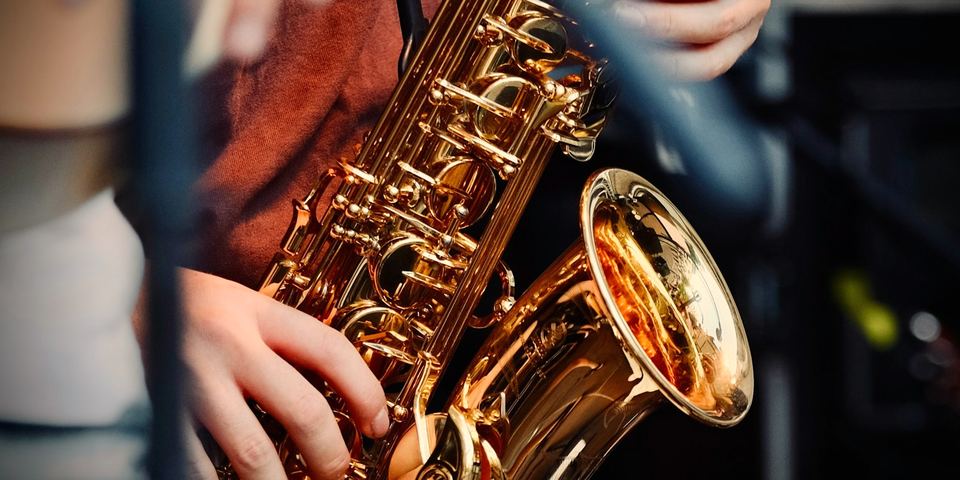
The saxophone is a single-reed woodwind with a conical brass body, which widens steadily toward the bell. The Belgian instrument maker Adolphe Sax invented it in the nineteenth century. Leather pads on the keys close its tone holes. The main sizes are the soprano, the alto, the tenor and the baritone. Saxophonists play them in bands, orchestras and jazz groups.
A tenor saxophone leads this jazz piece with piano and double bass. Listen for how the tone grows and fades within the phrases.
Music: Envato (Music-Ideas)
The sound of the saxophone
In the opening piece, listen to how the phrases start. The player shapes the tone with the lips and the breath. A slow vibrato can warm a long note, and a slight bend can soften the pitch at the end of a phrase.
A quartet of saxophones plays the Little Fugue in G minor by Bach. Bach wrote it for organ, and this version is arranged for saxophones. A single saxophone plays the theme alone, and the others enter in turn.
The next recordings are a pair of discs from the early years of the saxophone in the United States. On the first a soloist plays a quick, playful showpiece with an orchestra. On the second a saxophone quintet plays a march.
Next an alto saxophone improvises with no accompaniment. A tenor saxophone ends the set with a low note, a middle note and a short, detached note.
History of the saxophone
Adolphe Sax was born in Dinant, in what is now Belgium. His father made instruments in Brussels, and the son learned the trade in his workshop. He studied the flute and the clarinet, and he improved the bass clarinet. He then moved to Paris and opened a workshop of his own. The saxophone takes its name from him. Players often call it the sax, and a person who plays it is a saxophonist.
Sax wanted an instrument with the power of brass and the agility of a woodwind. He gave it a single reed and a conical brass body. A player can overblow, which means forcing the tube to sound a higher note with the same fingering. An overblown clarinet rises by a twelfth, which is an octave and a fifth. An overblown saxophone rises by an octave. Both registers therefore use the same fingerings. Sax received a patent for the saxophone a few years after he moved to Paris. It covered fourteen instruments in two families of seven. The instruments of one family were pitched in C and F, and those of the other in B♭ and E♭. The B♭ and E♭ family soon became the standard.
French and Belgian military bands took up the saxophone quickly. Late in the nineteenth century, classical interest faded, and the Paris Conservatory stopped teaching the instrument for about seventy years. In the United States, the bandmaster Patrick Gilmore and the saxophonist Edward Lefebre promoted it. The firm of C. G. Conn began to make saxophones in large numbers. Vaudeville, ragtime bands and dance orchestras then spread it across the country. Vaudeville was a stage show of songs, comedy and dance.
Solo showpieces for the saxophone sold well on records in those years. The full recording below is one of them. The disc is called Saxophobia. A soloist plays quick runs and playful effects above an orchestra. Makers improved the keywork through the first half of the twentieth century. Early saxophones had two octave keys, and makers joined them into one. The layout that the Paris firm of Selmer set out in the middle of the century became the model for most saxophones today.
The Victor company recorded this disc of Saxophobia on April 27, 1920. The Library of Congress digitized it for its National Jukebox.
The role of the saxophone in music
A concert band usually has two alto saxophones, a tenor and a baritone. A classical saxophone quartet has a soprano, an alto, a tenor and a baritone. French and Belgian military bands include at least a quartet of saxophones. Orchestras call for a saxophone only in some works. In musicals, a woodwind player often plays the saxophone part along with other instruments.
A jazz big band has a whole section of saxophones beside its trumpets and trombones. In small jazz groups the saxophone often plays the melody and the longest solos. The rhythm and blues bands of the middle of the century had strong, bluesy saxophone soloists. Their style passed into rock and roll, soul, funk and ska, where saxophones play solos and join the horn section.
Music for the saxophone
Some orchestral composers wrote solos for the saxophone. In Boléro, Ravel gives solos to the tenor and the soprano saxophone. In his orchestration of Pictures at an Exhibition by Mussorgsky, an alto saxophone plays the melody of The Old Castle. Bizet wrote for the alto saxophone in his music for L'Arlésienne. In the concert hall, the Concerto by Glazunov and the Concertino da camera by Ibert are central works for the alto saxophone. The French saxophonist Marcel Mule made the instrument a classical study at the Paris Conservatory.
In jazz, Coleman Hawkins made the tenor saxophone a solo instrument. His tone was rich, with a wide vibrato, and jazz players still study his recording of Body and Soul. Lester Young played with a smoother, darker tone and long melodic lines. The alto saxophonist Charlie Parker led bebop. Bebop is a fast and complex style of jazz. John Coltrane played fast, dense runs on the tenor and made the soprano saxophone popular again. Johnny Hodges, the alto saxophonist of the Duke Ellington Orchestra, shaped the alto style of the swing era. Harry Carney played the baritone in the same band and made it a solo voice.
When you listen to jazz saxophonists, compare their tone first. Hawkins filled his notes with sound and used a wide vibrato. Young used less vibrato and played long lines that wove in and out of the chords.
How the saxophone is made
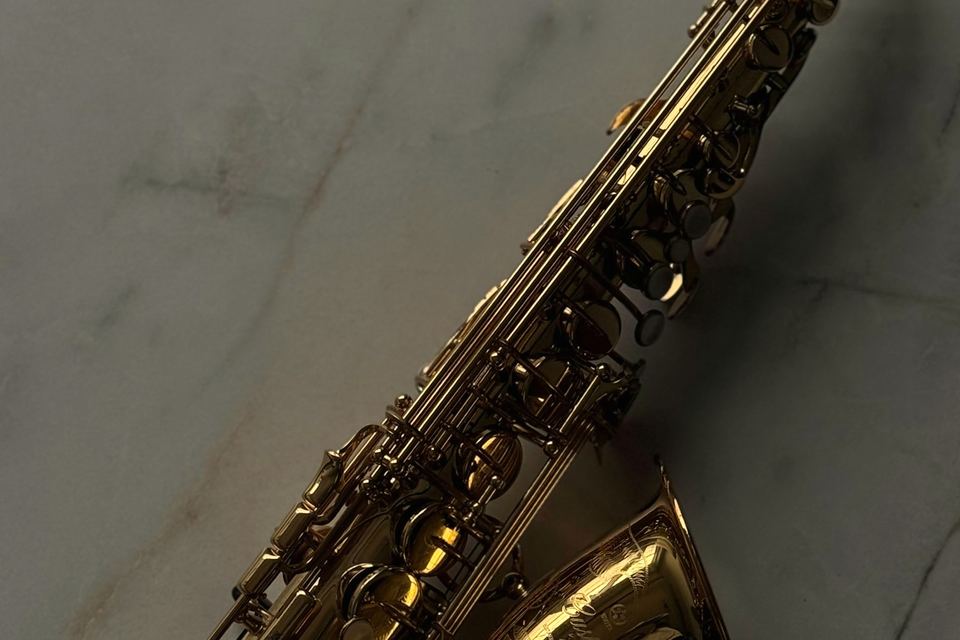
The body and the key cups are made of sheet brass, which can be shaped into complex forms. Most saxophones are finished with clear lacquer. Some are plated with silver or gold. Rods and springs are usually steel, and the buttons under the fingers are plastic or, traditionally, mother of pearl. Felt and cork buffers quiet the keys as they move. Leather pads on the keys close the tone holes.
Alto and larger saxophones have a detachable curved neck and a U-shaped bend, called the bow, that turns the tube up toward the bell. The soprano is usually straight. The baritone and the larger sizes have extra loops to hold their long tubes. The lowest note on most modern saxophones is the written B♭ below middle C. Most baritones also have a key for low A.
The reed is a thin blade of cane. Most saxophonists use cane from the giant reed, Arundo donax, and some players use reeds of synthetic material. A band called the ligature holds the reed against the mouthpiece. Mouthpieces are made of hard rubber, plastic or metal. Saxophones of different sizes use mouthpieces and reeds of matching sizes.
How the saxophone is played
The player blows into the mouthpiece, and the reed vibrates against it. The fingers press the keys, which change the length of the air column inside. An octave key raises the lower notes by an octave. All saxophones share the same fingerings, so a player can move from one size to another.
Saxophone music is written in the treble clef. The saxophone is a transposing instrument, which means that a written note sounds at another pitch. On the alto, a written C sounds as the E♭ a major sixth below. On the tenor, it sounds as the B♭ a major ninth below.
The tongue starts a note by touching the reed and releasing it. Jazz players also shape notes with bends, growls and a breathy edge to the tone. The notes above the normal range are called the altissimo register. They need special fingerings and careful control of the lips and the breath. Some players also sound two or more notes at once. These sounds are called multiphonics.
What makes a fine saxophone
A saxophone maker places and sizes the tone holes so that the notes sound in tune with one another. The bore and the neck shape the tone and the way the notes respond. A good instrument lets the player move from the lowest note to the top of the range without a weak or stuffy note.
The keywork must work smoothly and quietly. The pads must close fully, because a small leak makes the low notes hard to play. A repair technician adjusts the pads, the springs and the corks in a setup. A worn saxophone often plays well again after new pads.
The mouthpiece changes the tone a great deal. Its inner shape can make the sound darker or brighter, and players often choose a different mouthpiece for classical music and for jazz. Opinions differ on how much the metal and the finish of the body change the sound.
Adolphe Sax built the first saxophones in his Paris workshop. Later makers include Selmer and Buffet Crampon in France and the American firms of Conn, Buescher, Martin and King.
Choosing a saxophone
The alto and the tenor are the usual sizes for a first saxophone. Because the fingerings are the same on all sizes, a player can change size later. Many young players begin on the alto, which is lighter and smaller.
Reeds differ in hardness. Players try several to find one that suits the mouthpiece and the way they blow. Check that the pads close fully and that the keys move freely. Ask a teacher or a repair technician to play-test a used saxophone before you buy it. Keep a neck strap and a case with the instrument.
Who keeps these instruments
Adolphe Sax was born in Dinant. A small museum there, called the Maison de Monsieur Sax, stands in the street that bears his name. In Brussels, where Sax began his career, the Musical Instruments Museum shows the history of instrument making in Belgium. Its collection of close to ten thousand instruments includes his work.
The Metropolitan Museum of Art in New York keeps saxophones that Sax made in his Paris workshop, among them an alto and a soprano. It also keeps saxhorns and a saxtuba that he built. The National Music Museum in Vermillion, South Dakota, holds two large saxophone collections and their archives.
Some museums keep saxophones because of the musicians who played them. The National Museum of African American History and Culture in Washington keeps an alto saxophone that the firm of King made for Charlie Parker. He played it for the rest of his life.
First steps on the saxophone
Wet the reed, and fix it on the mouthpiece with the ligature. Fit the mouthpiece on the neck, and the neck on the body.
Rest the top teeth on the mouthpiece, and fold the lower lip over the bottom teeth. Blow a steady stream of air, and hold one note for as long as it stays even.
Then use the left hand. The first finger alone plays B. The first two fingers play A, and the first three play G. The saxophone sounds lower than the written note, so the tuner shows another letter. On the alto, written B shows as D, A shows as C and G shows as B♭. Hold the notes, and keep the pitch steady on the tuner.
A short check
Choose one answer per question. The explanation appears below the correct answer.
What makes the sound of a saxophone?
The reed vibrates against the mouthpiece. That is why the saxophone counts as a woodwind, although its body is brass.
What does the octave key do?
With the octave key pressed, the same fingering sounds an octave higher.
On an alto saxophone, which note sounds when a C is written?
The alto is pitched in E♭. A written C sounds as the E♭ a major sixth below.
Which saxophones make up a saxophone quartet?
The classical saxophone quartet has a soprano, an alto, a tenor and a baritone saxophone.
Sources
- Wikipedia: Saxophone
- Wikipedia: Adolphe Sax
- Internet Archive: Saxophobia, a Victor disc from the National Jukebox
- Library of Congress: National Jukebox
- The Met: alto saxophone by Adolphe Sax
- Wikipedia: Musical Instruments Museum, Brussels
- Wikipedia: National Music Museum
- Wikipedia: National Museum of African American History and Culture
Common questions
Is the saxophone a brass instrument?
No. Its body is brass, but its sound comes from a reed. Instruments that sound with a reed or with air across an edge are woodwinds.
Which saxophone should a beginner learn?
Many players begin on the alto or the tenor. The fingerings carry over to all sizes, so the first choice does not lock a player in.
Is the saxophone hard to learn?
A steady tone comes first, and it depends on the lips and the breath. Next come B, A and G with the left hand. Many beginners play a simple tune within their first weeks.
What is the difference between a saxophone and a clarinet?
Both use a single reed. The saxophone has a conical brass body and rises by an octave when overblown. The clarinet rises by a twelfth.
Who invented the saxophone?
The Belgian instrument maker Adolphe Sax designed it while he worked in Paris. He had also improved the bass clarinet.
Why is saxophone music written in another key?
The sizes sound at different pitches, but all share one fingering. Writing the music transposed lets a player read the same fingering on any size.
What is the lowest note of a saxophone?
Most saxophones reach the written B♭ below middle C. Most baritone saxophones have an extra key that reaches the A below it.