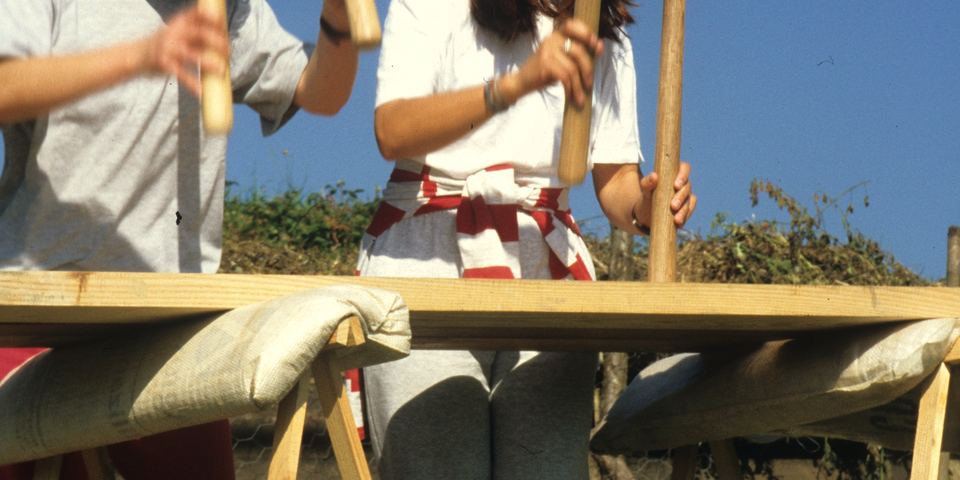
The txalaparta
The txalaparta is a percussion instrument of the Basque Country. Wooden boards lie across two trestles. The instrument needs two players. They stand on opposite sides and strike the boards with thick upright sticks. They take turns, so a new stroke always answers the last. The rhythm comes from the exchange between the two players.
The sound of the txalaparta
In this recording, two players strike the boards. It comes from a public event in Santurtzi in the Basque Country.
Listen for the alternation. The first player strikes, and the second answers.
Names of the txalaparta
The name is said “cha-LA-par-ta.” In some Basque regions the word zalaparta means a racket or a din. In Navarre, txalaparta once meant the trot of a horse. The sticks are called makilak, and the players are called txalapartariak.
Where the txalaparta is played
The txalaparta belongs to the Basque Country, which lies on both sides of the border between Spain and France. A festival in the town of Hernani is devoted to it.
The role of the txalaparta in music
In the farms of the Basque Country, the txalaparta once worked as a signal. After the apples for cider were pressed, people struck the board of the cider press to call the neighbors. A celebration followed, and the txalaparta played while the cider was drunk.
It also marked funerals and other shared tasks. Today it is a concert instrument of Basque music.
Music for the txalaparta
The players have two sticks apiece and may strike twice, once or not at all in a turn. A turn with no stroke is a rest called hutsunea.
The two players have different roles. The ttakuna player keeps an even pattern of two strokes per turn. The herrena player breaks the pattern or twists it. Herrena means limping. Many performances open with a traditional phrase called Sagardo deia. The name means the cider call.
How the txalaparta is made
The old txalaparta used long boards from the cider press. They rested on two supports, and corn husks lay between the boards and the supports so that the wood could ring.
Modern boards are shorter, at most about one and a half meters. They lie on trestles padded with foam and cloth. Makers use alder, chestnut, cherry and hardwoods such as iroko and sapele. Some groups add boards of stone or metal tubes.
How the txalaparta is played
The players hold a stick upright in either hand and drop the sticks onto the board. Different spots of the wood and its knots give different tones.
The two players agree only on the main pattern before they begin. The rest is made up as they play, so the players must listen closely to one another.
How the txalaparta has changed
By the middle of the twentieth century only a few pairs of farmers still played the txalaparta. Folklorists then revived it. Players began to tune boards to notes, and some groups now play melodies on it. Others keep it a rhythm instrument.
Choosing a txalaparta
Boards of dense hardwood, such as iroko or sapele, are the usual modern choice. Shorter boards and light sticks are easier to handle.
Learn with a partner from the start. The txalaparta is an instrument for two.
First steps on the txalaparta
Stand across the boards from your partner. Hold a stick upright in your left hand and another in your right. Drop the sticks onto the board one after the other, and let them bounce.
Next, set the metronome to a slow tempo. Your partner plays two strokes on one beat, and you answer with two strokes on the next. This even exchange is the ttakuna pattern.
Then try the herrena. Leave out one stroke, or add one in an unexpected place. Your partner keeps the ttakuna and listens for the change.
A short check
Choose one answer per question. The explanation appears below the correct answer.
How many players does a traditional txalaparta need?
The two players stand on opposite sides of the boards. They strike in turn, and the music comes from their exchange.
What does the ttakuna player do?
The ttakuna keeps the balance with two strokes. The herrena breaks or twists the pattern.
Which work was the txalaparta tied to in Basque farm life?
After the apples were pressed, people struck the board of the cider press to call the neighbors to a celebration.
Sources
Common questions
What is the txalaparta made of?
It is made of wooden boards laid across trestles and struck with wooden sticks. Some modern sets add stone or metal.
Can one person play the txalaparta?
Its music is built on two players who answer one another. A single person can practice strokes alone, but the real music needs a partner.
Where does the txalaparta come from?
It comes from the Basque Country of northern Spain and southwestern France. It grew out of farm work, especially the making of cider.
Does the txalaparta play melodies?
Traditionally it plays rhythm only. Some modern players tune the boards to notes and play melodies.
What are ttakuna and herrena?
They are the two roles of the players. The ttakuna keeps the balance, and the herrena breaks it.
Is the txalaparta similar to any other instrument?
The Romanian toacă and the Greek semantron are also boards struck with sticks. They call people to prayer.
World MusicTaikoXylophonePolyrhythmMetronome