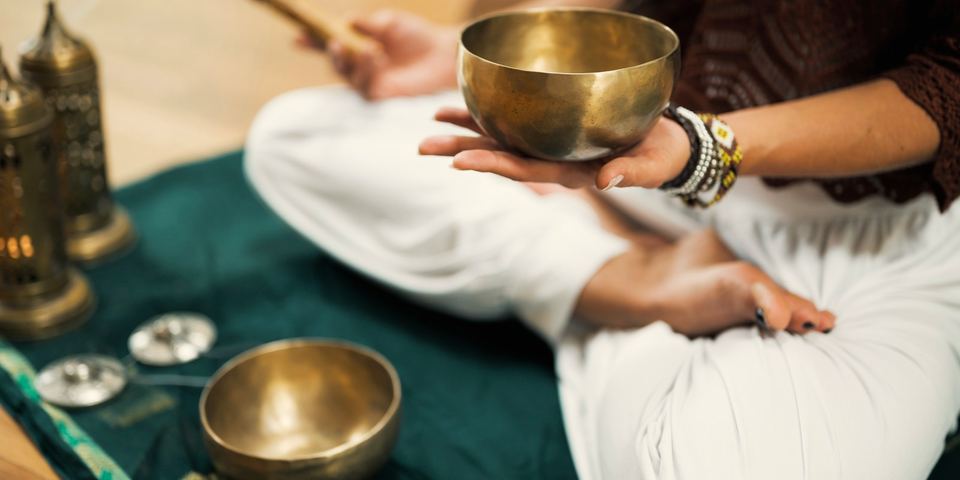
The singing bowl
A singing bowl is a standing bell. It rests on a cushion with its open rim upward. The player strikes it with a padded beater, or rubs a wooden stick around the rim to draw out a long tone. Standing bells began in China and are struck in Buddhist temples across East Asia. Making them sing is a modern practice.
Singing bowls ring over drones in this piece. In a long hum, listen for a gentle wavering.
Music: Envato (PremiumBeat)
Listening to singing bowls
Listen to one struck note from start to end. A short, bright attack comes first. A long hum follows and slowly fades. Inside the hum you may hear a gentle wavering. No bowl is perfectly round, so a bowl sounds two tones that lie close together in pitch. They beat against one another, and the beat makes the wavering.
A rubbed bowl gives a different sound. Its tone holds steady and does not fade, because the stick grips the rim and slips again and again. Notice how the size of a bowl sets its pitch. Large bowls give the low tones and ring the longest. Small bowls give the high tones, and their sound starts quickly.
Names of the singing bowl
In Japan a standing bell of this kind is the rin (りん) or the kin (磬). A large temple bowl may be a daikin. In Chinese temples the same kind of bell is the qing, which is also written 磬. In the ancient Chinese court that word meant a stone chime. The earliest Chinese standing bells are the nao (鐃).
In English the bowls carry many names. They include standing bell, resting bell, Himalayan bowl and Tibetan singing bowl. Concert scores often call them temple bells or Japanese temple bells.
History of the singing bowl
Standing bells began in China. The nao of the Shang dynasty, more than three thousand years ago, stood on a hollow stem with its rim upward. Players struck it on the outside with a mallet. Some nao were made to give two different tones when struck at two different points. Later, with the spread of Buddhism, temples across East Asia cast bells for their rituals.
The use of bowls for their long, rubbed tone is recent. Visitors who wrote about the music of Tibet in the early twentieth century did not mention singing bowls. Bowls that could sing reached Western buyers in the late twentieth century.
Recordings in the calm style called new-age music then made the bowls famous in America and Europe. These recordings were often sold as Tibetan music. Many bowls sold as Tibetan are made in workshops in the Himalayan region and in northern India for this new market.
Bowls in Buddhist temples
In the Buddhist temples of China and Japan, a struck bowl marks the chanting of prayers. In a Chinese temple the qing is a bowl of hammered bronze about ten to fifteen centimeters across. It often sounds with a wooden fish drum called the muyu. In Japanese temples the rin sounds beside a small hand bell and other percussion. Many Japanese homes keep a small rin at the family altar. In Buddhist ritual these bells are struck. They are not rubbed.
Bowls in concert music
Composers write for standing bells in concert music. John Cage and Lou Harrison called for them in Double Music, which is a piece for four percussionists. John Tavener used them in Total Eclipse. Kabuki theater in Japan also uses struck bowls.
Percussion sections keep sets of tuned bowls for concert scores. Players today also build slow pieces from many bowls. They let the bowls ring into one another.
How a singing bowl works
A singing bowl is a bell. A bell vibrates most at its open rim, and a gong vibrates most near its center. When the bowl is struck, the rim bends in and out in four sections. A pair of opposite sections moves outward while the other pair moves inward. Higher patterns with more sections add the overtones.
When the player rubs the rim, the stick grips the metal, pulls it a little and slips. This happens again and again at the rate of the bowl's own tone, so the bowl keeps sounding. A violin bow works on a string in the same way, and so does a wet finger on the rim of a glass. A faster stroke or a firmer press makes the tone louder. Too much speed makes the stick rattle against the rim.
Water in the bowl lowers its pitch, and some players tune bowls in this way. A Chinese spouting bowl has two handles. When the player rubs the handles with damp hands, the water inside forms a pattern of waves that stays in place. Drops of water spray up from the surface.
The stick is usually wood. Shops often call it a puja. The word comes from the Sanskrit word for worship. A cover of suede or felt gives a softer and rounder tone, and bare wood gives a brighter one.
How the singing bowl is played
Place the bowl on a soft cushion or a ring, so the rim can vibrate freely. A small bowl can rest on the flat palm of the hand. Do not hold it by the rim, because the fingers stop the sound.
To strike the bowl, tap the outer wall a little below the rim with a padded beater. To make the bowl sing, first strike it gently. Then press the stick against the outer rim and circle the bowl slowly with even pressure. Keep the stick upright and move the whole arm. The tone grows over a few turns. If the stick rattles, slow down.
What makes a fine singing bowl
The best bowls are hammered from bronze by hand, or cast and then turned on a lathe. Hand hammering leaves a field of small marks on the surface. Bowls made for their sound have thick rims and a carefully shaped wall.
A thick, even rim lets the bowl sing easily and keeps the tone steady. A thin or uneven rim gives a weak tone or a strong wavering. The wall should thin gradually from the rim to the base and have no weak spots.
Listen for a long ring after a single stroke. A good bowl sounds for a long time and fades slowly and evenly. Its main tone should be clear, and its overtones should blend with it. The rubbed tone should rise smoothly and stay steady without rattling.
Choosing a singing bowl
Play several bowls before you choose one. Strike the bowls softly one at a time and listen to the length of the ring. Then try to make it sing with the stick that comes with it.
For a first bowl, choose a medium size that sings easily under your hand. For a set, choose bowls whose notes sit well together. Use a tuner to find the main note of a bowl.
Who keeps these instruments
The ancient standing bells of China are held in museums. The Metropolitan Museum of Art in New York holds a nao, which is an upright bell of the Shang dynasty. It was cast more than three thousand years ago. The Met also holds bronze bells of the Zhou dynasty. Bells of that time hung in tuned sets, and musicians played melodies on them at court rituals.
Buddhist temples still use standing bells. Temples in China and Japan sound the qing, the rin and the kin at their services. Foundries and workshops in East Asia still cast and hammer bronze bells for temples and homes.
First steps on the singing bowl
A single bowl of medium size is enough at first. Strike it once and listen until the sound is gone. Notice how long it rings. Then practice the rubbed tone. Strike gently, press the stick to the rim and circle slowly. Keep the speed and the pressure even.
When the tone holds steady, find its pitch with the tuner. Then sing that pitch softly against the bowl. Matching a long tone in this way trains the ear and the voice to stay on one pitch.
A short check
Choose one answer per question.
What kind of instrument is a singing bowl?
A singing bowl is a bell that rests with its rim upward. Like other bells, it vibrates most strongly at its rim.
How does a stick make a bowl sing?
The stick grips the rim, pulls it a little and slips. This repeats at the rate of the bowl's own tone, so the sound does not fade.
Which use of the bowls is modern?
Temples have struck standing bells for many centuries. Rubbing the rim for a singing tone is a modern use.
Sources
Common questions
What is a singing bowl?
It is a standing bell that rests with its rim upward. It sounds when it is struck, or when a stick is rubbed around its rim.
Are singing bowls Tibetan?
The link is doubtful. Early accounts of Tibetan music do not mention them, and many bowls sold as Tibetan are made for the modern market.
How do you make a singing bowl sing?
Strike it gently. Then circle the outer rim with the stick at a slow and even speed, and keep the pressure steady.
Why does my singing bowl rattle?
You are moving the stick too fast or pressing too lightly. Slow down, press a little more firmly and use a covered stick.
What are singing bowls made of?
Most are made of bronze, which is mainly copper with tin. Some are hammered by hand, and others are cast and turned.
Can I tune a singing bowl?
A bowl has a fixed main note. Adding water lowers the pitch a little, so players choose bowls by their notes.
World MusicTibetan musicGongTuner