The tambourine
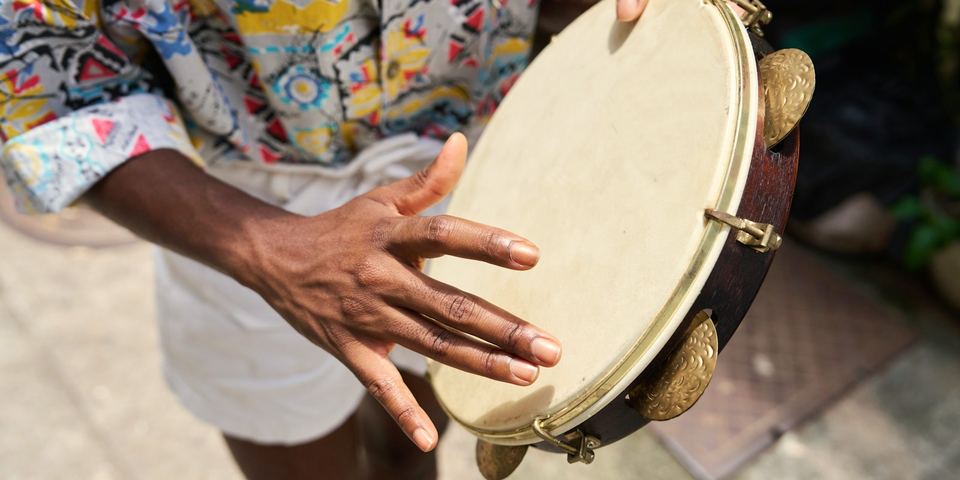
The tambourine is a frame drum with pairs of small metal jingles set into its frame. A classic tambourine has a drumhead on one side. Some tambourines have no head at all. The player holds it in one hand and strikes it with the other, or shakes it. It is heard in folk music, gospel, orchestras and rock bands.
This piece is a tarantella. The tarantella is a fast dance in six-eight time from southern Italy. Listen for the jingles of the tambourine under the mandolin and the accordion.
Music: Envato (99Instrumentals)
The sound of the tambourine
The first button below plays a steady rhythm with four beats to a bar. On a tambourine with a head, the strokes have two layers of sound. The head gives a short, dry thud. The jingles add a bright ring that lasts a moment longer. A stroke near the rim brings out the jingles. A stroke near the center brings out more of the head.
The roll is a long and unbroken sound of the jingles. The shake comes from one quick turn of the hand. In the single stroke, listen to how quickly the ring of the jingles fades. An orchestral player chooses among these sounds passage by passage. A soft roll gives a shimmer under the strings. A sharp stroke marks an accent in a dance.
Names of the tambourine
The English word comes from the French tambourin. In Provence, the tambourin was a long, narrow drum. Its name comes from tambour, which is the French word for drum. Orchestral scores use the names of their own languages. Italian scores write tamburello or tamburo basco. French scores write tambour de basque, which means Basque drum. In German scores the instrument is the Schellentrommel, which means jingle drum.
Frame drums with jingles have their own names across the world. The riq (رق) of Arabic music is a small tambourine with a thin head of fish or goat skin. The Persian daf (دف) is a larger frame drum with jingles. Brazil has the pandeiro, and South India has the kanjira (கஞ்சிரா). The kanjira has one pair of jingles, and its head was traditionally made of lizard skin. In the Hebrew Bible the frame drum is the tof (תוף), which English Bibles translate as timbrel.
History of the tambourine
Frame drums are among the oldest instruments known. Musicians in ancient Egypt and the ancient Near East played them, and from there they reached Greece and later the rest of Europe. Egyptian amulets show the household god Bes beating a tambourine. In the Hebrew Bible, Miriam leads the women with timbrels and dancing after the crossing of the Red Sea. In ancient Israel and its neighbors, the frame drum was played above all by women.
In ancient Greece and Rome the frame drum was called the tympanon. Worshippers of Dionysus and of the goddess Cybele beat it in their rites. In Greek art it is often held by a maenad, a female follower of Dionysus. Frame drums with jingles later reached medieval Europe through the Islamic world.
In southern Europe the tambourine became an instrument of dance. In southern Italy the tamburello plays the fast rhythm of the tarantella. The pizzica of Apulia belongs to the same family of dances. In Spain the small pandereta accompanies folk songs and dances. The Romani people of Europe also made the tambourine part of their music, and they passed it around the audience to collect money.
Late in the eighteenth century the tambourine became fashionable in England. Composers of salon music wrote parts for it with many different strokes, and some frames had a hole for the thumb. Orchestral composers took it up at about the same time, and Mozart was among the first. In the nineteenth century the Salvation Army made it one of its main rhythm instruments. It used the biblical name timbrel.
In the United States, enslaved African Americans were denied drums. They turned to smaller instruments such as the tambourine and the bones to accompany spirituals and dancing. Revival meetings brought the tambourine into Pentecostal worship early in the twentieth century. Within a few decades it was the main percussion instrument of gospel music. From gospel it moved into blues, jazz, rhythm and blues, and pop.
Music for the tambourine
Orchestral composers use the tambourine for color and for the rhythm of dances. They often use it in music that portrays Spain or Italy. Bizet used it in the opera Carmen, and the Habanera has a tambourine stroke in all its choruses. Rimsky-Korsakov used it in his Capriccio espagnol. Dvořák gave it a part in his Carnival Overture. There it plays beside the triangle and the cymbals.
Tchaikovsky used it in dances of The Nutcracker, and Holst used it in the Jupiter movement of The Planets. In the orchestra the percussion section plays it. A percussionist often moves between the tambourine, the triangle and the cymbals within one piece.
In folk and popular music the tambourine keeps a steady pulse. In the tarantella it plays with mandolins, guitars and accordions. In gospel churches the singers themselves shake it, and it carries the rhythm of the congregation. Rock and pop drummers often mount a headless tambourine on the drum kit. Singers who play no other instrument often hold one on stage.
How the tambourine is made
A tambourine has a frame and a set of jingles. Most tambourines also have a head. The frame, also called the shell, is a narrow hoop of wood or plastic. The maker bends a thin strip of wood into a circle to make a wooden frame. The two ends overlap in a long, slanted joint called a scarf joint, and the maker glues them together. Slots cut through the frame hold the jingles.
The jingles are small discs of metal. They sit in pairs on pins that cross the slots. The two discs of a pair strike one another when the frame moves. Some tambourines have one row of jingles, and others have two rows for a fuller sound. The jingles are also called zills. The name comes from zil, which is the Turkish word for a small cymbal.
The head is a thin membrane stretched over one side of the frame. Traditional heads are calfskin or goatskin. The maker tacks or glues the head to the frame. Many modern tambourines have a plastic head, which does not change with the weather. Some tambourines have tuning screws around the rim like a drum. A headless tambourine, or jingle ring, has only the frame and the jingles.
How the tambourine is played
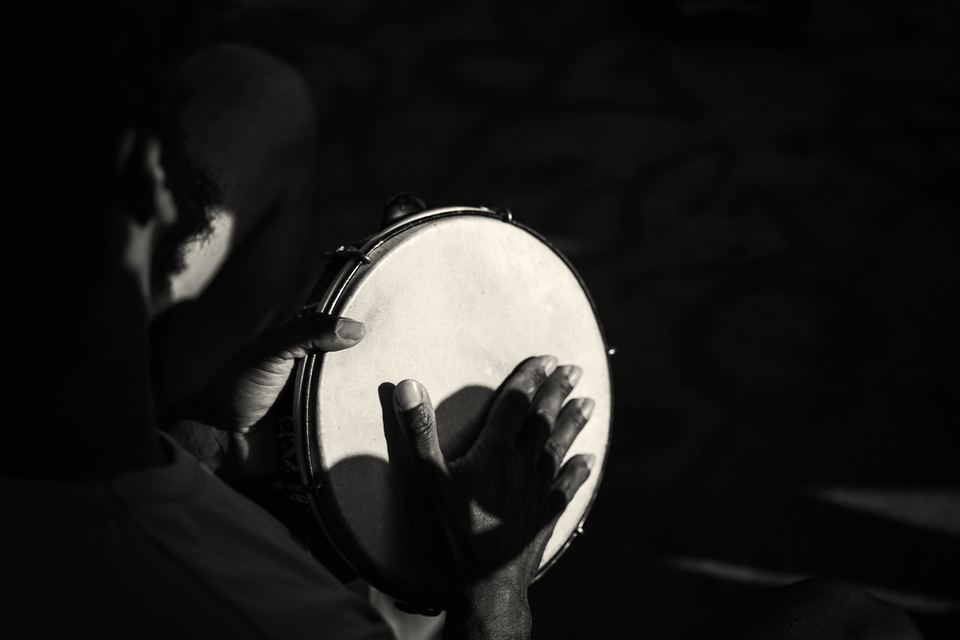
Hold the tambourine by the frame in one hand. Strike the head with the fingers or the heel of the other hand, or with a stick. You can also shake it, or strike it against the leg or the hip. A stroke with the fingertips near the rim gives a light, crisp sound. A stroke with the flat of the fingers near the center gives a fuller sound with more of the head.
For a roll, rotate the hand that holds the tambourine quickly back and forth at the wrist. In a thumb roll, the thumb runs around the head near the rim and bounces as it goes. Players put a little beeswax or rosin on the thumb so that it grips the head. Moving the thumb in a figure eight keeps the roll going for a long note. A stroke with the heel of the hand often ends the roll.
What makes a fine tambourine
The metal of the jingles does much to shape the sound. Makers use several alloys. German silver, an alloy of copper, nickel and zinc, gives a bright tone with a long ring. Phosphor bronze gives a darker tone that rings even longer. Beryllium copper gives a dark tone with a shorter ring. Some tambourines mix two metals in their rows to blend these colors.
Orchestral players often keep several tambourines and choose one to suit the piece. A bright tambourine cuts through a loud orchestra. A dark one blends with the strings in a quiet dance. Many orchestral tambourines have two rows of jingles and a calfskin head. Calfskin gives a warm, natural stroke. It slackens in damp air, so players keep it away from humidity.
The frame must be round and strong enough to hold the jingles without flexing. The jingles should move freely on their pins without rattling against the slots. Their edges should be smooth, so the instrument is safe to hold. A fine tambourine sounds even all the way around the rim, and its roll starts at the lightest touch.
Choosing a tambourine
A tambourine with a head can be struck as well as shaken. A headless tambourine sounds only through its jingles, and it is the kind most often used in pop music. For a school or a church group, a tambourine with a head and one or two rows of jingles is a good first choice.
Before you buy, check that the jingles move freely in their slots and that the head is tight. Shake the tambourine. Then strike it near the rim and near the center. Listen for a clear, even ring with no buzz from a loose jingle. A plain wooden frame and a natural head give the warmest sound.
Who keeps these instruments
Museums keep tambourines and frame drums from many centuries. The Metropolitan Museum of Art in New York holds ancient Egyptian amulets that show the god Bes with a tambourine. Its musical instrument collection includes a riq from Egypt made of wood, ivory and mother-of-pearl, and a Spanish pandereta. It also keeps American tambourines with calfskin heads from the nineteenth century.
Percussion students at conservatories learn the orchestral strokes and rolls beside the timpani and the snare drum. In southern Italy, folk musicians teach the tamburello and its dance rhythms to their children. In gospel churches, the tambourine still keeps time for the choir.
First steps on the tambourine
Start with a steady beat. Hold the tambourine in your weaker hand, and tap the head with the fingers of the other hand on the beat. Keep the wrist of the holding hand loose, so the jingles ring freely.
Set the metronome to a slow tempo with four beats to a bar. Tap on the beat. Then tap only on beats two and four, and shake the tambourine on beat one. When this feels easy, end the groups of four bars with a short roll.
A short check
Choose one answer per question.
What are the small metal discs of a tambourine called?
The jingles, also called zills, sit in pairs in slots cut into the frame.
What is a headless tambourine?
A headless tambourine, or jingle ring, has only the frame and the jingles.
Which movement gives a simple roll?
A quick turn of the wrist back and forth keeps the jingles sounding.
Where were frame drums with jingles first played?
They were played in ancient Egypt and the ancient Near East. Later they reached Greece and the rest of Europe.
Sources
- Wikipedia: Tambourine
- Encyclopaedia Britannica, eleventh edition: Tambourine
- Wikipedia: Timbrel
- Wikipedia: Tympanum (hand drum)
- Wikipedia: Daf and riq
- Wikipedia: Kanjira
- Wikipedia: Tarantella
- Metropolitan Museum of Art: riq from Egypt
- Metropolitan Museum of Art: amulet of Bes with a tambourine
- Black Swamp Percussion: tambourine jingle metals
Common questions
How do you play a tambourine?
Hold it by the frame in your weaker hand. Tap the head on the beat with the other hand, and shake the tambourine for a longer sound.
What are the metal discs on a tambourine called?
They are jingles, also called zills. They are thin metal discs set in pairs in slots cut through the frame.
Is a tambourine a drum?
A tambourine with a head is a frame drum with jingles. A headless tambourine has no drumhead, so you hear only its jingles.
What is a tambourine roll?
A roll is an unbroken sound of the jingles. Players make it by turning the wrist quickly or by running the thumb around the head.
What is the riq?
The riq is a small tambourine of Arabic music. It is used in both folk and classical music across the Arabic-speaking world.
Which classical pieces use the tambourine?
Tchaikovsky used it in dances of the Nutcracker. Bizet used it in the Habanera from Carmen, and Holst in the Jupiter movement of The Planets.
What is a timbrel?
Timbrel is the word English Bibles use for the tof, the frame drum of ancient Israel. The Salvation Army also calls its tambourines timbrels.
What are tambourine jingles made of?
Most are brass, German silver, phosphor bronze or beryllium copper. German silver sounds bright, and the bronze and copper alloys sound darker.