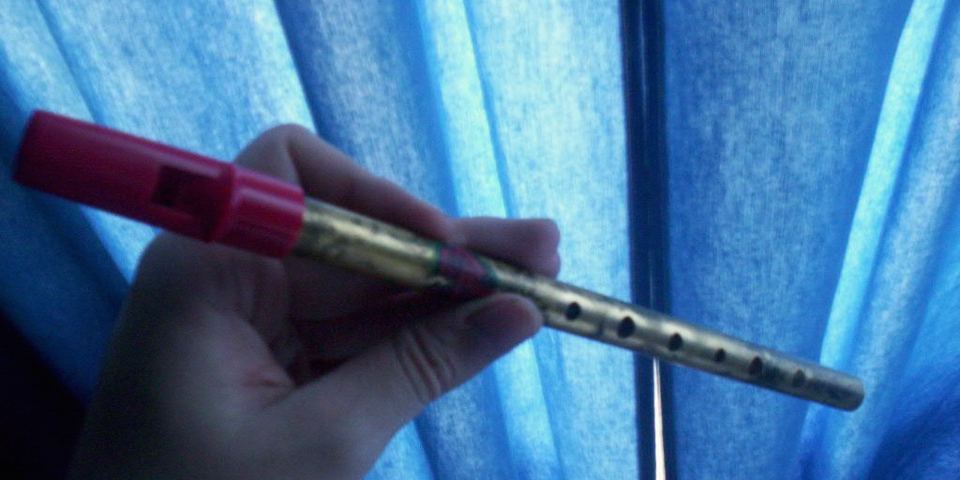
The penny whistle
The penny whistle, also called the tin whistle, is a simple woodwind with six finger holes. It is a fipple flute: a block in the mouthpiece aims the breath at an edge. The most common whistle is in D, and its lowest note is the second D above middle C. It is a main melody instrument of Irish traditional music.
A low whistle plays this solo melody. The low whistle is a larger kind of tin whistle that sounds an octave lower. Compare its deep tone with the higher whistles in the recordings below.
Music: Envato (Orchestralis)
The sound of the penny whistle
An Irish jig called Trip to the Cottage comes first. A jig is a lively dance tune in compound meter, so the beats divide into three quick notes.
Short melodies on different whistles follow. The first whistle is all plastic and pitched in E♭. The second is a metal whistle in D with a plastic mouthpiece. The third is a cone of rolled metal with a wooden block, and its tone is breathier.
The final button gives the scale of a D whistle on a recorded grand piano. Its notes are D, E, F♯, G, A, B and C♯. The high D sits at the top.
Names of the tin whistle
Tin whistle and penny whistle are two names for one instrument. It is also called the Irish whistle, and in Irish the feadóg stáin. A person who plays it is a whistler.
The name penny whistle comes from the price. In the nineteenth century a whistle could be bought for a penny.
Where the tin whistle is played
Fipple flutes are ancient, and they appear in many cultures. The modern tin whistle comes from England, where a factory in Manchester made it in large numbers in the nineteenth century.
The whistle became part of the traditional music of England, Scotland, Ireland and the United States. In South Africa it led the street music called kwela. It also plays in the tuk bands of Barbados.
The role of the tin whistle in music
In Irish traditional music the whistle plays dance tunes, such as jigs and reels, and slow airs. It usually plays the melody. Other instruments often play with it.
It is also a common first instrument. Its fingering is close to that of the Irish flute and the uilleann pipes, so many pipers begin on the whistle.
Music for the tin whistle
Most of the repertoire is Irish dance music. A jig divides the beats into three, and a reel moves in even pairs of notes.
Film music uses the whistle as well. It plays in the scores of the Lord of the Rings films, and a whistle solo opens the love song of the film Titanic.
How the tin whistle is made
Most whistles today have a brass or nickel-plated brass tube and a plastic mouthpiece that holds the fipple. Others are made entirely of plastic, of metal or of wood.
An older design rolls a sheet of metal into a cone and fits a wooden block into the wide end. Its tone is airier than the clear tone of a cylindrical whistle.
How the tin whistle is played
The left hand covers the top three holes, and the right hand covers the bottom three. With all six holes closed the whistle plays its lowest note. Lifting the fingers one at a time from the bottom plays the scale upward.
A slightly stronger breath lifts the same fingerings into the second octave, and the usual range is two octaves. Players decorate the tune with ornaments. A cut is a quick lift of a finger from a hole above the note you are playing. The extra note is so short that it sounds like an accent. A strike is a quick tap of a finger on an open hole below the note. A roll joins a cut and a strike.
How the tin whistle has changed
Old whistles often had mouthpieces of lead, which is poisonous. Modern whistles use plastic. In the early nineteen-seventies, a flute maker in England built the first modern low whistle for an Irish musician. It is larger than the usual whistle and sounds an octave lower.
Small workshops now make whistles by hand. The maker shapes the duct and the edge of a whistle to set its tone.
Choosing a tin whistle
Begin with a whistle in D. It is the most common key, and it suits most Irish and Scottish tunes.
Some cheap whistles sound airy, and their second octave is hard to play in tune. Before you buy, check that the high notes sound clearly and in tune.
First steps on the whistle
Hold the whistle with the left hand above the right. Cover the holes with the flat pads of the fingers, so that no air escapes.
Blow gently. Too much breath makes a low note jump to the upper octave. Play the scale of D slowly from the lowest note upward, and check all the notes with the tuner.
Then learn a slow tune by ear. Add cuts and strikes once the tune flows evenly.
A short check
Choose one answer per question. The explanation appears below the correct answer.
What is a fipple?
The fipple leaves a narrow duct. The breath passes through it and strikes the sharp edge of the window.
Which note does a D whistle play with all six holes covered?
With all holes closed the whistle plays its lowest note. That note, D, gives the D whistle its name.
How does a whistler reach the second octave?
A faster breath lifts the same fingerings into the second octave.
What is a cut?
In a cut the player lifts a finger from a hole above the sounding note. The lift is so brief that it is not heard as a separate note.
Sources
Common questions
Is the penny whistle the same as the tin whistle?
Yes. Both names describe the same six-hole fipple flute. Irish players also call it the feadóg.
What is the difference between a tin whistle and a recorder?
Both are fipple flutes. The recorder has a thumb hole and seven finger holes, so it plays sharps and flats more easily. The whistle has six holes and no thumb hole.
Which whistle should a beginner buy?
A whistle in D is the usual first choice. Irish tunes are mostly played on it, and most tutor books are written for it.
Is the tin whistle easy to learn?
It is one of the easiest wind instruments to start, because the mouthpiece shapes the air. The ornaments and the second octave take longer to learn.
Can a D whistle play sharps and flats?
Yes, it can play some of them. The player covers half of a hole or uses a cross-fingering, which closes a hole below an open one. On a D whistle a cross-fingering gives C natural, which opens the key of G.
What is a low whistle?
It is a larger, wider whistle that sounds an octave lower. Its holes are far apart, so many players cover them with the flat middle of the fingers.