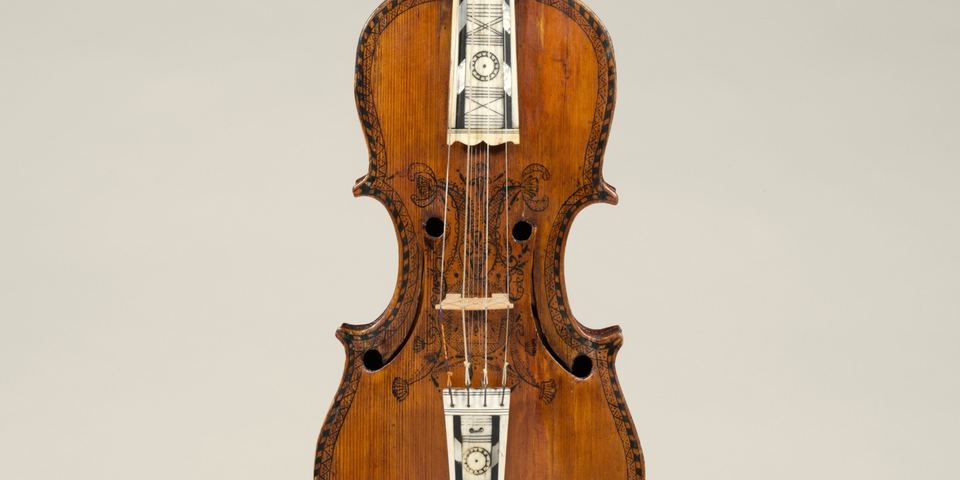
The Hardanger fiddle
The Hardanger fiddle is a folk fiddle of Norway. In Norwegian it is the hardingfele. It looks like a violin with four or five extra strings beneath the fingerboard. These strings are never bowed. They vibrate by themselves when the bowed strings sound their notes. They are called sympathetic strings, and they give the fiddle a soft halo of sound.
A fiddler plays The Dairymaids on Vikafjell. It is a slått, which is a solo folk tune.
Listening to the Hardanger fiddle
The fiddler bows two strings together almost all the time. The melody moves on one string, and an open string beside it sounds a drone. A drone is a steady note held beside the melody. Behind both, the sympathetic strings add a soft ring that lingers after the notes.
A slått repeats short phrases and changes them a little whenever they return. Fiddlers often stamp a foot to mark the beat. The second recording is a springar from Voss. The springar is a dance in three beats. In many springar tunes the three beats are of unequal length, and the valleys of Norway have their own patterns.
Names of the Hardanger fiddle
In Norwegian the instrument is the hardingfele, the fiddle of Hardanger. Hardanger is a fjord district of western Norway. Players also call it the harding. An ordinary violin is called the flatfele, which means flat fiddle. It is also called the vanlig fele, which means common fiddle.
A solo tune for the fiddle is a slått, and the plural is slåttar. Many slåttar are dances. The springar and the gangar are two of them. The halling is a showy solo dance with leaps and kicks. A lydarslått is a listening tune. It is played for an audience that sits and listens.
History of the Hardanger fiddle
The oldest known Hardanger fiddle was made in Hardanger in the seventeenth century, and it is kept in Bergen. Early fiddles had a rounder, narrower body. In the nineteenth century the body grew to the shape and size of the violin.
Some religious revivals of the nineteenth century treated the fiddle as a sinful instrument of dancing and drinking. Many fiddles were burned or hidden. For a long time the fiddle was not played in churches. Fiddlers kept the tunes alive in the valleys. Folk tales said that the best fiddlers learned from the devil or from the water spirit called the nix.
In the same century Norwegians sought a national culture, and the fiddle became a symbol of the country. The violinist Ole Bull brought the fiddler Myllarguten to concerts in Christiania, which is the old name of Oslo. Edvard Grieg arranged slåttar for the piano. He worked from the playing of a fiddler who came from Telemark in southern Norway. Fiddle contests, called kappleik, began late in the century. The national contest, the Landskappleiken, is still held yearly.
The fiddle in Norwegian folk music
The Hardanger fiddle belongs mainly to western Norway and the inland valleys of the south. The ordinary violin is the folk fiddle of other regions. The Hardanger fiddle plays for dances, and the dancers stamp the beat with their feet. A fiddler once led the bridal procession to the door of the church.
The fiddle is almost always a solo instrument. A single fiddler carries the melody, the drone and the rhythm. Fiddlers learn their tunes by ear from older players, often within one valley. Many tunes carry the name of a fiddler or of a place.
Tunes for the Hardanger fiddle
The repertoire holds hundreds of slåttar, and many have several versions. The Hardanger fiddle tunes are printed in a series of volumes called Norsk folkemusikk. Some tunes carry legends. The fanitullen, the devil's tune, is played in a special troll tuning.
Composers have drawn on the fiddle. The opening of Morning from Grieg's music for Peer Gynt follows the notes of the sympathetic strings. Johan Halvorsen wrote for the Hardanger fiddle in his music for the play Fossegrimen. Geirr Tveitt wrote concertos for it.
How the Hardanger fiddle works
The body is close to a violin in shape, and its wood is thinner. The f-holes are the two sound holes shaped like the letter f. On the Hardanger fiddle they are straighter and look sunken.
The four main strings lie on top. The player bows and fingers them as on a violin. The four or five sympathetic strings run beneath the fingerboard. Players also call them understrings. The fingerboard is higher than a violin's and hollow underneath to make room for them. They pass through a small opening in the middle of the bridge and are fastened to the tailpiece. Their pegs sit in a long pegbox above the playing pegs. The head of the fiddle is therefore about twice as long as a violin's.
The bridge is flatter than a violin bridge. The bow can therefore touch two strings at once with ease. The strings are thinner than violin strings and close to those of Baroque violins.
The fiddle is a transposing instrument. Its music is written a whole step lower than it sounds. In the most common tuning, written A D A E, the sympathetic strings are tuned to B, D, E, F♯ and A. Players use more than twenty tunings in all. The troll tuning is A E A C♯. With a new tuning the understrings ring with a different set of notes.
The fiddle is richly decorated. A carved head of a dragon, a lion or a woman crowns the pegbox. Mother-of-pearl and bone are inlaid in the fingerboard and the tailpiece. Black ink drawings of flowers and scrolls, called rosing, cover the body.
How the Hardanger fiddle is played
The fiddler holds the instrument under the chin as on a violin. The bow moves with a lighter, bouncier stroke. Many violinists use a light bow, such as a Baroque bow, when they play the hardingfele.
The left hand adds quick trills, slides and grace notes. The open strings sound between the melody notes. The player retunes the fiddle for different slåttar. In Valdres the troll tuning is said to come at dawn, after a fiddler has played through the other tunings during a long night.
What makes a fine Hardanger fiddle
Lightness is the mark of a good Hardanger fiddle. Makers carve the top and the back thinner than on a violin. The thin body responds to the light bow and to the ring of the understrings. The top is usually spruce, and the back and the ribs are maple.
The bridge and the sympathetic strings must be set with care. The opening in the bridge must let the understrings ring freely without buzzing. The fingerboard must stand high enough to clear them. When the main strings are in tune, the understrings should ring clearly as soon as the melody touches their notes.
Decoration shows the skill of the maker. It adds little to the sound. Fine rosing is drawn by hand with pen and ink, and the inlay of the fingerboard is cut by hand. Old fiddles from known families of makers, such as the Botnen family of Hardanger, are prized by players and museums.
Choosing a Hardanger fiddle
Buy a Hardanger fiddle from a specialist maker, because the bridge and the understrings need expert setting. Ask the maker to set the fiddle in the common tuning before you take it home.
If you already play the violin, keep your posture and learn the new bowing first. A lighter bow helps. The understrings are thin, so keep spare strings with the fiddle.
Who keeps these instruments
The University Museum of Bergen keeps the oldest known Hardanger fiddle. The Hardanger Folk Museum in Utne shows the fiddle beside the folk costume and the buildings of the district. The Norwegian Museum of Cultural History in Oslo keeps fiddles and rural houses from across Norway. The Metropolitan Museum of Art in New York holds a decorated hardingfele with a carved head and an inlaid fingerboard.
Folk music is taught at several Norwegian schools. The Ole Bull Academy in Voss is one of them. The Norwegian Academy of Music in Oslo and the University of South-Eastern Norway in Rauland teach the fiddle in degree programs. Fiddlers' associations organize the kappleik contests, where fiddlers and dancers are judged.
First steps on the Hardanger fiddle
If you play the violin, begin with the bowing. Tune the four main strings to the common tuning, and play slow double stops on two neighboring strings. A double stop is two notes bowed at once. Keep the bow light and let the strings ring.
Then learn a short slått by ear from a recording or from a teacher. Tune the understrings with a tuner, one by one. Folk music schools in Norway and fiddlers' associations abroad offer courses for beginners.
A short check
Choose one answer per question.
What do the strings under the fingerboard do?
The understrings are never bowed. They vibrate when the bowed strings sound their notes, and they give the fiddle its ringing halo.
What is a slått?
A slått is a solo tune for the Hardanger fiddle. Many slåttar are dances, and the springar and the gangar are two of them.
Why is the bridge of the Hardanger fiddle flatter than a violin bridge?
A flatter bridge lets the bow touch two strings with ease. Fiddlers play two notes at once almost all the time. A pair of notes bowed together is called a double stop.
Sources
Common questions
What is a Hardanger fiddle?
It is the folk fiddle of western and southern Norway. It has sympathetic strings under the fingerboard and is richly decorated.
How many strings does a Hardanger fiddle have?
It has eight or nine strings. The player bows four of them, and four or five ring in sympathy beneath.
What does hardingfele mean?
It means the fiddle of Hardanger. Hardanger is a fjord district of western Norway.
How is the Hardanger fiddle tuned?
The most common tuning is written A D A E, and the understrings are tuned to notes of its scale. Fiddlers use more than twenty tunings.
Can a violinist play the Hardanger fiddle?
Yes. The fingering is the same, but the bowing is lighter and the fiddler plays two strings at once most of the time.
What is the difference between the Hardanger fiddle and the nyckelharpa?
Both have sympathetic strings. The nyckelharpa of Sweden changes notes with wooden keys, and the Hardanger fiddle is fingered like a violin.
World MusicViolinNyckelharpaTuner