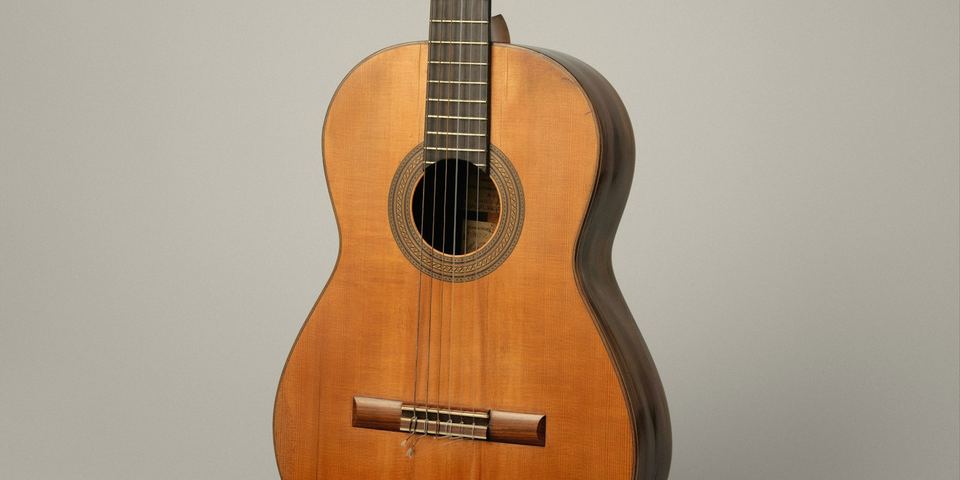
The guitar
The guitar is a string instrument with a long fretted neck and, most often, six strings. The left hand presses the strings on the frets, and the right hand strums or plucks them. From the lowest string, standard tuning is E, A, D, G, B and E. The modern classical guitar took its shape in Spain.
A classical guitar plays Adelita by Francisco Tárrega. The piece is a short mazurka. A mazurka is a Polish dance in three beats.
Music: Envato (PremiumBeat)
The sound of the guitar
The first button below plays a Bourrée by Bach on a classical guitar. A bourrée is a quick dance in two beats. Listen to how the bass line in the thumb moves against the melody on the high strings. A single guitar plays both parts. The second button plays a short phrase in E major on a nylon-string guitar.
The third button plays the open E strings of a steel-string guitar. Steel strings sound brighter and ring longer than nylon strings. The last button plays an E minor chord on a nylon-string guitar. The chord uses all six strings and needs only two fingers.
Names of the guitar
The English word guitar comes from the Spanish guitarra. That word came through Arabic and Latin from the Greek kithara. The kithara was a lyre of ancient Greece. In Spain the classical guitar is the guitarra clásica, and the flamenco guitar is the guitarra flamenca. In Brazil the six-string acoustic guitar is called the violão. A maker of guitars and other string instruments is a luthier.
The guitar has three main types. The classical guitar has nylon strings and a wide neck. The steel-string acoustic guitar has metal strings, a narrower neck and a louder, brighter tone. The electric guitar has pickups that send its sound to an amplifier.
History of the guitar
Instruments with a neck, a hollow body and plucked strings are ancient. The direct ancestors of the guitar appear in Spain in the fifteenth and sixteenth centuries. The four-course guitar was a small instrument with four pairs of gut strings. A pair of strings tuned together is called a course. Its larger relative, the vihuela, had six courses. Luis de Milán printed the first book of music for the vihuela. It was written in tablature, a notation that shows the string and the fret of the notes.
The five-course guitar followed. It spread from Spain to Italy and France in the seventeenth century. Players strummed chords on it to accompany songs and dances, and they also played delicate solo pieces. Gaspar Sanz in Spain and Francesco Corbetta in Italy wrote books of music for it. In France, Robert de Visée dedicated his first book of guitar music to Louis XIV.
Late in the eighteenth century, makers in France and Italy replaced the pairs with single strings, and the guitar gained a sixth string. In the nineteenth century Antonio de Torres of Almería gave the classical guitar its modern form. He enlarged the body, thinned the top and braced it with a symmetrical fan of wooden struts. Most classical guitars today still follow his model.
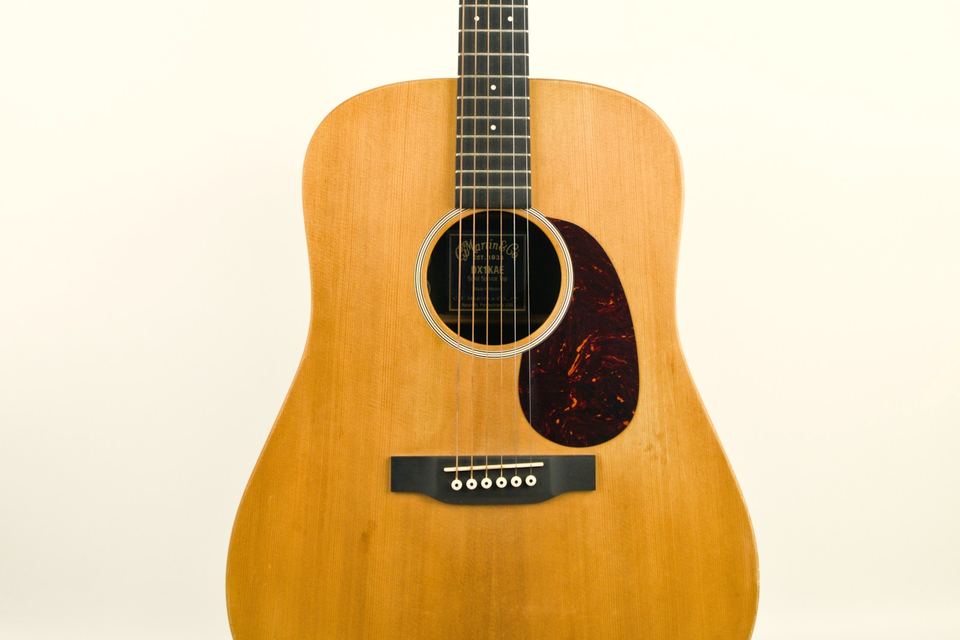
In the United States, makers who had come from Germany built guitars with a different bracing. C. F. Martin of Nazareth, Pennsylvania, is credited with developing X bracing. It was strong enough for steel strings, which spread early in the twentieth century. The louder steel-string guitar became the usual guitar of folk, country and the blues. Electric guitars with pickups followed, and they led the rise of rock and roll.
The role of the guitar in music
The guitar plays chords, melody and bass. In a band it usually keeps the rhythm with strummed or picked chords under the singer. It also plays riffs, which are short repeated patterns, and solos between the verses. In a jazz group the guitar plays chords in the rhythm section and takes its turn to improvise.
In classical music and in flamenco, one player sounds melody, bass and harmony together. Singers often accompany themselves on the guitar, because it plays chords while they sing. The guitar is the main instrument of flamenco and of the blues, and it leads folk, country and rock. In Brazil the violão carries the rhythm of samba and bossa nova.
Music for the guitar
Music for the guitar begins with the vihuela books of sixteenth-century Spain and the dances of the baroque guitar. In the early nineteenth century the six-string guitar gained its first major composers. Fernando Sor of Barcelona and Mauro Giuliani of Italy wrote sonatas, variations and studies that students still play.
Later in that century the Spanish guitarist Francisco Tárrega laid the foundations of modern classical guitar playing. He wrote Recuerdos de la Alhambra, Lágrima and Capricho árabe. He also arranged Bach's lute music for the guitar, and he played guitars made by Torres. In the twentieth century the Spanish guitarist Andrés Segovia played concerts around the world and asked composers for new music. Heitor Villa-Lobos of Brazil wrote twelve études and five preludes. Joaquín Rodrigo wrote the Concierto de Aranjuez for guitar and orchestra. Agustín Barrios of Paraguay wrote La catedral.
Adelita, the piece at the top of the page, is a mazurka. A singing melody lies on the high strings, and the thumb plays the bass notes below it. Listen for the three beats of the dance under the melody.
Music: Envato (SCOREWIZARDS)
This waltz is played on a nylon-string Spanish guitar. Count three beats to a measure, and feel the stress on the first.
How the guitar is made
A guitar has a body, a neck and a headstock. On an acoustic guitar the body is a hollow box. Its top, also called the soundboard, is a thin plate of spruce or cedar a few millimeters thick. The back and the sides are usually rosewood, mahogany or maple. A round sound hole in the top lets the air inside the body move with the top.
The bridge is glued to the top. The strings run from the bridge over the saddle and the nut to the tuning machines on the headstock. A plucked string barely moves the air by itself. It passes its vibration through the saddle and the bridge into the top. The top vibrates like the skin of a drum, and the air in the body makes the sound louder and richer.
Under the top, thin strips of wood called braces keep it from cracking under the pull of the strings. A classical guitar uses fan bracing, a set of struts that spread out like a fan below the sound hole. A steel-string guitar uses X bracing, two struts that cross below the sound hole. It holds the greater tension of steel strings.
The neck holds the fingerboard and the frets. Frets are metal wires set across the fingerboard. A fret shortens the vibrating string enough to raise the pitch a half step. The frets lie closer together as they go up the neck. The neck of a steel-string guitar holds a steel rod called the truss rod. It resists the pull of the strings and keeps the neck straight. The vibrating length of the open string, from the nut to the saddle, is the scale length. On a classical guitar it is usually about sixty-five centimeters.
Classical strings are nylon. The three bass strings are wound with fine metal wire over a core of nylon threads. Steel-string guitars use steel strings, and their lower strings are wound with bronze. Steel strings pull much harder on the guitar, so their sound is louder and brighter. Nylon strings are softer under the fingers and give a warmer tone.
How the guitar is played
A classical guitarist sits with the waist of the guitar on the left leg. The left foot rests on a small footstool, or a support lifts the guitar from the leg, so the neck rises at a slant. Folk and popular players usually rest the guitar on the right leg, or they stand and wear a strap.
The left hand presses the strings close behind the frets. Guitarists number the fingers of this hand from 1 to 4. The index finger is 1, and the little finger is 4. A barre is one finger laid flat across several strings. It lets one hand shape move up the neck to play the same chord in other keys. Positions give the place of the hand on the neck. In first position the first finger plays the notes at the first fret.
Classical guitarists pluck with the fingertips and the nails. The fingers of the right hand carry the letters p, i, m and a. They come from the Spanish words for thumb, index, middle and ring finger. In a free stroke, called tirando in Spanish, the finger plucks the string and passes above the next one. In a rest stroke, called apoyando, it comes to rest on the next string, and the note sounds fuller.
Folk, pop and rock players often strum with a pick, a small flat piece of plastic. Fingerstyle players pluck patterns with the thumb and fingers, and the thumb keeps a steady bass. Flamenco players use rasgueado, rapid strums made by flicking the fingers outward one after another. Guitar music is written in the treble clef, and it sounds an octave lower than written. Many players also read tablature, which shows the string and the fret of the notes.
What makes a fine guitar
The top shapes most of the tone of an acoustic guitar. Makers prefer a top of solid spruce or cedar with straight, close grain. Spruce gives a clear, focused tone. Cedar sounds warm and open. A solid top is cut from solid wood, usually as two matched halves joined at the center. A laminated top is made of thin layers glued together. It is stronger and costs less, but it vibrates less freely.
The maker thins the top and shapes its braces by hand. As the work goes on, the maker taps and flexes the wood. Heavy wood and heavy braces make a guitar sturdy but quiet. Wood carved too thin loses strength and can crack under the strings. Torres held that the top shaped the tone more than the back and the sides did. To show it, he built a guitar with back and sides of papier-mâché, which is paper pressed with glue. It was later restored, and it can still be played.
The back and the sides color the tone. Indian rosewood gives a deep bass and rich overtones. Mahogany gives a dry, focused sound. Maple sounds bright and clear. Brazilian rosewood, the traditional wood of fine Spanish guitars, is now a protected wood, and its trade is strictly limited.
A fine guitar also plays well. The frets are level and polished, so no string buzzes. The action, the height of the strings above the frets, is low enough to press easily. The intonation is true, so the note at the twelfth fret sounds an exact octave above the open string. The tuning machines turn smoothly and hold their pitch. A thin finish lets the top move freely, while a thick coat can damp it.
Choosing a guitar
Classical guitars come in full size and in smaller sizes for children. These include the half-size, the three-quarter-size and the seven-eighths-size guitar. Choose the size by the player's height and arm length. Age is only a rough guide. Steel-string guitars come in several body shapes. The dreadnought, which Martin introduced early in the twentieth century, is large and has a strong bass. Smaller bodies, such as the concert and the auditorium shapes, sit more easily against a smaller player.
A classical guitar with nylon strings suits classical music, flamenco and bossa nova, and its soft strings are kind to a beginner's fingertips. A steel-string guitar suits folk, country and popular songs. Before you buy, check that the strings lie low over the frets and that the neck is straight. Play the strings one at a time at the twelfth fret, and compare the note with the open string. A solid top is worth its cost if the budget allows it. The price guide explains what a step up in price brings.
Who keeps these instruments
The Music Museum of Barcelona keeps the guitar that Torres built with back and sides of papier-mâché. Antonio Stradivari of Cremona made guitars as well as violins, and five complete guitars by him survive. The Ashmolean Museum in Oxford keeps one of them. The National Music Museum in Vermillion, South Dakota, keeps another.
The National Music Museum also holds the New York workshop where John D'Angelico built archtop guitars. An archtop guitar has a carved, arched top. In Nazareth, Pennsylvania, the Martin Guitar Museum shows the guitars that the Martin company has made over its history. The company has worked in the town since the first half of the nineteenth century.
Spain still has many workshops that build classical guitars by hand. Conservatories around the world teach the classical guitar as a full course of study. The course runs from the vihuela books to the music of the present day.
First steps on the guitar
Tune the six strings to E, A, D, G, B and E with the tuner. Sit upright, and rest the guitar on the leg so that the neck rises slightly. Press the strings close behind the fret with the end of the finger. Pluck it with the thumb, and listen for a clear note with no buzz.
Learn E minor first. It needs only two fingers, on the second fret of the A and D strings. Then learn A minor and C. Change between two chords with the metronome at a slow tempo. Give the chords four beats apiece. Short daily practice builds calluses. These patches of hard skin on the fingertips make pressing comfortable.
A short check
Choose one answer per question.
Which notes are the open strings of the guitar in standard tuning?
Standard tuning runs E, A, D, G, B and E from the thickest string. The two E strings are two octaves apart.
Which part of an acoustic guitar shapes its tone the most?
The top vibrates and moves the air. Its wood, its thickness and the braces under it shape the tone.
What is a course on an early guitar?
Early guitars had pairs of strings. A pair, played as one string, is called a course.
What kind of strings does a classical guitar use?
A classical guitar uses nylon strings. The three bass strings are wound with fine metal wire.
How much does one fret raise the pitch of a string?
A fret shortens the vibrating string by the amount that raises the pitch a half step.
Sources
- Wikipedia: Guitar
- Wikipedia: Classical guitar
- Wikipedia: Vihuela
- Wikipedia: Baroque guitar
- Wikipedia: Antonio de Torres Jurado
- Wikipedia: Francisco Tárrega
- Wikipedia: C. F. Martin and Company
- Wikipedia: Steel-string acoustic guitar
- Wikipedia: List of Stradivarius instruments
- Wikipedia: Classical guitar making
- Wikipedia: Brazilian rosewood
- National Music Museum
- Museu de la Música de Barcelona
Common questions
How is a guitar tuned?
From the thickest string to the thinnest, standard tuning is E, A, D, G, B and E. The two E strings are two octaves apart. The tuner page plays all of these notes.
What is the difference between a classical and an acoustic guitar?
Both have hollow bodies. A classical guitar uses nylon strings and a wider neck. A steel-string acoustic guitar uses metal strings and has a narrower neck.
Which guitar size does a child need?
Many children start on a half-size or three-quarter-size guitar. Choose by height and arm length, and let the child try the guitar before you buy it.
Should a beginner start on an electric guitar?
A beginner can start on any type. An electric guitar needs an amplifier to be heard. An acoustic guitar needs nothing more than the instrument.
What does a fret do?
A fret is a metal strip across the neck. Pressing a string behind a fret shortens the part that vibrates, so one fret raises the pitch by a half step.
Where does the guitar come from?
The modern guitar developed in Spain. It grew from two earlier Spanish instruments, the vihuela and the baroque guitar.
How long does it take to learn the guitar?
With daily practice, many beginners change between a few open chords within a few weeks. Barre chords and fingerstyle pieces take months. Classical repertoire takes years of steady study.
What wood is best for a guitar top?
Most fine guitars have a top of solid spruce or cedar. Spruce gives a clear, focused tone, and cedar gives a warm, open tone.