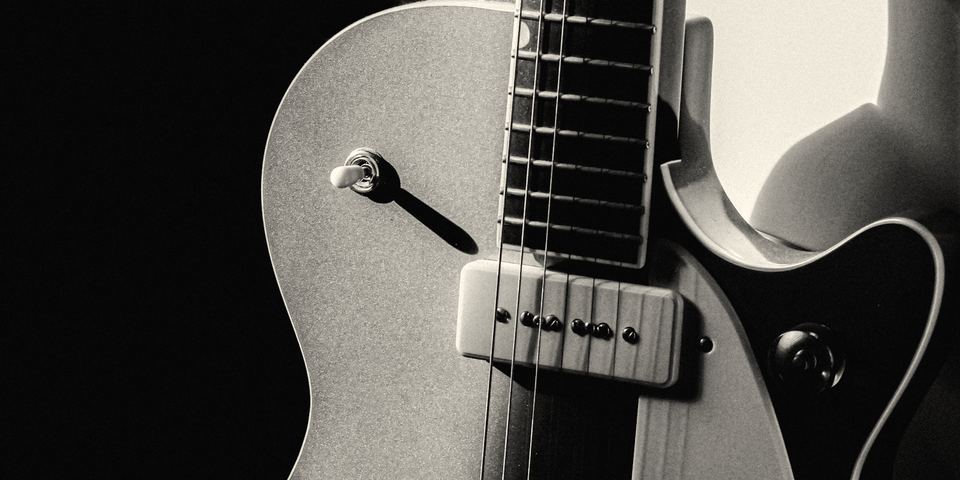
The electric guitar
The electric guitar is a guitar with pickups, which turn the vibration of its steel strings into an electric signal. An amplifier makes the signal loud. Most electric guitars have a solid body and six strings tuned E, A, D, G, B and E. It is the leading instrument of rock, blues and much of pop.
An electric guitar plays this blues. Listen for how long the notes ring through the amplifier.
Music: Envato (AudioZen)
The sound of the electric guitar
The first button below plays clean chords and an arpeggio. A clean sound has no distortion. Distortion is a rough, buzzing edge that the amplifier adds to the tone. An arpeggio is a chord played one note at a time. Then you hear a clean melody and a blues rhythm part. Listen to how the tone turns rough in the rock riff and in the chord with distortion. The guitar and its strings stay the same, and only the treatment of the signal changes. The piano button gives the six open strings, which you can match when you tune.
Names of the electric guitar
Players often call it an electric or a guitar for short. Early makers called it the electric Spanish guitar. The name set it apart from the electric steel guitar, which lies flat on the lap and is played with a metal bar. Gibson's first electric Spanish model was the ES-150. The letters ES stand for Electric Spanish.
Electric guitars are grouped by their bodies. A solid-body guitar has a body of solid wood. A hollow-body guitar has a full acoustic chamber, and jazz players often choose one for its warm tone. A semi-hollow guitar has a solid block of wood down the center of a hollow body. It resists feedback better than a fully hollow guitar. Feedback is a howl. It starts when the sound from the amplifier sets the strings or the body vibrating.
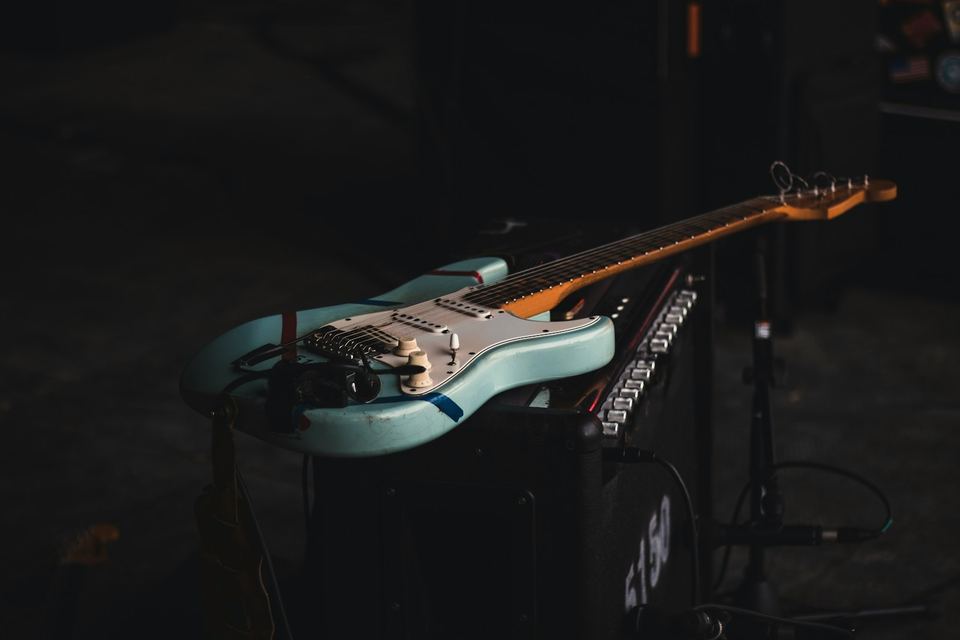
History of the electric guitar
The first electric string instrument sold to the public was a lap steel guitar with a body and neck of cast aluminum. Players called it the Frying Pan for its round body and long neck. George Beauchamp designed it in Los Angeles with Paul Barth, and the company of Adolph Rickenbacker built it. Its pickup used two horseshoe magnets that arched over the strings.
Jazz guitarists in big bands needed to be heard over the horns. Gibson answered with the ES-150. It was a hollow archtop guitar with a pickup near the neck. Charlie Christian played one in the Benny Goodman Sextet. His long single-note solos made the guitar a lead voice in jazz. T-Bone Walker took up the electric guitar in the blues in the same years.
Hollow guitars howled with feedback at high volume. Makers turned to solid bodies, which let the strings ring longer without it. Les Paul built a test instrument called the Log from a solid wooden beam. He attached the halves of a hollow guitar to its sides. Paul Bigsby built a solid-body guitar for the country guitarist Merle Travis. Leo Fender then produced the Esquire and the Telecaster. They were the first solid-body electric guitars made in large numbers. Their necks bolted onto the body, so a factory could build them quickly. Gibson answered with the Les Paul model, and Fender with the Stratocaster.
At Gibson, Seth Lover designed the humbucker, a pickup with two coils that cancels hum. Electric blues in Chicago, rock and roll and later rock and heavy metal grew around the electric guitar. Muddy Waters carried the blues of the Mississippi Delta onto the electric guitar, and Jimi Hendrix used feedback and distortion as musical colors.
The role of the electric guitar in music
In a band the electric guitar plays the rhythm part, the chords under the singer. It also plays riffs and solos. A riff is a short pattern that repeats. Many bands have a rhythm guitarist and a lead guitarist. The lead guitarist plays the melodies and solos.
The electric guitar leads rock, blues, metal and funk. It also plays in jazz, country, pop and soul, and in many kinds of African and Asian popular music. In funk it plays short, muted chords that lock with the drums. In jazz the hollow-body guitar plays chord melodies and long solo lines.
Music for the electric guitar
The electric guitar shaped electric blues, rock and roll, rock and heavy metal. In these styles the guitar solo became a central part of the song. Players shape the sound with effects pedals. Distortion boosts and clips the signal until it sounds rough and sustained. A wah pedal sweeps the tone up and down, and a delay repeats the notes.
The opening recording is a blues. Most blues follow a twelve-bar pattern of three chords. In a slow blues the guitar often answers the phrases of the melody. A voice and a guitar answer one another in the same way in the older country blues. Blues guitarists bend strings to reach the blue notes, pitches that fall between the keys of a piano. They also shake long notes with a wide vibrato. Bends and vibrato let the guitar imitate a singer.
How the electric guitar works
A pickup is a magnet wrapped in a coil of fine copper wire. The coil often has several thousand turns. A steel string vibrating over the magnet disturbs its magnetic field, and this makes a small electric current in the coil. A single-coil pickup sounds bright and clear, but it also picks up hum from electrical equipment. A humbucker has two coils wound in opposite directions with opposite magnets. The signal of the strings adds up, and the hum cancels out. Its tone is fuller and warmer.
Most electric guitars have two or three pickups. A pickup near the neck senses the middle of the string, where it swings widely. This pickup sounds round and warm. A pickup near the bridge senses the end of the string and sounds bright and sharp. A switch chooses among the pickups, and knobs set the volume and the tone. A cable carries the signal to the amplifier.
The bridge holds the strings at the body. A fixed bridge keeps the tuning steady. A tremolo bridge pivots on the body, and its arm lowers or raises the pitch of all the strings at once. The amplifier has two stages. The preamplifier shapes the tone and can add distortion. The power amplifier drives the speaker. Many players prefer amplifiers with vacuum tubes for the way they distort when they are pushed hard.
How the electric guitar is played
The left hand presses the strings behind the frets, as on any guitar. The right hand picks or strums, and most players use a pick. In alternate picking the pick moves down and up in turn, which keeps fast lines even. Palm muting rests the edge of the right hand on the strings near the bridge, so the notes sound short and heavy.
Electric strings are thinner than acoustic strings, so they are easier to press and to bend. A bend pushes a string across the fret and raises the note. A hammer-on sounds a note by striking a finger down onto the string. A pull-off plucks the string with the finger as it lifts. In slide guitar the player glides a tube of glass or metal along the strings. Players also use the volume knob and the pick attack to change the tone without touching the amplifier.
What makes a fine electric guitar
The body wood affects the tone and the sustain of an electric guitar. The wood matters less than it does on an acoustic guitar. Alder and ash give a bright, open tone. Mahogany gives a warm, thick tone, and a cap of maple on top adds brightness. Necks are usually maple, and fingerboards are rosewood, maple or ebony.
The neck joint matters too. A bolt-on neck is easy to adjust and to replace. A set neck is glued into the body. A neck-through design runs one piece of wood the whole length of the guitar. The last two let the strings sustain a little longer. Scale length changes the feel. Fender guitars usually use a scale of twenty-five and a half inches, and Gibson guitars twenty-four and three-quarter inches. The shorter scale feels slacker and bends more easily.
Fine pickups are wound with care. The number of turns and the kind of magnet set their output and their tone. A fine electric guitar also has smooth, level frets, a well-cut nut and a bridge that holds the intonation. Its controls turn quietly and do not crackle. The setup brings these parts together. A good technician sets the height of the strings and the pickups, the curve of the neck and the intonation of the strings.
Choosing an electric guitar
A beginner needs a guitar, an amplifier and a cable. A small practice amplifier with a headphone jack lets you play quietly. Some players use an audio interface with a computer and headphones in place of an amplifier.
A guitar with a bolt-on neck and single-coil pickups suits blues, funk and pop. A guitar with humbuckers suits rock and heavier styles. A hollow or semi-hollow body suits jazz. Look for strings that lie low over the frets and controls that turn quietly. Make sure the guitar holds its tuning.
Who keeps these instruments
The Musical Instrument Museum in Phoenix, Arizona, is one of the largest museums of its kind. It shows electric guitars beside instruments from around the world. The National Music Museum in Vermillion, South Dakota, keeps American guitars by Fender, Gibson, Martin and other makers.
The Rock and Roll Hall of Fame in Cleveland, Ohio, shows guitars played by the musicians it honors. The early firms still build guitars on the models of their first decades. Fender began in Fullerton, California, and Gibson began in Kalamazoo, Michigan. Guitar makers and technicians in many countries now build and repair electric guitars by hand.
First steps on the electric guitar
Connect the guitar to the amplifier with the volume low. Tune the six strings with the tuner. Set the amplifier to a clean sound, with no distortion, so that you can hear all the notes clearly.
Hold the pick between the thumb and the side of the first finger. Play the open strings one at a time with slow downstrokes. Next, play down and up strokes in turn. Our lesson for beginners covers the first power chords and palm muting. The price guide explains what sets the price of any kind of guitar.
A short check
Choose one answer per question.
What does a pickup do?
A pickup turns the vibration of the steel strings into a signal. The amplifier makes the signal loud.
Why does an electric guitar need an amplifier?
A solid body hardly moves the air, so the guitar is quiet without an amplifier.
What is distortion?
Distortion clips the signal. The sound grows rough and sustained, as in rock and metal.
Which notes are the open strings of an electric guitar?
The electric guitar is tuned like an acoustic guitar: E, A, D, G, B and E from the thickest string.
Why does a humbucker have two coils?
The two coils are wound and magnetized in opposite directions. The string signal adds up, and the hum cancels out.
Sources
Common questions
Is an electric guitar easier to learn than an acoustic guitar?
Many beginners find it easier to press, because the strings are thinner and lie lower. It also needs an amplifier and a cable.
Can you play an electric guitar without an amplifier?
You can hear it faintly. For practice, use headphones with a small amplifier or an audio interface.
What is the difference between single-coil and humbucker pickups?
A single-coil pickup has one coil and a bright tone. A humbucker has two coils wired to cancel hum, and its tone is thicker.
How many strings does an electric guitar have?
Most have six strings. Some metal players use guitars with seven or eight strings.
What is a whammy bar?
It is the tremolo arm, which is a lever at the bridge. Pushing it lowers the pitch of all the strings at once.
Is the electric guitar the same as the bass guitar?
No. The bass guitar has four thicker strings tuned an octave lower, and it plays the bass line.
Who invented the electric guitar?
No single person did. George Beauchamp and Adolph Rickenbacker made the first electric pickups sold to the public. Gibson, Les Paul, Paul Bigsby and Leo Fender all shaped the hollow and solid electric guitars that followed.