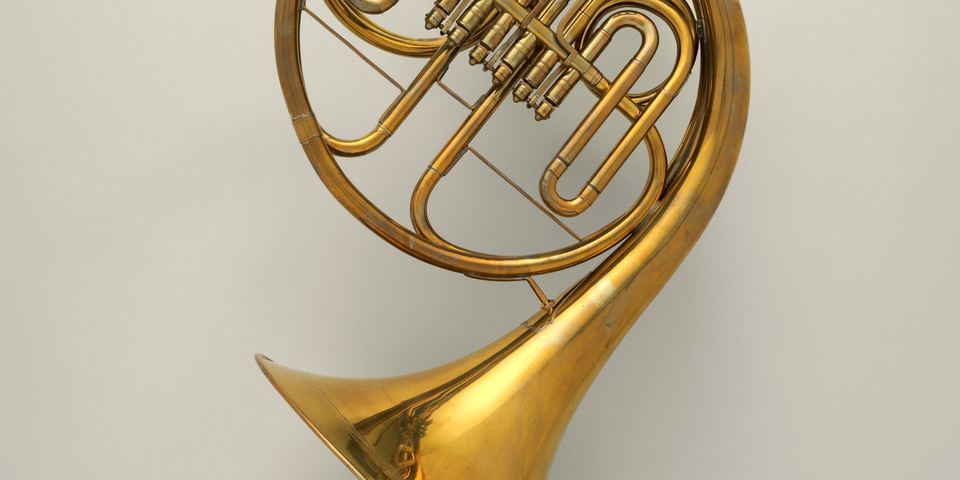
The French horn
The French horn is a brass instrument with a long coiled tube that widens into a large bell. The player buzzes the lips into a small mouthpiece. Valves under the left hand change the length of the tube, and the right hand rests inside the bell. Most horns today are double horns in F and B♭.
This is the Rondo from Mozart's Horn Concerto No. 4. A solo horn plays with an orchestra. In a rondo, the main tune returns between other passages. The piece is in six-eight time, so the beats divide into three quick notes. Listen for the main tune, which is built like a hunting call.
Music: Envato (gballx)
The sound of the French horn
You can hear a low note held on an orchestral horn and a higher note with a mute in the bell. The mute makes the sound distant.
Names of the French horn
Musicians often call it the horn. The name French horn came into use in English late in the seventeenth century.
In German it is the Horn or Waldhorn. In French it is the cor, and in Italian it is the corno.
Where the French horn is played
The horn grew from the hunting horns of Europe. Today it is heard in orchestras and concert bands around the world.
It is also a standard member of two small groups: the brass quintet and the wind quintet. In marching bands, players usually use a related instrument called the mellophone.
The role of the French horn in music
In an orchestra the horns play melodies and fill in chords.
In a wind quintet, the horn plays beside the flute, oboe, clarinet and bassoon.
Music for the French horn
Composers have written concertos for the horn. Mozart wrote four of them. The fourth ends with the Rondo that plays at the top of this page. Orchestral and band music gives it solos as well as section parts.
Students play horn parts in school bands and youth orchestras.
How the French horn is made
The horn is made of brass tubing coiled into a circle. The tube is narrow at the mouthpiece and widens slowly toward the bell. This shape is called a conical bore, and it gives the horn its mellow sound.
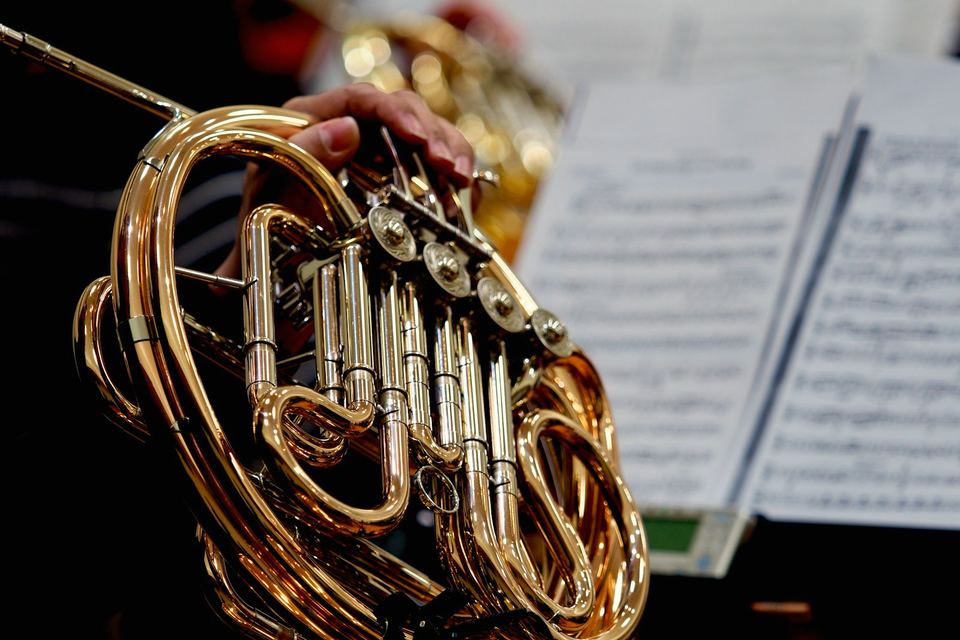
Rotary valves turn to send the air through extra loops of tubing. A double horn has a fourth valve, worked by the thumb, that switches between a side in F and a side in B♭.
How the French horn is played
The player holds the horn with the bell facing back and down. The left hand works the valves, and the right hand is inside the bell. Moving the right hand changes the pitch and color of the sound.
The player chooses the note with the lips. A length of tube can sound a set of notes called the natural notes, and the valves fill the gaps between them. Horn music is written in F, so the horn sounds a perfect fifth lower than the written note.
The double horn plays from about the C two octaves below middle C up to the C two octaves above middle C.
How the French horn has changed
Early horns had no valves. A horn without valves is called a natural horn. It plays only its natural notes. Players of the natural horn changed the pitch with the hand in the bell. Valves were added in the nineteenth century, and the double horn later became the usual choice.
Choosing a French horn
A single horn is tuned in F, and a double horn adds a side in B♭. Ask the band or orchestra teacher which kind the program uses.
Check that the valves turn smoothly and the slides move freely before you buy.
Sources
Common questions
Why is it called the French horn?
The name came into use in English late in the seventeenth century. At that time, French makers led the making of hunting horns, the instruments from which the horn grew. In most countries musicians call it the horn.
Why does the player put a hand in the bell?
The right hand supports the horn and shapes its sound. Moving the hand deeper into the bell changes the pitch and darkens the tone.
What is a double horn?
A double horn joins a horn in F and a horn in B♭. A thumb valve switches between them. The B♭ side helps with high notes.
Is horn music written in treble or bass clef?
Horn parts are written in F and use both clefs. The low notes appear in the bass clef.
What is a mellophone?
The mellophone is a horn in F with its bell facing forward. Many marching bands use it in place of the French horn.
Brass instrumentsEuphoniumInstrumentationLevel 3 courseTrumpet