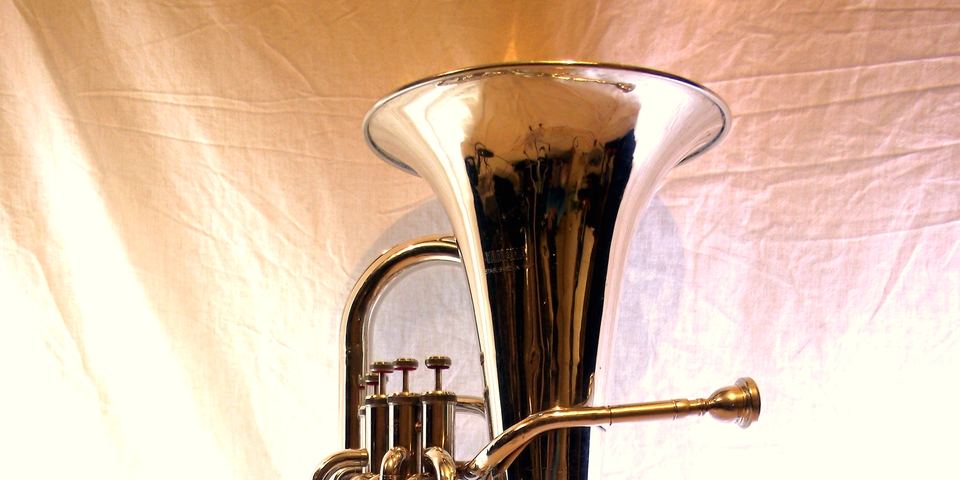
The euphonium
The euphonium is a tenor brass instrument in B-flat. It sounds an octave below the trumpet. Its wide tube widens steadily from the mouthpiece to the bell, which gives it a mellow sound. It is heard mainly in brass bands, military bands and concert bands. Its name comes from a Greek word that means "sweet-voiced."
On this early record, a euphonium plays the Song to the Evening Star from the opera Tannhäuser by Wagner. A band accompanies it.
The sound of the euphonium
Few solo records of the euphonium are older than this one. The euphonium plays a long, slow melody from an opera, and the band accompanies it. Listen to how the player joins the notes into long phrases as a singer does. The low notes are full and the high notes are clear. The soloist was known for a pure tone with no vibrato.
The two buttons below play two American marches on a euphonium: On Wisconsin and Hail Columbia. Here the euphonium plays the tune alone. Listen for its quick, clean attacks in the fast notes of a march.
Names of the euphonium
The name comes from the Greek word euphonos, which means "sweet-voiced" or "well-sounding." British composers sometimes call the euphonium the tenor tuba. German scores use Baryton or Tenorbasshorn. In Spanish it is the bombardino.
In American school bands, the name baritone is often used for the euphonium. The common German name Baryton may have led Americans to this use. The baritone horn of British brass bands is a separate instrument with a narrower tube.
Italian bands call the euphonium the flicorno basso when it has four valves. With three valves it is the flicorno baritono.
History of the euphonium
The euphonium grew from the search for a good brass bass early in the nineteenth century. Its nearest ancestor is the ophicleide. This metal bass horn had keys over large tone holes. The wide bore of the ophicleide gave it a warm tone, and the euphonium kept that tone. When valves were invented, makers in Vienna, Berlin and Milan began to build wide brass instruments in the tenor and baritone range.
Ferdinand Sommer, a bandmaster in Weimar, designed an instrument that a Viennese maker patented as the Euphonion. Sommer toured with it as a soloist and presented it at the Great Exhibition in London. The English form of the name, euphonium, soon took hold. In Paris at about the same time, Adolphe Sax built his family of saxhorns. His bass saxhorn in B-flat is the closest early form of the modern euphonium.
British makers gave the instrument its modern form. At Boosey and Company in London, the factory manager David Blaikley patented a compensating system for four valves. The tube of the fourth valve passes back through the other three, and small extra loops correct the tuning of the low notes. British euphoniums have used his system ever since. In Austria-Hungary, the Czech maker Václav František Červený built an oval euphonium with rotary valves. That shape is still standard in Central and Eastern Europe.
In the United States, the euphonium became a star of the professional concert bands. The Italian-born Simone Mantia played solos in the bands of John Philip Sousa and Arthur Pryor. He made some of the first solo euphonium records, and the record heard on this page is one of them. Some American players of his time used a double-bell euphonium. A valve switched the sound to a second, smaller bell, which gave a brighter tone close to that of a trombone.
The role of the euphonium in music
The euphonium is the tenor solo voice of the band. In a concert band it often has the part that the cello has in an orchestra. It plays a warm melody in the middle range or a countermelody under the tune. British brass bands are now popular around the world, and their music gives the euphonium many fast, expressive solos.
Orchestras use the euphonium only now and then. When they do, the score often calls it the tenor tuba. It also plays old parts written for the ophicleide or for the small French tuba. Today most full-time professional posts for euphonium players are in military bands.
Music for the euphonium
The first music for the euphonium came from the air varié. This was a popular theme with variations. The variations on the Carnival of Venice by Jean-Baptiste Arban are one example. They moved from the cornet to the ophicleide and then to the euphonium. The earliest surviving solo written for the euphonium itself is a concerto for flicorno basso by the Italian composer Amilcare Ponchielli.
Solo and band music for the euphonium grew quickly from the late nineteenth century into the early twentieth. In those years the instrument became central to bands. Band soloists often wrote their own showpieces. Many of them are fast variations on a well-known song.
The euphonium also appears in the orchestra. Richard Strauss wrote important tenor tuba parts in Don Quixote and Ein Heldenleben. Holst gave it solos in The Planets, and Janáček used it in his Sinfonietta. Since the middle of the twentieth century, composers have written many concertos for euphonium. Some are accompanied by a band or a brass band, and others by an orchestra.
How the euphonium is made
The euphonium is pitched in B-flat, as the tenor trombone is. Its open tube is about nine feet long, and it sounds an octave below the trumpet. The tube is wide and conical. A conical tube widens steadily along its length. Like the tuba, the euphonium favors the lower overtones of its notes, so its tone is mellow and round. The bell is ten to twelve inches across.
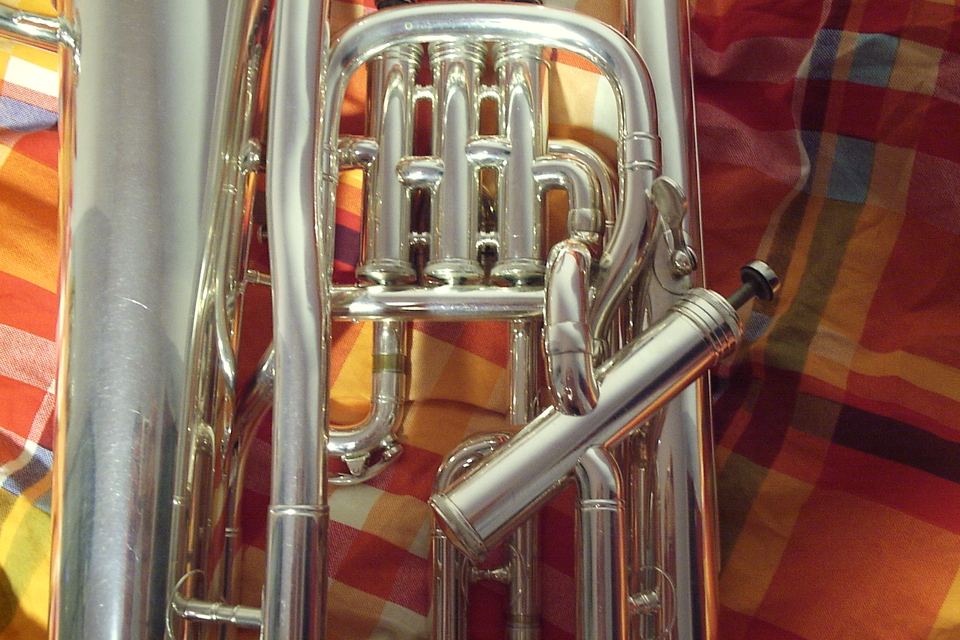
Most euphoniums have four valves, and beginner models often have three. The three upper valves are pressed by the first three fingers of the right hand. On many models the fourth valve is on the side, where the left hand plays it. The fourth valve lowers the pitch by a perfect fourth. It extends the range below E2, which lies one ledger line below the bass staff.
The baritone horn looks similar, but its tube is narrower and its bell is smaller, so its tone is lighter. A marching euphonium has its bell turned forward. It usually has only three valves, which keeps it light enough to carry.
How the euphonium is played
The player buzzes the lips into a cup-shaped mouthpiece and chooses the notes with the lips and the valves. The euphonium easily covers the notes from E2 to about G4. Skilled players reach well above that range and down into the deep pedal notes, which lie below the normal range.
Euphonium music is written in the bass clef at sounding pitch, or in the treble clef in B-flat. The treble-clef part is written a ninth above the sound. British brass bands use the treble clef. American band parts use either clef.
The euphonium and the baritone horn share their range and their fingering. Many players play both and make small changes to the breath and the lips.
What makes a fine euphonium
A fine euphonium has a full, singing tone that stays even from the lowest notes to the highest. The bore and the bell shape this tone most. A wide bore and a large bell give the dark, rich sound that brass bands prize. A narrower bore gives a lighter sound that is closer to the sound of the baritone horn.
The valves come next. A compensating fourth valve lets the low notes sound in tune without forcing the lips. On a professional instrument the valves move smoothly and seal well. Modern makers widen and taper the valve tubing and soften its sharp bends. Some models add a trigger on the main tuning slide, or an adjustable lead pipe that changes how the instrument responds.
Before you buy, play long notes in all registers and a slow scale. Listen for notes that start cleanly, sound even and stay in tune. Ask a teacher to play the instrument too, because a listener a few steps away hears the tone better than the player does.
Choosing a euphonium
A student euphonium in B-flat with three valves and an upright bell is a common first instrument. Ask the band teacher which clef the band reads before you buy music.
A euphonium with a compensating fourth valve is the usual next step. It plays the low notes in tune and covers the full range. Many school bands lend instruments, so a student can begin before buying one.
Who keeps these instruments
The musical instrument collection of the University of Edinburgh holds many brass instruments of the nineteenth century. Among them are a five-valve euphonium by Besson and an oval Kaiserbaryton by Červený. The two show the British and the Central European forms of the instrument side by side.
The Library of Congress keeps early American records of euphonium solos in its National Jukebox. These records preserve the playing of the band soloists who made the euphonium popular in the United States.
Historical makers include Boosey and Company and Besson in London, Higham in Manchester, Červený in Austria-Hungary and Conn in the United States. Conn built the American euphoniums, sold as baritones, that Simone Mantia played for the rest of his career.
First steps on the euphonium
Buzz the lips gently into the mouthpiece alone, and hold a steady sound. Then put the mouthpiece into the euphonium. Play the B-flat on the second line of the bass staff with no valve pressed.
Play long notes with the metronome at a slow tempo, and keep them even to the end of the breath. Then play a slow B-flat major scale, and check the notes with the tuner.
Sources

Common questions
What is the difference between a euphonium and a tuba?
Both have wide conical tubes and valves. The tuba is larger and plays lower.
What is the difference between a euphonium and a baritone?
The euphonium has a wider tube and a larger bell, so its sound is darker. The baritone horn is narrower and often has only three valves.
Is euphonium music written in bass clef or treble clef?
Both clefs are used. Bass clef parts are at sounding pitch. Treble clef parts are written in B-flat, a ninth above the sound, as in British brass bands.
How many valves does a euphonium have?
Most euphoniums have four valves. Many beginner models have three.
What does euphonium mean?
The name comes from the Greek word euphonos, which means "sweet-voiced" or "well-sounding."
What is a compensating euphonium?
It is a euphonium whose fourth valve sends the air back through the first three valves. Small extra loops correct the tuning of the low notes.