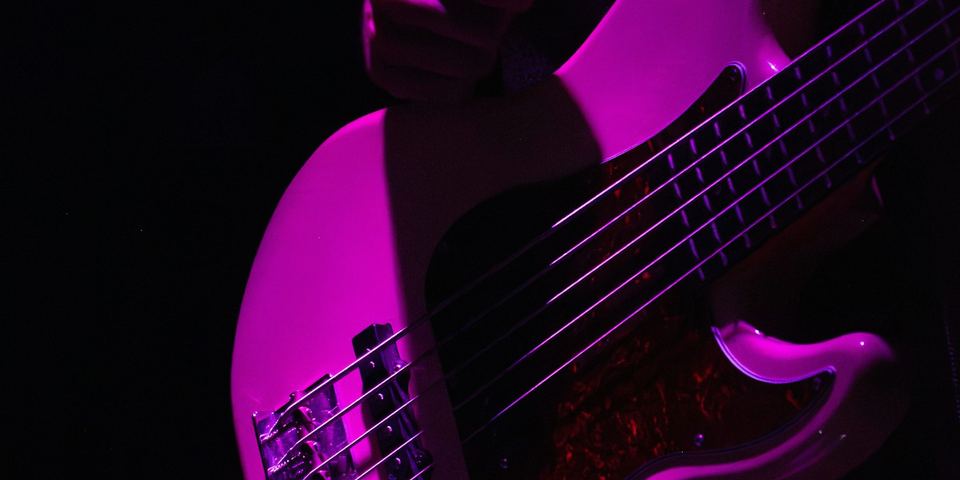
The bass guitar
The bass guitar, or electric bass, is the lowest member of the guitar family. It looks like an electric guitar with a longer neck. Most basses have four strings tuned E, A, D and G. These notes sound an octave below the four lowest strings of a guitar. The bass needs an amplifier to be heard.
A funk band of bass guitar, guitar and drums plays this groove. Listen for the bass, which holds the lowest part and locks with the drums.
Music: Envato (alexunderthesky)
The sound of the bass guitar
In funk the bass and the drums lock together. The bass usually lands firmly on the first beat of the bar and fills the spaces between the beats with short notes. Listen for the lowest part of the groove, and tap your foot with it. In a funk bass line the rests are as important as the notes.
The buttons below play a riff with a pick and a short line with the fingers. The third recording is one plucked note. The last button plays the notes of the four open strings on a recorded grand piano.
Names of the bass guitar
Musicians call it the bass guitar, the electric bass or the bass for short. Early players often called it the Fender bass. The Fender company was the first to make it in large numbers. A bass guitar whose neck has no frets is a fretless bass.
The bass guitar uses the tuning of the double bass, which is also called the upright bass or the acoustic bass. A player of either instrument is a bassist, and many bassists play both.
History of the bass guitar
In the early twentieth century, bands played the bass part on the double bass or the tuba. The double bass is large and hard to carry. In a loud band it is also hard to hear, so musicians and inventors began to try to amplify it.
In Seattle, the musician and inventor Paul Tutmarc built the first electric bass guitar of the modern kind before the Second World War. It had four strings, frets and a solid body, and the player held it flat like a guitar. His company Audiovox sold it in its catalog. Only about one hundred were made.
In California, Leo Fender and George Fullerton designed the Precision Bass. It was the first electric bass made in large numbers. Its frets let a player find the notes precisely, which gave the bass its name. It was light, easy to carry and loud through an amplifier, and it was less prone to feedback than an amplified double bass. Players who had started on the guitar could learn it quickly.
Other makers soon built basses of their own. Gibson, Höfner and Rickenbacker were among them. Fender added the Jazz Bass, which has two pickups. Fretless basses, basses with active electronics and basses with five or six strings came later. In Detroit, James Jamerson played the bass on most of the Motown hits of his time. Many bassists regard him as the most influential player of the instrument.
The role of the bass guitar in music
The bass and the drums form the core of the rhythm section. Together they give a song its pulse. The bassist listens closely to the bass drum, and the two often play the same rhythms.
The bass plays the bassline, the lowest part of the music. A bassline usually stresses the root, the third and the fifth of the chord, which outlines the harmony for the band. When the bass moves to a new root, the listener hears the chord change even before the other instruments make it clear.
Music for the bass guitar
In swing jazz and jump blues, bass players often play a walking bass line. This is a steady line of quarter notes. In bluegrass and country music, the bass often plays the root and the fifth of the chord. In rock the bass often plays steady eighth notes on the root.
Funk and disco players made slapping popular on the bass guitar. The thumb strikes a string against the frets. In popping, a finger pulls a string away and lets it snap back.
Reggae and dub place the bass at the front of the sound. Its notes are deep and round, and they leave space between them. In jazz fusion some bassists play fast solos and chords. On a fretless bass, players slide between notes as a singer does.
How the bass guitar is made
Most bass guitars have a solid wooden body. The neck is bolted or glued to it, or it runs through the whole body. A steel truss rod inside the neck resists the pull of the heavy strings. The fingerboard holds metal frets.
Pickups sit in the body under the strings. They turn the vibration of the strings into an electric signal, and an amplifier makes the signal loud enough to hear.
Bass strings have a core of steel or nickel wound with a finer wire. Roundwound and flatwound strings are the common types, and they give different sounds. Roundwound strings sound bright. Flatwound strings sound warmer and smoother under the fingers.
How the bass guitar is played
Most players pluck the strings with the fingers or the thumb, and some use a pick. The left hand presses the strings behind the frets, as on a guitar.
Bass music is written in the bass clef. It sounds an octave lower than it is written. The bass part is the lowest line of the music, and it supports the chords above it.
What makes a fine bass guitar
A fine bass feels comfortable in the hands. The neck should be straight or have a slight bow that the truss rod can adjust. The frets should be level and smooth at the ends, so that the strings can sit low without buzzing. A good bass stays in tune when you press the strings in the high positions.
The pickups shape the sound most of all. A single split pickup in the middle of the body gives a deep, round tone, as on the Precision Bass. A second pickup near the bridge adds a brighter, clearer edge, as on the Jazz Bass. Active electronics, powered by a battery, let the player boost or cut the low and the high frequencies.
The scale length is the vibrating length of string from the nut to the bridge. It changes the feel and the tone. A standard bass has a scale of thirty-four inches. A short-scale bass of about thirty inches is easier for small hands. A bass with five strings often has a longer scale of thirty-five inches, which gives the low B string a firmer tone.
Strings complete the sound. Fresh roundwound strings give a bright tone with a clear attack. Flatwound strings give a warmer, rounder tone. Try a bass through a good amplifier with the kind of strings you plan to use.
Choosing a bass guitar
Most beginners start on a four-string bass. A standard bass has a scale length of thirty-four inches, which is the vibrating length of string from the nut to the bridge. Short-scale basses of about thirty inches are also made.
A bass needs an amplifier and a cable. An amplifier or an audio interface with a headphone jack lets you practice quietly. Before you buy, check that the strings lie low over the frets.
Who keeps these instruments
The Museum of Pop Culture in Seattle keeps an original Audiovox Model 736 bass, one of the few that Paul Tutmarc made. It shows that the electric bass guitar began in Seattle, years before the instruments made in California.
The Rock and Roll Hall of Fame in Cleveland honors Leo Fender, who designed the Precision Bass. He was not a guitarist himself. The Museum of Making Music in Carlsbad, California, presents the history of the musical instrument industry.
Audiovox, Fender, Gibson, Höfner and Rickenbacker were among the first makers of the bass guitar. Leo Fender later helped to found Music Man. That company made the first widely sold bass with active electronics. Many players still choose basses that follow the designs of the first Precision and Jazz basses.
First steps on the bass
Tune the four strings to E, A, D and G with the tuner. Rest the thumb of the plucking hand on a pickup, and pluck with the index and middle fingers in turn.
Start with the roots of the chords. Play one note per beat with the metronome at a slow tempo. Then add the fifths of the chords.
A short check
Choose one answer per question.
Which notes are the open strings of a four-string bass?
From the thickest string, a four-string bass is tuned E, A, D and G.
Which notes of a chord does a bassline usually stress?
A bassline usually stresses the root, the third and the fifth. These notes outline the harmony for the band.
How does bass guitar music sound compared with the written notes?
Like guitar music, bass music sounds an octave lower than written.
Which open string sounds lowest?
The open strings rise from E to A, D and G. The E string is the lowest.
Sources
Common questions
How is a bass guitar tuned?
Standard tuning runs E, A, D and G from the thickest string. These notes match the four lowest strings of a guitar. On the bass they sound an octave lower.
What is the difference between a bass guitar and a guitar?
The bass has a longer neck and heavier strings. It usually has four strings in place of six, and it plays the lowest part in a band.
Do I need an amplifier for a bass guitar?
Yes. Without one the bass is hard to hear. You can also connect it to an audio interface or a bass effects unit with a headphone jack.
What is a fretless bass?
A fretless bass has a smooth fingerboard with no frets. The player places the fingers exactly where the notes lie to play in tune.
What is slap bass?
Slap bass is a way of playing in which the side of the thumb strikes the string against the frets. Players often alternate it with popping.
Which clef does bass guitar music use?
It uses the bass clef. The notes sound an octave lower than written, as guitar notes do.
Who invented the bass guitar?
Paul Tutmarc of Seattle built the first electric bass guitar of the modern kind. Leo Fender and George Fullerton designed the Precision Bass. It was the first bass guitar made in large numbers.