Writing for instruments
Grade 7 theory exams include reading a score for several instruments. They also include writing a melody for one instrument. Instruments differ in their clefs, their ranges and the way they make sound.
The aim of this lesson
Read a string quartet score with a part in the alto clef. Find the sounding notes of transposing instruments. Plan a melody that suits the instrument that plays it. You complete the lesson when you answer at least six of the eight questions in the check correctly on your first try.
Short score or open score
A short score puts several parts on two staves, as in a hymn. The lesson Harmonizing a melody used a short score for four voices.
An open score gives the instruments their own staffs. A string quartet score has four staves: first violin, second violin, viola and cello.
Below, the first phrase of the harmonized melody is set out for string quartet. The viola plays the tenor part, and the cello plays the bass part.
Read the score from the top staff down. Notes that sound together are lined up one above the other.
The C clefs
The alto clef and the tenor clef are C clefs. The center of the clef marks the line of middle C.
In the alto clef, middle C is on the middle line. The viola reads this clef.
In the tenor clef, middle C is on the fourth line from the bottom. The cello, the bassoon and the trombone use it for their high notes.
To read a note in a C clef, find middle C first. Then count the lines and spaces up or down from it.
Transposing instruments
On some instruments, the written notes differ from the notes that sound. They are called transposing instruments.
A clarinet in B flat sounds a major second lower than written. A trumpet in B flat does the same. When either one plays a written C, the note B flat sounds.
A horn in F sounds a perfect fifth lower than written. An alto saxophone in E flat sounds a major sixth lower than written.
To write a part for a clarinet in B flat, write the notes a major second above the sound you want. The key signature of the part also moves up a major second.
| Instrument | Sound of a written C | Interval below the written note |
|---|---|---|
| Clarinet in B♭ | B♭ | A major second |
| Trumpet in B♭ | B♭ | A major second |
| Horn in F | F | A perfect fifth |
| Alto saxophone in E♭ | E♭ | A major sixth |
Ranges of instruments
Keep a melody inside the range that a student player finds comfortable. The table gives the lowest note and a comfortable highest note. Middle C is C4.
The violin, the flute and the cello sound as written. The notes for the clarinet are written notes, and they sound a major second lower.
The lowest notes of the flute are soft. They do not carry over a loud accompaniment.
| Instrument | Lowest note | Highest note | Notes shown |
|---|---|---|---|
| Violin | G3 | E6 | As heard |
| Flute | C4 | A6 | As heard |
| Clarinet in B♭ | E3 | C6 | As written |
| Cello | C2 | A4 | As heard |
A melody for one instrument
Choose the instrument first. Then plan a melody of about eight measures inside its comfortable range.
Write only what the instrument can play. A wind player needs to breathe, so leave a rest or a long note wherever a phrase ends.
For a string player, a slur shows notes played in one bow. For a wind player, a slur shows notes played in one breath without tonguing.
Add dynamics such as p and f. Add articulation such as staccato dots and accents.
In a Grade 7 exam, a melody of this kind often moves to the dominant key in the middle. It returns to the tonic key for the final cadence.
Instruments in music
Haydn's Lark Quartet opens with short detached chords in the second violin, the viola and the cello. Then the first violin enters with a melody high above them.
In the Badinerie by Bach, a solo flute plays quick running notes above the strings. The piece ends his Orchestral Suite No. 2 in B minor.
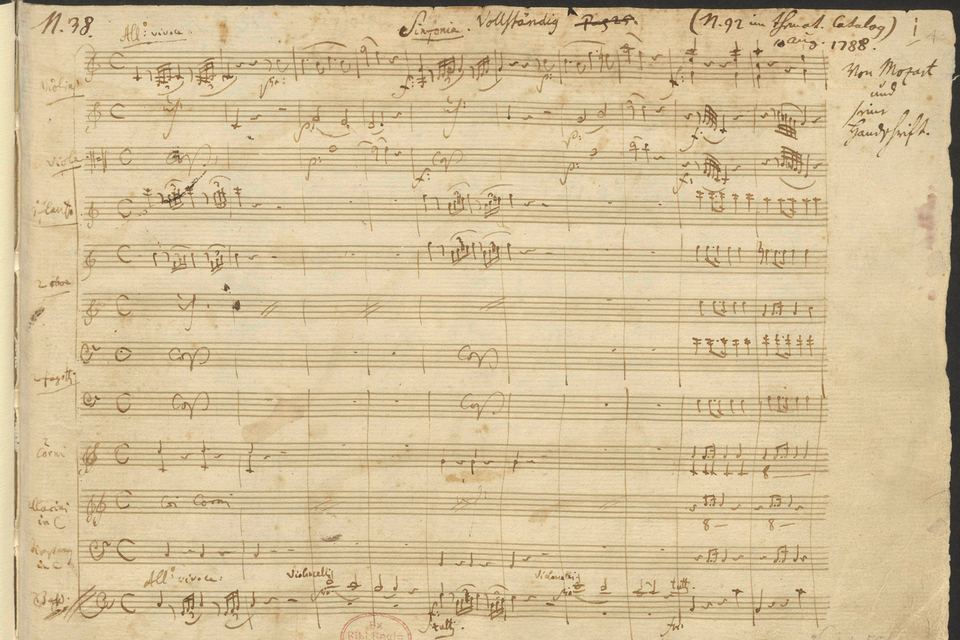
Mozart's Dissonance Quartet, K. 465, opens with a slow introduction. The cello enters first with repeated low notes. The viola is the second voice to enter. The second violin enters third, and the first violin enters last. The viola part is written in the alto clef.
The slow movement of Mozart's Clarinet Concerto in A major, K. 622, is an Adagio. The clarinet plays a long, singing melody over a soft accompaniment. The solo part is written for a clarinet in A, which sounds a minor third lower than written.
Recording of the Dissonance Quartet: Wikimedia Commons
Music: Envato (gballx)
Score reading check
Answer the eight questions. For a note in a C clef, find middle C first.
This note is in the alto clef. Which note is it?
In the alto clef, the middle line is middle C. The note sits on the middle line.
This note is in the alto clef. Which note is it?
The note is on the top line. Count up from middle C on the middle line. D is in the space above it, and E is on the fourth line. F is in the next space, and G is on the top line.
In the quartet score of this lesson, which staff uses the alto clef?
The viola reads the alto clef, and it is the third instrument of a string quartet score. The violins read the treble clef, and the cello reads the bass clef.
On which line of the tenor clef does middle C lie?
The tenor clef marks middle C on the fourth line from the bottom. The alto clef marks it on the middle line.
A clarinet in B♭ plays a written D. Which note sounds?
A clarinet in B flat sounds a major second lower than written. A major second below D is C.
A horn in F plays a written C. Which note sounds?
A horn in F sounds a perfect fifth lower than written. A perfect fifth below C is F.
An alto saxophone in E♭ plays a written C. Which note sounds?
An alto saxophone in E flat sounds a major sixth lower than written. A major sixth below C is E flat.
What is the lowest note of the violin?
The lowest string of the violin is the G below middle C. The violin cannot play lower than this open string.
You answered six or more questions correctly on the first try. You have completed this skill.
You need six correct answers on the first try. Read the lesson above again. Then press Try the check again.
After the check
If you misread the alto clef, find middle C on the middle line first. Then count up or down by lines and spaces.
If you mixed up the transpositions, remember the key in the name of the instrument. A written C on a clarinet in B flat sounds B flat.
Practice on another day: plan a melody of eight measures for the flute in D major. Keep it between D4 and G6. Mark breaths at the ends of the phrases.
The full level
- Membership costs US$4.99 a month. It includes all the lessons of the Level 7 Western path, the Level 7 test and the certificate.
- You can cancel at any time, and the certificate does not expire.
Next lesson: Scales in all keys