Tuner
Hum a low note and hold it. The tuner shows the note and how steady it stays.
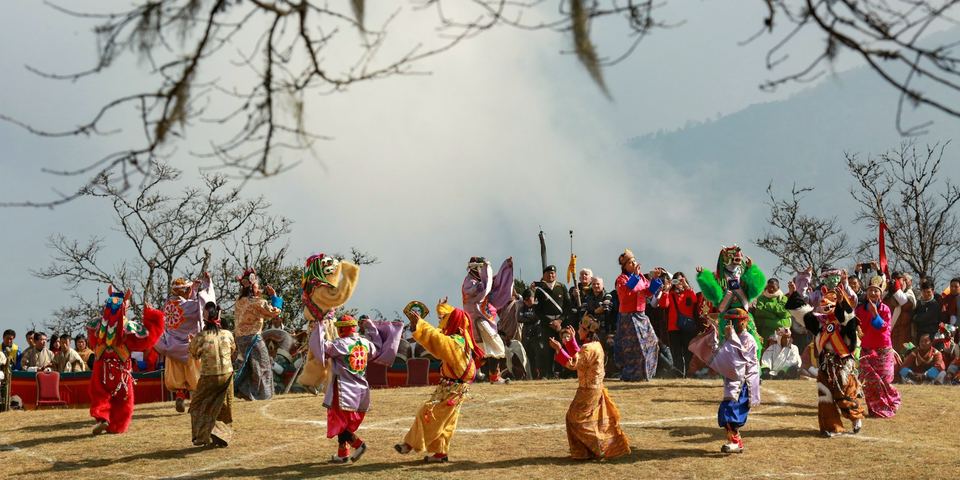
Tibetan music belongs to Tibet and to the Tibetan Buddhist lands of the Himalayas. Bhutan is one of these lands. In the monasteries, monks chant in deep, low voices to drums, cymbals, shawms and long horns. Outside the monasteries, people sing folk songs, perform lhamo opera and play the dranyen, a long-necked lute.
A bamboo flute plays a slow melody. The folk flute of Bhutan is the lingm, which is also made of bamboo. Listen for the long held notes.
Music: Envato (ProHits)
Much Tibetan religious music is chant. Monks chant their prayers together. They often chant at the lowest pitch that the voice can reach. A deep style of this chant is called gyuke. In some monasteries, a singer's voice sounds a low note with higher overtones above it.
The recording was made during the morning prayers of the monks at Ganze Gompa. This monastery lies in Kham, in eastern Tibet.
The dungchen is a long brass horn. Monks often play it in pairs, and its notes are long, slow and deep. The gyaling is a shawm, a pipe with a double reed. The kangling is a trumpet made from a leg bone.
Drums and cymbals keep the time. The rolmo are cymbals, and the damaru is a small drum shaped like an hourglass. The dril-bu is a hand bell. The bell, the damaru and the kangling came to Tibet from Indian Buddhist practice.
The second recording comes from Changangkha Lhakhang, which is a temple in Thimphu. Thimphu is the capital of Bhutan. In it, two monks play a pair of shawms.
Cham are sacred dances performed in costume and mask. In Bhutan, monks and laymen dance them at the festivals called tshechu.
The Drametse Ngacham is the mask dance of the drums from Drametse in eastern Bhutan. In it, sixteen men dance in costume and mask while ten musicians play cymbals, trumpets and drums.
Lhamo is Tibetan opera. It joins singing, dance, chanting and acrobatics, and its stories come from Buddhist teaching. Many actors wear a traditional mask. Different kinds of mask have their own shapes and colors. A performance begins with a prayer ceremony.
Bards sing the epic of King Gesar, who is a hero of legend. Tibetan bards use gestures and sound effects as they sing. Tibetan, Mongolian and Tu communities share the story. UNESCO lists the Drametse Ngacham, Tibetan opera and the Gesar epic as intangible cultural heritage.
Lu are Tibetan folk songs sung without instruments. Their singers use high pitches and a quick shake in the throat.
Nangma and toeshey are styles of song with dance. Nangma is popular in the karaoke bars of Lhasa.
The dranyen is a long-necked lute without frets. Its body is usually carved from one piece of wood. The Tibetan dranyen has six strings in three pairs. The Bhutanese dranyen often has seven strings. Players in Ladakh, Sikkim, Bhutan and other Himalayan lands use it to accompany songs.
Bhutan has two main forms of folk song. Zhungdra comes from the central valleys of Paro, Thimphu and Punakha. Its singers stretch long vocal tones in complex patterns over a simple melody. Boedra grew from Tibetan court music, and the chiwang fiddle often joins it.
The lingm is a flute with six holes, and the chiwang is a fiddle with two strings. With the dranyen, they make up the basic instruments of Bhutanese folk music. Rigsar is the modern popular music of Bhutan. It has electronic instruments and faster rhythms.
Many shops sell metal singing bowls as Tibetan instruments. Older accounts of Tibetan music do not mention them. Scholars believe that the use of the bowls for their singing sound is modern.
Begin with the chant. Listen for the lowest voice, and notice how slowly the prayers move. In the second recording, listen to the two shawms together.
To feel the low chant in your own voice, hum a comfortable low note and hold it steady. Keep the throat loose.
Hum a low note and hold it. The tuner shows the note and how steady it stays.
Choose one answer per question.
What is the dungchen?
The dungchen is a long brass horn. Monks often play it in pairs.
Which instrument is a long-necked lute without frets?
The dranyen is the lute. The gyaling is a shawm, and the rolmo are cymbals.
Where is the Drametse Ngacham danced?
The Drametse Ngacham is a mask dance of the Drametse community in eastern Bhutan.
It is the music of the Tibetan people and of the Tibetan Buddhist cultures of the Himalayas. It ranges from monastery chant to folk song, opera and modern pop.
Monasteries use the dungchen horn, the gyaling shawm, cymbals, drums and bells. Folk musicians play the dranyen lute, flutes and the piwang, which is a Tibetan fiddle with two strings. Bhutan has a similar fiddle called the chiwang.
Their link to Tibet is doubtful. Early accounts of Tibetan music say nothing about them. The bowls reached the West in the nineteen-seventies. There they became popular in new-age music, which is calm music made for relaxation.
It is chant at an extremely low pitch. Higher overtones sound above the main note. Monks use it in their prayers.
Bhutan has the folk songs zhungdra and boedra, the sacred cham dances and a modern pop style called rigsar.
Lhamo is the opera of Tibet. Performers in costume and mask sing, dance and act out Buddhist stories.
World MusicIndian musicBrass instrumentsSingingLevel 3 course