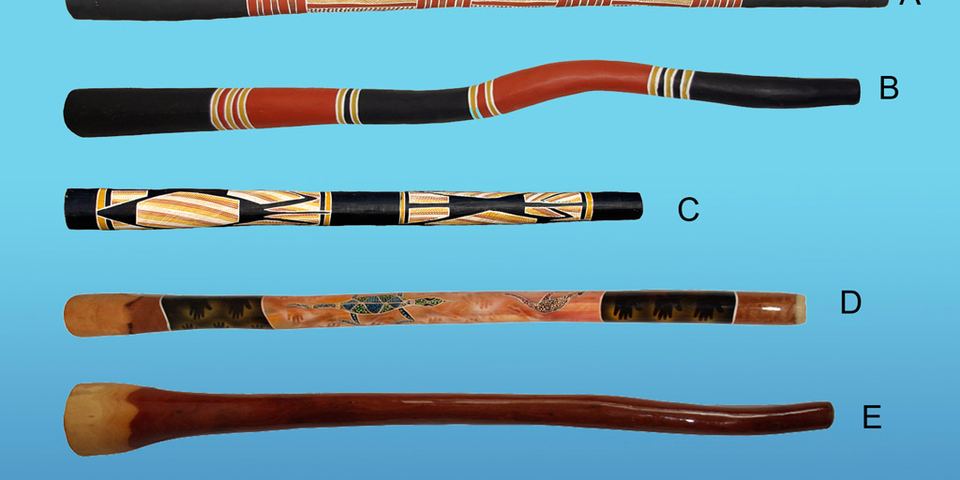
The didgeridoo
The didgeridoo is a long wooden wind instrument of the Aboriginal peoples of northern Australia. The Yolŋu people of northeast Arnhem Land call it the yiḏaki. The player buzzes the lips into one end to sound a deep, steady drone. Circular breathing keeps the sound going without a break. A traditional instrument is a eucalyptus trunk hollowed by termites.
A didgeridoo plays with percussion in this piece. Listen for the low drone and for the tone above it, which the player changes with the tongue, the cheeks and the lips.
Music: Envato (Triple7Music)
The sound of the didgeridoo
The first button plays a short passage on the didgeridoo. Listen to the drone first. It stays on one low note, while the tone above it keeps changing. The player moves the tongue, the cheeks and the lips, and the shapes let different overtones through.
In the second recording, clapsticks join the drone. In the songs of northern Australia the clapsticks set the beat, and the rhythms of the didgeridoo fit closely to them. These rhythms have been handed down for many generations.
Names of the didgeridoo
Didgeridoo is not a word from an Aboriginal language. It is probably an imitation of the sound of the instrument, and it appeared in Australian newspapers early in the twentieth century. Aboriginal peoples have many names of their own for the instrument. More than forty of them are still in use.
The Yolŋu peoples of northeast Arnhem Land call it the yiḏaki, which is written yidaki in English. Some Yolŋu people now use the word mandapul. They began to use it out of respect after the death of a man whose name sounded like yiḏaki. In the Kunwinjku language of west Arnhem Land the instrument is the mako, which is often written mago.
The Buku-Larrŋgay Mulka Centre, the Yolŋu art center at Yirrkala, gives a rule for these names. Yiḏaki is the right name only for instruments from northeast Arnhem Land that Yolŋu people made and decorated. Other instruments should be called didgeridoos, unless an Aboriginal maker gives them a local name.
History of the didgeridoo
The didgeridoo comes from northern Australia, most likely from Arnhem Land. Scholars do not agree on its age. Rock paintings show that people in the region have played it for many centuries. A painting on the northern edge of the Arnhem Land plateau shows a didgeridoo player with two song-men in a ceremony.
European visitors to the north coast described the instrument in the nineteenth century. A naval surgeon wrote an account of a voyage around the world. It includes a drawing of a man from Raffles Bay, on the Cobourg Peninsula, playing the instrument. Other visitors saw players in the same area with pipes of bamboo about a meter long.
For a long time the instrument belonged only to the north. Until the middle of the twentieth century, it was known only in the eastern Kimberley and the northern third of the Northern Territory. In the second half of the century it spread across Australia and the world. Aboriginal players toured widely, and David Blanasi, a Bininj man from west Arnhem Land, brought the mako to world attention. Aboriginal musicians now also play the didgeridoo in concert halls with orchestras.
The role of the didgeridoo in music
The didgeridoo sounds a drone. This is a low and continuous note beneath the music. In traditional music it accompanies singers and dancers. A song-man sings and strikes the clapsticks, and the didgeridoo player accompanies him. The rhythm of the didgeridoo and the beat of the clapsticks lock together exactly.
Some Aboriginal peoples call the clapsticks bilma. In the song style called wangga, the singer begins alone. He then adds the clapsticks, and the didgeridoo joins them. Outside ceremony, the didgeridoo is also played alone for pleasure.
The yiḏaki in Yolŋu life
For the Yolŋu, the yiḏaki belongs to ceremony, song, dance, painting and story. It is tied to Yolŋu law and to their country. Yolŋu elders describe the yiḏaki and the clapsticks as the rhythm and pulse of the stories told in their ceremonies.
At the Garma Festival in northeast Arnhem Land, Yolŋu elders issued a statement on the yiḏaki through the Yothu Yindi Foundation. It rests on five principles. They include respect, Aboriginal law, permission and ethical relationships. It says that Yolŋu law governs how the yiḏaki is made and used, and that permission from the custodians of that law is required. It also warns that the trade in instruments can separate the yiḏaki from its origins in sacred stories.
In ceremonies the didgeridoo is traditionally played by men. Customs outside ceremony differ between communities. Researchers have recorded Aboriginal women in the north playing it in informal settings. In parts of southeastern Australia, many Aboriginal people strongly object to women playing it. A learner shows respect by asking about the custom of the place and following it.
How the didgeridoo is made
A traditional yiḏaki is made from a young eucalyptus tree, often a stringybark, whose heartwood termites have eaten. The termites remove only the dead heartwood. The living outer wood keeps them away. The maker uses knowledge of the land and of termite activity to find a hollow trunk. Some makers peel back a little bark and knock on the wood to hear whether the hollow will resonate well.
The maker cuts the tree down and cleans out the hollow. The bark is removed, the ends are trimmed, and the outside is shaped and sanded. A rim of beeswax may be added at the mouthpiece. It seals against the lips and makes playing more comfortable. Yolŋu makers often paint the finished yiḏaki, and the painting can carry cultural meaning.
Most didgeridoos are about one hundred twenty to one hundred fifty centimeters long, and some reach three meters. A longer instrument usually sounds lower. A flared instrument sounds higher than an unflared one of the same length. Modern makers also use bamboo, glass, fiberglass, clay and plastic pipe. These new designs have raised debate about their aesthetics, their ethics and their legal standing.
How the didgeridoo is played
The player keeps the lips loose and buzzes them into the mouthpiece, as a brass player does. The drone is the basic sound. The mouth and throat then work as a second resonator. When the player moves the tongue, some bands of overtones are held back and others pass through. These shifting bands, called formants, work like the vowels of speech. They give the didgeridoo a sound close to speech.
The voice can add calls above the drone. These calls often imitate Australian animals such as the dingo and the kookaburra. Blowing harder gives a second, higher note. It lies about an octave and a fourth above the drone.
In circular breathing, the player breathes in through the nose while the cheeks push stored air out through the lips. The drone continues without a break. Skilled players can keep one note sounding for as long as they wish.
What makes a fine didgeridoo
The bore shapes the voice of the instrument. A termite-hollowed trunk has an irregular bore that usually widens toward the far end. Its resonances are not evenly spaced. This gives the traditional instrument a complex tone that a smooth plastic pipe does not have.
Researchers at the University of New South Wales studied why players prefer some instruments. The main reason was simple. Players prefer instruments whose own resonances are weak in the range where the mouth shapes the formants. On such an instrument the player's mouth controls the tone more fully. The players in the study also preferred drones between A1 and F2. These notes lie low in the bass.
A fine didgeridoo also has a smooth, comfortable mouthpiece that seals well against the lips. Its walls are sound and free of cracks. A traditional yiḏaki carries the knowledge of its maker. That knowledge reaches from the choice of the tree to the painting on its surface.
Choosing a didgeridoo
Choose a didgeridoo by its key, the note of its drone. A longer instrument usually has a lower key. Try the drone and the higher overblown note on any instrument you consider.
Ask the seller where the instrument was made and by whom. Art centers owned by Aboriginal communities, such as the Buku-Larrŋgay Mulka Centre at Yirrkala, sell instruments made by Aboriginal makers. A plastic or wooden tube with a smooth bore costs less and is a common practice instrument. Its sound differs from that of a termite-hollowed trunk.
Who keeps these instruments
The Yolŋu clans of northeast Arnhem Land are the custodians of the yiḏaki. Learning the yiḏaki in the Yolŋu way needs the permission of elders who hold the right to teach it. The Buku-Larrŋgay Mulka Centre at Yirrkala is a Yolŋu art center that exhibits and sells yiḏaki made by Yolŋu makers. Its Mulka Project keeps an archive of Yolŋu films, recordings and photographs.
The Yothu Yindi Foundation runs the Garma Festival in northeast Arnhem Land. Its statement on the yiḏaki sets out how Yolŋu people ask others to treat the instrument. Yolŋu masters have taught yiḏaki classes there for visitors.
Museums outside Australia also keep didgeridoos. The Metropolitan Museum of Art in New York holds a yiḏaki of the twentieth century. It is a little over one and a half meters long.
First steps on the didgeridoo
Learn the drone alone first. Relax your lips and blow gently until the sound stays steady. Use as little air as you can. Then change the shape of your mouth, as if you were saying different vowels, and listen to the tone.
Practice circular breathing away from the instrument first. Fill your cheeks with air and push it out slowly with them. At the same time, breathe in through your nose. Try it with a straw in a glass of water, and watch for a steady stream of bubbles.
A short check
Choose one answer per question.
How does a player keep the drone going without a pause for breath?
The player breathes in through the nose while the cheeks push stored air out through the lips. The drone does not stop.
What hollows out the trunk of a traditional didgeridoo?
Termites eat the dead heartwood of living eucalyptus trees. Makers look for trunks that the termites have hollowed.
What do the Yolŋu people call the instrument?
Yiḏaki is the Yolŋu name. The art center at Yirrkala uses it for instruments made and decorated by Yolŋu people.
What changes the tone above the drone?
The mouth and throat work as a second resonator. Moving the tongue changes which bands of overtones pass into the sound.
Sources

Common questions
What is a didgeridoo made of?
A traditional didgeridoo is a eucalyptus trunk hollowed by termites. Modern makers also use bamboo, glass, fiberglass, clay and plastic.
Who plays the didgeridoo traditionally?
The Aboriginal peoples of northern Australia play it. In traditional ceremonies men play it, while customs for other settings vary.
Can women play the didgeridoo?
In ceremonies it is traditionally played by men. Customs outside ceremony differ between communities, and some communities object to women playing it. Ask about the custom where you learn.
What is circular breathing?
Circular breathing lets a player sound a note without stopping. Air stored in the cheeks keeps flowing out while the player breathes in through the nose.
How long is a didgeridoo?
A didgeridoo measures from about one meter to three meters. Most are about one hundred twenty to one hundred fifty centimeters long.
What is a yidaki?
Yiḏaki, written yidaki in English, is the Yolŋu name for the instrument. Strictly, it means the type made and played by the Yolŋu peoples of northeast Arnhem Land.
Where does the word didgeridoo come from?
It is not an Aboriginal word. It is probably an imitation of the sound of the instrument. It was first printed in Australian newspapers early in the twentieth century.