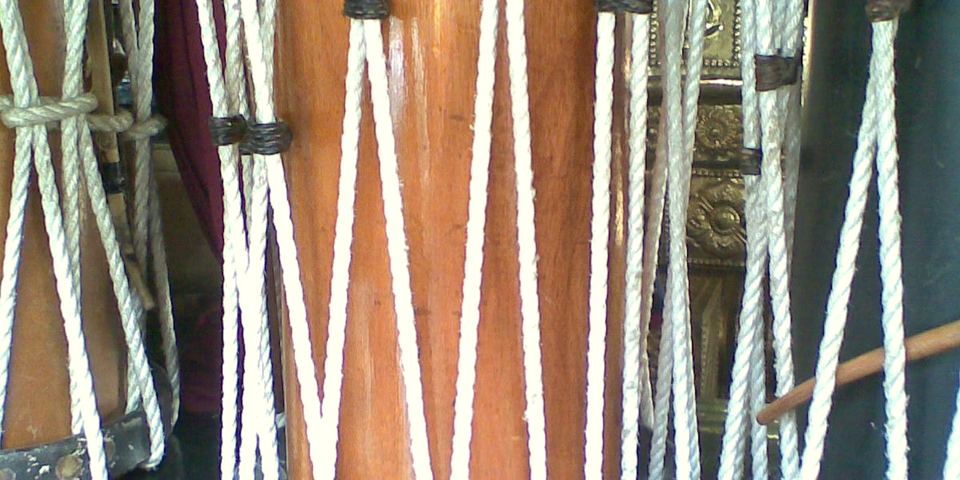
The chenda
The chenda is a cylindrical drum of Kerala in South India. It is famous for its loud, sharp sound. The player hangs it from the shoulder and strikes the upper skin with two thin sticks. Large groups of chenda players lead temple festivals. It also accompanies Kathakali and other dance dramas of Kerala.
The skins of the chenda
The two skins of the chenda sound different. The edamthala has one or two layers of cow skin. It gives a high, sharp crack.
The valamthala has five or seven layers. It gives a deep bass. A chenda melam joins both sounds with cymbals and wind instruments.
Names of the chenda
In Malayalam the drum is the chenda. In Tulu Nadu, on the coast of Karnataka, it is called the chende. The left head is the edamthala, and the right head is the valamthala.
Chenda melam means music for a group of chendas. Chendas also take their names from their purpose. The uruttu chenda leads the group, and the veekku chenda keeps the basic rhythm.
Where the chenda is played
The chenda comes from Kerala, and it is also played in Tulu Nadu in coastal Karnataka. It is closely tied to the cultural identity of both regions. The craft of making it belongs to a few families of smiths in villages such as Peruvembu and Vellarkad.
The role of the chenda in music
The chenda is mainly played at Hindu temple festivals. A melam of many drummers marches with the temple procession, and decorated elephants carry the image of the deity.
The chenda also accompanies the dance dramas and rituals of Kerala. Among them are Kathakali, Koodiyattam and Theyyam. In Tulu Nadu it plays for the dance drama called Yakshagana.
Music for the chenda
Kerala has several forms of chenda melam. Panchari melam is the best known. Its cycle has six beats. The performance moves through five stages of ninety-six, forty-eight, twenty-four, twelve and six beats, and it grows more intense from stage to stage.
In panchari melam the chendas play with cymbals called ilathalam. A curved horn called the kombu joins them, and so does a reed pipe called the kuzhal. Pandi melam is another major form.
Thayambaka is a solo form. A single chenda player improvises in the center. A group of chendas and cymbals keeps the rhythm around the soloist.
How the chenda is made
The body is about thirty centimeters across and is made of the soft wood of the jackfruit tree. Makers thin the wall at points along its length so that the drum resonates.
The skins are fastened to rings of palm wood or bamboo with a gum made from seeds. The rings are boiled, bent into circles and dried. Ropes join the two rings and set the tension. Players replace worn rings often to keep the sound bright.
How the chenda is played
The player hangs the chenda from the shoulder so that one skin faces up. On the uruttu chenda, the right hand rolls the wrist between strokes. The palm turns in and out. This stroke gives the rolls of the lead drum.
On the veekku chenda, the player strikes hard and straight without rolling the wrist. This stroke keeps the basic rhythm of the melam.
How the chenda has changed
Chenda melam has been part of Kerala festivals for more than three centuries. A lighter style called shingari melam uses cheaper, harder skins. It is popular at celebrations, but players do not count it among the classical forms.
Choosing a chenda
A student starts on a practice block. A teacher then chooses the first drum, because chendas are made in several sizes for different art forms.
Ask a maker from the Kerala tradition for a jackfruit-wood shell. Check that the rings are tight and the skins are even.
First steps on the chenda
In the traditional way, a student first strikes a stone or a block of wood. The practice stick is thick and is usually made of tamarind. The student then learns on the bass head of the veekku chenda, and later on the uruttu chenda.
Lessons begin and end with the Ganapathi kai. It is a fixed pattern of strokes offered as a prayer to the deity Ganapathi.
Next comes a repeated exercise called sadhakam. The pattern Tha Ki Ta has three strokes. The student plays it at one speed and then at twice and four times that speed. The cycle stays the same length. Practice it with the metronome.
A short check
Choose one answer per question. The explanation appears below the correct answer.
Which skin of the chenda gives the bass sound?
The valamthala has five or seven layers of cow skin, so it sounds deep. The thin edamthala sounds high and sharp.
In panchari melam, how many beats are in the basic cycle?
Panchari is a cycle of six beats. The performance grows faster through stages of ninety-six, forty-eight, twenty-four, twelve and six beats.
What does a beginner practice on first?
Students first strike a stone or block of wood with a thick stick. They move to the bass chenda and then to the uruttu chenda.
Sources
Common questions
Why is the chenda so loud?
The tight skin and the hard sticks give a sharp attack. A melam of many chendas can be heard far across a temple ground.
What is the chenda made of?
The shell is jackfruit wood. The heads are cow skin on rings of palm wood or bamboo, and ropes join the rings.
What is chenda melam?
It is a performance by a group of chenda players, often with cymbals and wind instruments. It is a part of almost all festivals in Kerala.
Which art forms use the chenda?
It accompanies Kathakali, Koodiyattam, Theyyam and Kannyar Kali in Kerala. In Tulu Nadu it plays for Yakshagana.
What is thayambaka?
Thayambaka is a solo chenda performance. The soloist improvises on the high skin over a steady rhythm from other chendas and cymbals.
How long does it take to learn the chenda?
Students spend a long time on the practice stone before they touch a drum. Leading a melam takes many years of study with a teacher.
World MusicIndian musicTablaPunjabi dholMetronome