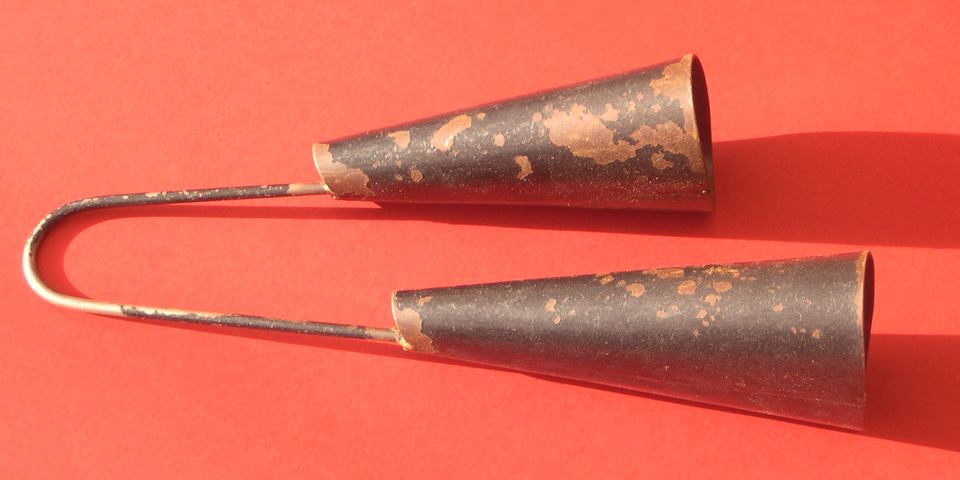
The agogo bell
The agogo is a double bell with no clapper. A curved handle joins two metal cones of different lengths, and the two cones give different pitches. The player strikes them with a stick. The agogo comes from the Yoruba and neighboring peoples of Nigeria. In Brazil it is heard in candomblé, capoeira and samba.
This piece is a batucada. A batucada is the drumming of a samba percussion group. Deep surdo drums mark the beat. Above them, the pandeiro and the tamborim play quick patterns. The pandeiro is a tambourine, and the tamborim is a small frame drum played with a stick. Listen for the agogo. Its two bells give a high note and a low note.
Music: Envato (Waderman)
The sound of the agogo bell
A rhythm on a modern agogo opens the recordings. The second recording is one stroke on the higher bell. The third is one stroke on a large agogo.
Names of the agogo bell
Agogo is a West African word. The Edo, Idoma, Igala and Yoruba peoples of Nigeria use ágogo for a bell with no clapper. The bell may be single or double. In Brazil the name is written agogô.
Where the agogo bell is played
The agogo began in West Africa. Enslaved West Africans carried the instrument and its name to the Americas. In Brazil it became part of Afro-Brazilian music, both religious and popular.
The role of the agogo bell in music
Drums are at the heart of Yoruba music, and the agogo plays with them. It belongs to the Ìpèsè, a drum ensemble of the Ifá festivals. It is also heard in jùjú, apala and fuji, which are popular styles of Yoruba music.
Music for the agogo bell
In Brazil the agogo is played in candomblé, a religion of African origin. It accompanies capoeira, which is the Afro-Brazilian martial art. It played in choro groups in the twentieth century. It also plays in the bateria, which is the percussion section of a samba school at Carnival.
How the agogo bell is made
The traditional agogo is made of wrought iron. Today makers use various metals and sizes. The bells are fan-shaped pieces of sheet metal rolled into cones. A U-shaped piece of metal joins the two bells.
A longer bell gives a lower note, and a shorter bell gives a higher one. Thick walls vibrate less than thin walls, so the thickness of the metal also shapes the sound.
How the agogo bell is played
Hold the agogo so that its handle rests in your palm. The openings of the bells face away from you, and the smaller bell sits above the larger one. Strike the bells with a stick or a beater of wood or metal.
Choosing an agogo bell
Listen to both bells before you buy. Both bells should give a clear pitch, and the two pitches should be easy to tell apart.
Thin metal rings more freely than thick metal. Choose a thickness that suits the music and the room.
First steps on the agogo
Hold the agogo with the small bell on top. Strike the small bell and the large bell in turn. Play slowly with the metronome. Keep the strokes at the same height and force, so that the two pitches sound even.
A short check
Choose one answer per question.
Which bell of the agogo gives the higher note?
The length of a bell sets its pitch. A shorter bell sounds higher, and a longer bell sounds lower.
Which people of Nigeria use the word ágogo for a bell?
The Yoruba, Edo, Idoma and Igala peoples of Nigeria use ágogo for a bell with no clapper.
Sources
Common questions
What is an agogo bell?
It is a double bell from West Africa with no clapper. The two bells have different pitches, and a stick strikes them.
What is an agogo made of?
The first agogos were wrought iron. Modern agogos come in several metals and sizes.
How do you hold an agogo?
Grip the handle in one hand with the openings facing away. The smaller bell goes above the larger one.
Where is the agogo used in Brazil?
It is used in candomblé, in capoeira and in the samba bateria of Carnival. Many Brazilian popular musicians use it as well.
Does the agogo have a clapper?
No. The agogo is a clapperless bell, so the player strikes the outside of the bells with a stick or a beater.
How did the agogo reach Brazil?
Enslaved West Africans brought the instrument and the knowledge of how to make it. Its name came with it.
World MusicClave rhythmGuiroMetronome