Skip to the main content
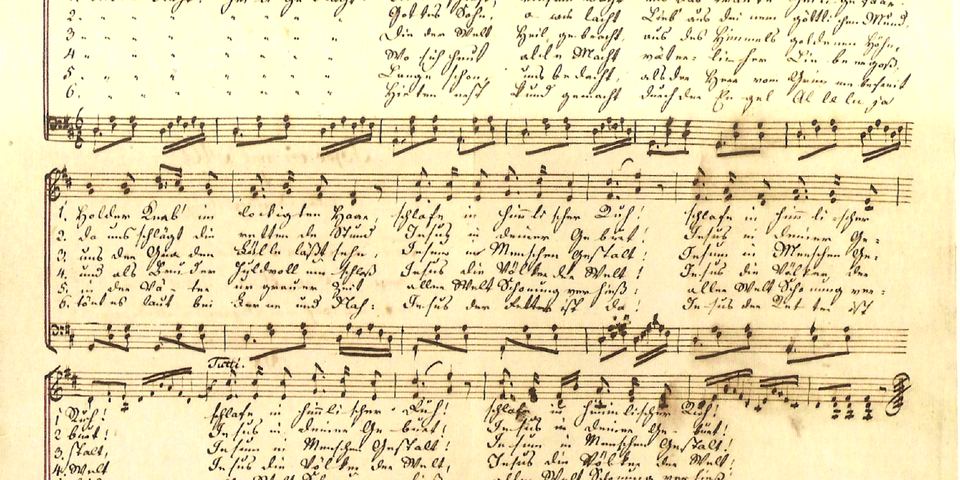
A handwritten score of Stille Nacht with the verses written below the staves
Image: Wikimedia Commons

Silent Night

Silent Night is a Christmas carol from Austria. Its German title is Stille Nacht, heilige Nacht. Joseph Mohr, a young priest, wrote the words. Franz Xaver Gruber, a schoolteacher and organist, wrote the melody. The carol was first sung in Oberndorf, near Salzburg, on Christmas Eve 1818.

Franz Xaver Gruber, Silent Night (Stille Nacht). This arrangement is for solo harp. Listen for the rhythm, in which the beats divide into three.

Music: Envato (PremiumBeat)

The story of the carol

Joseph Mohr wrote the poem two years before the carol was first sung. He was then an assistant priest in the village of Mariapfarr in the Salzburg region. Later he moved to Oberndorf on the Salzach River.

On Christmas Eve, Mohr brought his poem to Gruber. Mohr asked Gruber for a melody with an accompaniment for guitar. The carol was to be sung at the Christmas service that night. It was first heard in the Church of St. Nicholas in Oberndorf.

An organ builder who worked on the church organ took the song home to the Zillertal valley in Tyrol. Traveling families of folk singers from the valley sang it on their tours. In time it reached the rest of Europe and America.

Gruber's tune has changed a little since then. The version sung today is slower and calmer than his original. The English words most often sung were translated by John Freeman Young. He was a priest in New York. His version uses three of Mohr's six verses.

How the music works

Silent Night is in six-eight time. A measure has two beats, and a beat divides into three. This rhythm comes from an old dance from Sicily called the siciliana. Gruber wrote the carol in D major.

The melody moves mostly by step and has few large leaps, so it is easy to sing. It needs only three chords. They are built on the first, fourth and fifth notes of the scale. In D major these chords are D, G and A7.

Listen for the last two phrases. The melody climbs to its highest notes and then falls back to the tonic.

♯♯ABAF♯ABAF♯EEC♯DDA
The pitches of the opening of Silent Night in D major, as it is sung today: A, B, A, F-sharp, A, B, A, F-sharp, E, E, C-sharp, D, D, A

The carol on the piano

Music: Envato (Praded)

Franz Xaver Gruber, Silent Night (Stille Nacht). This arrangement is for piano with strings and bells. Listen for the piano, which plays the melody over the soft strings.

Free sheet music

IMSLP has a manuscript of Silent Night in Gruber's own hand and an early English edition. Mutopia has public-domain scores of the carol, among them one that follows Gruber's original version.

Learn to play it

Silent Night was first sung with a guitar, and it is a good first carol for guitarists. Learn the chords D, G and A7. Strum two beats to a measure, and feel the beats in three. Singers can learn the melody by ear, since it moves mostly by step.

Common questions

Who wrote Silent Night?

Joseph Mohr wrote the words, and Franz Xaver Gruber wrote the melody. Both lived near Salzburg in Austria.

Where was Silent Night first sung?

It was first sung in the Church of St. Nicholas in the village of Oberndorf near Salzburg.

Why was Silent Night written for guitar?

Mohr asked Gruber for a guitar accompaniment for the service that night. The story that the church organ was broken is often told, but it is not proven.

What are the chords of Silent Night?

In D major the chords are D, G and A7. In C major they are C, F and G7.

What is the time signature of Silent Night?

It is in six-eight time. A measure has two beats, and a beat has three eighth notes.

What does Stille Nacht mean?

Stille Nacht means silent night. The full German title is Stille Nacht, heilige Nacht, or Silent night, holy night.

Sources

Occasion musicO Holy NightGuitarSingingLevel 2