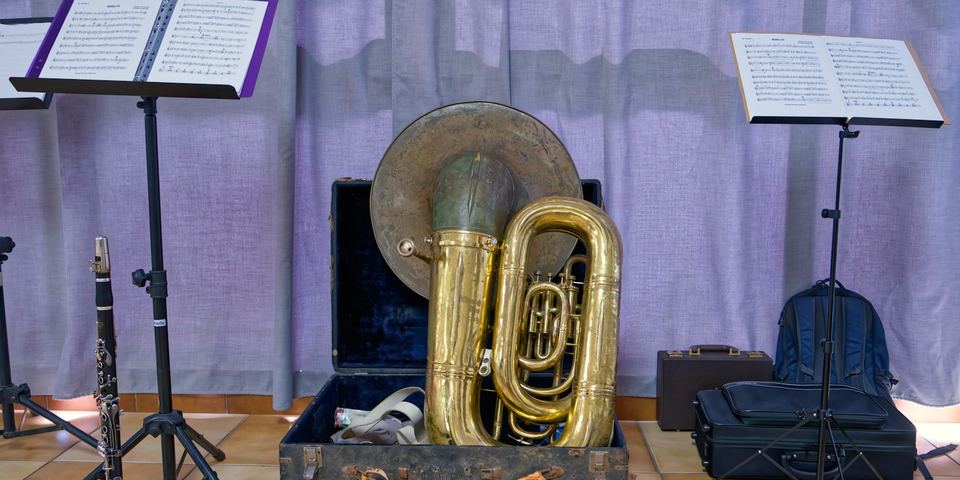
The tuba
The tuba is the lowest brass instrument of the orchestra and the band. Its long tube widens toward a large bell. The player buzzes the lips into a cup-shaped mouthpiece, and three to six valves change the length of the tube. Most tuba music is written in the bass clef.
This early record teaches the brass family. The horn, the cornet and the trombone play first. The tuba then plays the song Rocked in the Cradle of the Deep, and a brass quartet ends the record.
The sound of the tuba
Young listeners were meant to learn from it how the brass instruments sound. They play short melodies alone in turn. The tuba comes fourth. It plays the same nineteenth-century song as the trombone before it in a deeper voice. Listen for its round tone and its soft attack. Early recording machines caught low sounds poorly, so the tuba sounds lighter on this record than it does in a concert hall.
The first button below plays the tuba passage alone. The next one plays a low C major scale. A low held note and a higher held note follow. The last note is short and detached, which musicians call staccato.
Names of the tuba
The word tuba is Latin for "trumpet." A person who plays it is a tubist or a tuba player.
The letters in a tuba's name give the note of its open tube. The large contrabass tubas are the BB-flat and CC tubas. The smaller bass tubas are pitched in F or E-flat. In British brass bands the tubas are called basses. Players speak of the E-flat bass and the B-flat bass, and they call the larger one the double B.
Older names survive in scores and catalogs. In the nineteenth century, the wide band tubas of Central Europe were often called bombardons. A tuba that circles the player's body is a helicon. The sousaphone is the American form of the helicon.
History of the tuba
Before the tuba, bands and orchestras had no good brass bass. The serpent was a wooden bass horn with finger holes, and players often found its tone weak and uneven. A Paris maker then built the ophicleide. It was a metal bass with keys over large tone holes. It was louder and steadier, and French orchestras used it. Valves were invented early in the nineteenth century, and makers soon tried them on bass instruments.
The tuba itself was born in Berlin, which was the capital of Prussia. The military bandmaster Wilhelm Wieprecht worked with the instrument maker Johann Gottfried Moritz. Together they patented the bass tuba in F, which had five valves. It was the first successful valved brass instrument in the contrabass range. With its valves it could play all the notes of the scale deep into the bass.
Other makers soon built their own forms. In Paris, Adolphe Sax made a family of saxhorns in E-flat and B-flat. The largest saxhorns became the tubas of the British brass band, and their design has changed little since. In Austria-Hungary, the Czech maker Václav František Červený built wide tubas with rotary valves. He is credited with the first contrabass tuba in B-flat.
Marching bands needed a tuba that a player could carry. The helicon wraps around the body, and its bell rests above the left shoulder. In the United States, John Philip Sousa had a helicon built with its bell pointing up. Later makers turned the bell forward, and the sousaphone took its familiar shape. In Italian opera orchestras, the tuba replaced the older bass instruments early in the twentieth century.
The role of the tuba in music
In the orchestra one tuba plays the bass of the brass section. In loud passages it also strengthens the bass of the strings and the woodwinds. A few large works call for a second tuba. In a brass quintet the tuba plays the bass under two trumpets, a horn and a trombone.
Bands use more tubas. A concert band or a military band usually has two to four of them. A British brass band has one part for the E-flat basses and one for the B-flat basses. The parts usually have two players apiece. In American marching bands and in the banda music of Mexico, the tuba often takes the form of the sousaphone.
Early jazz bands used the tuba for a steady bass on the main beats, and they usually chose the sousaphone. Musicians call this bass pattern oom-pah. Early recording machines caught low sounds poorly. When a band or an orchestra made a record, a tuba often joined the double bass or took its place.
Music for the tuba
Composers wrote solos for the tuba soon after its invention. Wieprecht himself wrote a concertino for it. Many solos of the nineteenth century were polkas or sets of variations with band accompaniment. Tuba players still perform arrangements of the variations on the Carnival of Venice by Jean-Baptiste Arban.
At the end of "Jupiter" from The Planets by Holst, the tuba strengthens the bass of the full orchestra. Ravel orchestrated Pictures at an Exhibition by Mussorgsky. In the movement "Bydło," the tuba plays a famous high solo. Ravel wrote it for the small French tuba in C, which was the orchestral tuba of France in his time.
In the twentieth century the tuba became a solo instrument of the concert hall. Ralph Vaughan Williams wrote his Concerto in F minor for bass tuba and orchestra, and it is still the best-known tuba concerto. Paul Hindemith wrote a sonata for tuba and piano. Many concertos for tuba with orchestra or with band have followed.
How the tuba is made
A tuba is a long brass tube that widens steadily from the mouthpiece to the bell. A tube of this kind is called a conical bore. The tuba belongs to the family of valved bugles. The euphonium and the flugelhorn belong to it too. Their wide conical bores favor the lower overtones of the notes, so the tone is mellow and warm. The large bell strengthens the deepest notes.
Tubas are built in four pitches. The bass tubas in F and E-flat have about twelve and thirteen feet of tube. The contrabass tubas in C and B-flat have about sixteen and eighteen feet. The tube is coiled into a compact shape. Makers also describe size in quarters. A full-size tuba is called four-quarter, and smaller student models are three-quarter or half size.
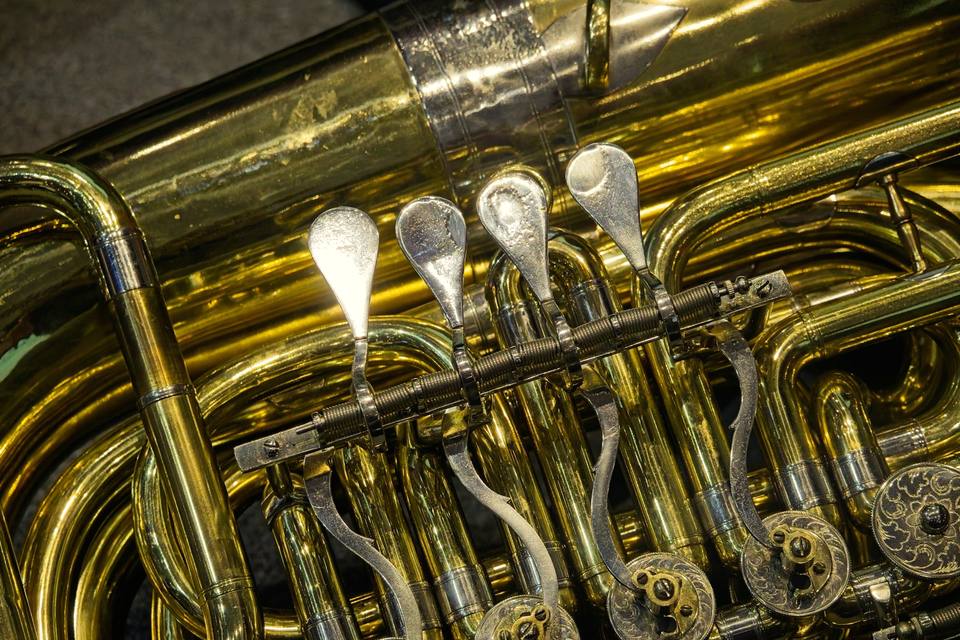
Most tubas have three to six valves. Piston valves move up and down, and rotary valves turn inside a round case. The first valve lowers the pitch by a whole step, the second by a half step and the third by a minor third. A fourth valve lowers it by a perfect fourth, which helps the low notes sound in tune. On many British band tubas the fourth valve is compensating. Its tube passes back through the other three valves, and small extra loops correct the tuning of the lowest notes.
The mouthpiece has a deep cup. Its rim is usually about thirty-two to thirty-four millimeters across. Most tubas are made of brass that is lacquered or plated with silver. Some sousaphones have a bell of fiberglass, which makes them lighter to carry.
How the tuba is played
Players sit and rest the tuba on the lap or on a stand. The bell points up. The lips buzz into the mouthpiece, and the right hand presses the valves. The player picks one of the notes that the tube can sound by changing the buzz of the lips.
The tuba needs a large, steady breath. Long, slow notes build the breath and the tone. On any tuba, the range from F1 up to middle C is comfortable. Solo music goes lower and higher. The wide bore makes the deep pedal notes easy to sound. These notes lie below the normal range.
Tuba music is written in the bass clef at the pitch you hear. High passages stay in the bass clef with ledger lines. British brass bands are the exception. Their tuba parts use the treble clef, as the other parts of the band do. A player can then change instruments and keep the same fingerings.
What makes a fine tuba
The bore shapes the sound most of all. A wide bore and a large bell give a dark, broad tone that fills a hall. A narrower bore responds more quickly and sounds lighter. The rate at which the tube widens toward the bell is called the taper, and it also changes the color of the tone. Makers design these measurements together, so two tubas in the same key can sound quite different.
The metal also changes the tone. Most tubas are made of yellow brass. Brass with more copper, sometimes called gold brass, gives a warmer tone. The York company made two large C tubas for the Philadelphia Orchestra from brass with a high share of copper. Players still call them some of the finest tubas ever made, and several makers have built copies.
The valves must be airtight and quick. Piston valves should move without sticking, and rotary valves should turn quietly. A fine tuba plays in tune across its range. A good fourth or fifth valve lets the player correct the low notes without forcing the lips. The slides should move freely, and the joints should be clean.
Size should suit the player and the music. Many orchestral players use a large C or B-flat tuba for most music and a smaller F tuba for high solos. Ask a teacher to play a tuba before you buy it. Listen for an even tone from the lowest notes to the highest.
Choosing a tuba
Many student tubas have three valves and are called three-quarter size or half size. They are lighter and easier for a young player to hold. Tubas in B-flat are the most common in schools, partly because school marching bands use B-flat sousaphones.
A tuba is heavy and costly, so many students start on an instrument that the school band lends. Ask the band teacher which tuba the band uses before you buy one.
Who keeps these instruments
An F tuba made in Manchester for the tubist of the Hallé Orchestra is now in the University of Edinburgh collection. It was built near the end of the nineteenth century. Tubas of this kind were the usual British orchestral tuba until the middle of the twentieth century.
A few giant tubas survive. Near the end of the nineteenth century, the Besson firm built a subcontrabass tuba in B-flat. It sounds an octave below the usual contrabass tuba. The Harvard University Band keeps it and has restored it to playing condition. The Chicago Symphony Orchestra owns the two large York tubas described above. Its principal tubists have played them for decades.
Moritz in Berlin, Červený in Austria-Hungary and Besson in Paris and London shaped the tuba family. In the United States, Conn, Holton, York and King built tubas before the Second World War. Their designs became the models for later American tubas.
First steps on the tuba
Buzz the lips without the tuba first. Then buzz into the mouthpiece alone and hold a steady sound.
Play a long low note on the tuba with no valve pressed. Breathe in deeply, and keep the sound even until the end of the breath. Then play the notes of a C major scale slowly with the metronome.
A short check
Choose one answer per question.
Which family does the tuba belong to?
The player's lips buzz into a cup-shaped mouthpiece. That makes the tuba a brass instrument.
What does a valve do on a tuba?
A pressed valve sends the air through an extra loop of tube. The longer tube gives a lower note.
Which clef does most tuba music use?
Most tuba music is written in the bass clef at the pitch you hear. British brass bands are the exception.
What is a sousaphone?
The sousaphone wraps around the player, and its bell faces forward. It is made for marching bands.
Sources
Common questions
Is the tuba hard to learn?
A first goal is a steady low B-flat with no valve pressed, and many beginners play it in the first lesson. The valves work as on the trumpet. The tuba needs a lot of air, and the breath grows stronger over the first months.
What is the difference between a tuba and a euphonium?
Both are brass instruments with wide conical tubes and valves. The tuba is larger, and it plays about an octave lower.
How many valves does a tuba have?
Most tubas have three or four valves. Some professional tubas have five or six, which help with low notes and tuning.
What is the difference between a tuba and a sousaphone?
A sousaphone is a tuba built for marching. Its tube circles the player's body, and its bell faces forward.
Which tuba does a beginner play?
Most beginners play a B-flat tuba with three or four valves. A younger player may start on a smaller three-quarter size tuba.
Does a tuba read treble clef?
Usually not. Tuba music is written in the bass clef. In British brass bands, the E-flat and B-flat tubas read the treble clef as transposing instruments.
Who invented the tuba?
The Prussian bandmaster Wilhelm Wieprecht and the Berlin instrument maker Johann Gottfried Moritz patented the first bass tuba. It was pitched in F and had five valves.