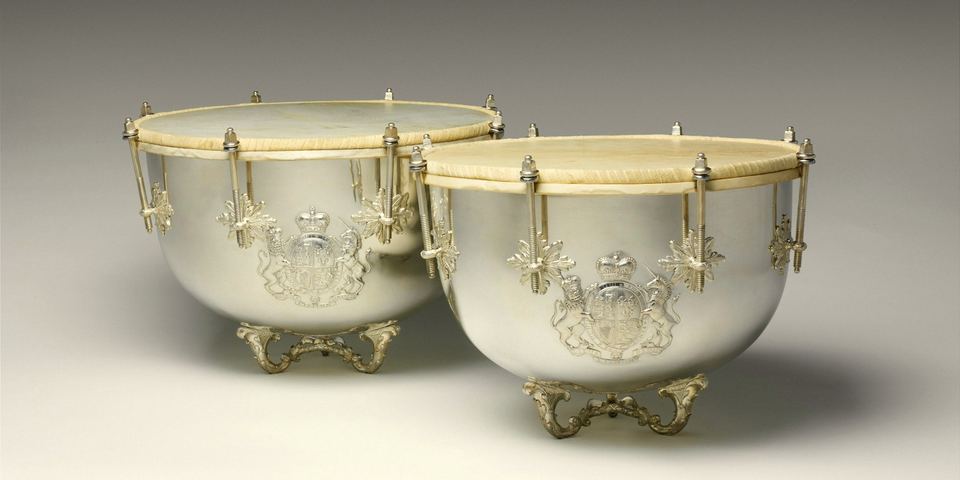
Timpani
Timpani, or kettledrums, are large drums that sound definite notes. The drums are copper bowls with heads stretched across their tops. A pedal tightens or loosens the head, which raises or lowers the note. A timpanist usually plays a set of four drums with soft mallets. Timpani are the main drums of the orchestra.
This scherzo is the second movement of the Ninth Symphony by Beethoven. Beethoven tuned the two timpani an octave apart. They answer the orchestra with short solos. Early records caught low sounds faintly, so the drums sound softer here than in a concert hall.
The sound of timpani
Listen for the clear pitch of the drums. The first recording is a roll that grows from soft to loud. A growing loudness of this kind is a crescendo. Then you hear one stroke on a large drum and one on a small drum. The set ends with a steady roll and three strokes on one drum.
Names of the timpani
Timpani is the Italian plural. A single drum is a timpano. Players often call the set timps for short. In English the drums are also called kettledrums.
A player of the timpani is a timpanist.
Where timpani are played
Kettledrums came to Europe from the Middle East in the Middle Ages. The small nakers arrived with returning crusaders. They were the ancestors of most timpani. Larger kettledrums were later played on horseback with trumpets in cavalry bands.
Timpani play in orchestras, concert bands and marching bands. They also play in film music and in some rock music.
The role of timpani in music
In music of the Classical period the timpani usually play the tonic and the dominant, the first and fifth notes of the key. They strengthen the bass and mark the rhythm.
A timpani roll can build a long crescendo, which is a growth from soft to loud. A single loud stroke can mark the end of a phrase.
Music for timpani
Mozart usually wrote for a pair of timpani tuned to the tonic and the dominant of the key. Beethoven gave the timpani more varied and more prominent parts.
With pedal timpani, a player could retune a drum during a piece. Richard Strauss often gave the timpani the bass line, and later composers wrote glissandos for them.
How timpani are made
The bowl is usually copper, fiberglass or aluminum. The head is plastic film. Some instruments have a calfskin head. Tension rods around the rim hold the head.
On pedal timpani, a foot pedal moves all the rods at once. The timpanist can change the note quickly, even while the drum sounds. Some drums have a gauge that shows the note.
How timpani are played
The timpanist strikes the head about four inches from the edge. A stroke in the center sounds dull and short. The mallet lifts quickly off the head so that the drum rings.
Mallets have handles of hardwood or bamboo, and most have heads of felt. Hard mallets sound sharp. Soft mallets sound round and warm.
How timpani have changed
Early timpani were tuned by hand screws around the rim. Changing a note took time, so composers wrote few changes.
Machine timpani and then pedal timpani made tuning fast. Composers began to write melodies and glissandos for the timpani.
Choosing timpani
Timpani are large and costly, so students usually learn on the timpani of a school, a band or a conservatory. Practice pads let students work on strokes at home.
A beginner first learns to play snare drum strokes and to read rhythm. Ear training helps, because the drums must be tuned to exact notes.
First steps on the timpani
Hold the mallets loosely between the thumb and the first finger. Let the other fingers rest around the handle.
Strike the head a few inches from the edge, and let the mallet bounce away. Play slow strokes of even strength with the metronome. Alternate the two hands. Then play a slow roll and speed it up gradually.
A short check
Choose one answer per question.
What changes the pitch of a timpano?
The pedal tightens or loosens the head. A tighter head gives a higher note.
How many drums does a standard set of timpani have?
A standard set has four drums of different sizes. They cover different ranges of notes.
Where do players usually strike the head?
A stroke a few inches from the edge gives a clear note. The center sounds dull.
What is a timpani roll?
In a roll the mallets strike quickly in turn. The sound becomes one long note.
Sources
Common questions
Are timpani tuned?
Yes. The drums sound definite notes. The timpanist tunes it with the pedal and checks it by ear.
What is the difference between timpani and a bass drum?
Timpani sound definite notes and are tuned to the music. A bass drum gives a deep sound with no clear pitch.
What are timpani heads made of?
Most heads are made of plastic film. Some players prefer calfskin, which gives a warmer sound but reacts to humidity.
What is a timpano?
Timpano is the Italian singular. It means one drum of the set.
Why are timpani also called kettledrums?
The drums have round bowls like large kettles. The head is stretched across the top of the bowl.
What mallets do timpanists use?
They use mallets with felt heads. Timpanists keep several pairs, from soft to hard, for different sounds.