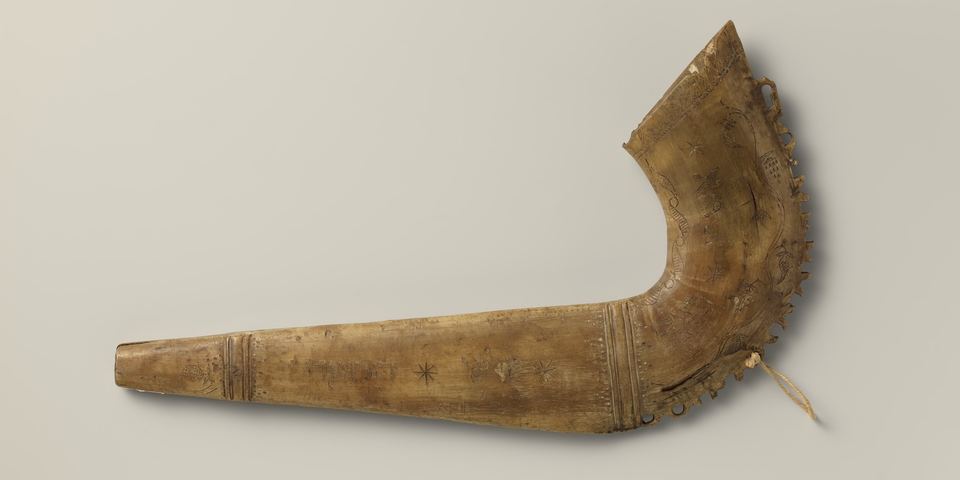
The shofar
The shofar is a horn blown in Jewish worship. It is usually a ram's horn. It has no finger holes and no valves, so the player shapes the sounds with the lips. Its calls are heard on Rosh Hashanah, which is the Jewish New Year. They also sound at the close of Yom Kippur, which is the Day of Atonement.
The calls of the shofar
The shofar does not play melodies. Its music is a small set of calls, and the calls have names. The tekiah is one long, unbroken blast. The shevarim is three short blasts with small breaks between them. The teruah is a rapid series of short blasts. Most communities sound it with quick strokes of the tongue. The last tekiah of a series is held as long as the breath allows. It is called the tekiah gedolah, which means the great tekiah.
The calls are blown in fixed sets, and the sets open and close with a tekiah. The first set joins tekiah, shevarim, teruah and tekiah. The second set is tekiah, shevarim and tekiah. The third set is tekiah, teruah and tekiah. Sounded three times apiece, these sets make the thirty calls that Jewish law requires per day of Rosh Hashanah. By custom about one hundred calls are sounded in the full service.
| Call | Hebrew | What you hear |
|---|---|---|
| Tekiah | תקיעה | A long, steady blast |
| Shevarim | שברים | Short blasts in a group of three |
| Teruah | תרועה | A rapid series of short blasts |
| Tekiah gedolah | תקיעה גדולה | A very long final tekiah |
Names of the shofar
The Hebrew word is shofar (שופר), and the plural is shofarot. The person who sounds the shofar is called the baal tekiah, which means master of the blast.
The Hebrew Bible uses the word shofar many times. It uses a different word, ḥatzotzrah (חצוצרה), for the silver trumpets of the Temple. The two instruments sounded together in the Temple in Jerusalem.
History of the shofar
The shofar is one of the oldest instruments still in use. The Hebrew Bible tells of a shofar blast from the cloud on Mount Sinai. It describes the shofar at the walls of Jericho and in war. It also describes the shofar announcing the new moon and the Jubilee. The Jubilee came once in fifty years, when land returned to its first owners. The first day of the seventh month is now Rosh Hashanah. The Bible calls it a day of blowing the horn.
In the Temple in Jerusalem, the shofar sounded with the trumpets. On Rosh Hashanah a straight shofar of ibex horn stood between two trumpets. The ibex is a wild mountain goat. Its mouthpiece was covered in gold. On fast days, curved rams' horns trimmed with silver joined the trumpets.
After the Temple was destroyed, the shofar kept its place in prayer. The Talmud is the great collection of Jewish law and teaching. Its rabbis set the rules for the calls of the shofar and for the horns that may be used. In Talmudic times the shofar also announced the start of the Sabbath. Today it sounds in synagogues around the world.
When the shofar is sounded
The main time is Rosh Hashanah. On both of its days the calls follow the reading of the Torah and continue through the additional service called Mussaf. When Rosh Hashanah falls on the Sabbath, the shofar is not sounded on that day. The shofar also sounds at the end of Yom Kippur, when the day of fasting is over. Many communities blow a single tekiah gedolah, and others blow a full set of calls.
Through the month of Elul, before Rosh Hashanah, many communities sound the shofar after the weekday morning prayers. The calls stop on the last day of Elul. This pause marks the difference between the custom of Elul and the commandment of the festival.
The commandment is to hear the shofar. Listeners fulfill it by hearing the calls with intention. For this reason the baal tekiah sounds the shofar on behalf of the whole congregation. People who cannot come to the synagogue are often visited, so that they can hear it too.
How the shofar is made
A shofar may be made from the horn of almost any animal of the family that includes sheep, goats, antelopes and cattle. The one exception is the cow, whose horn is not used. A ram's horn is preferred, because it recalls the ram of the binding of Isaac in the Book of Genesis. A horn has a core of bone inside an outer sheath of keratin. Keratin is the material of fingernails. The maker removes the bone and the soft tissue to leave the hollow sheath.
The maker softens the horn with heat and shapes it. A hole is drilled from the narrow end into the natural hollow. Ashkenazi Jews trace their roots to Central and Eastern Europe, and their shofarot have a plain mouth hole. Sephardi Jews trace their roots to Spain and Portugal, and their shofarot usually have a small carved mouthpiece. The Jews of Yemen use the long spiral horn of the kudu, which is an African antelope. The Moroccan shofar is flat and has one broad curve.
The shofar works like a bugle. The player buzzes the lips against the hole, and the air inside the horn vibrates. The horn has no valves, so the player changes the note with the lips alone. The horn can sound only a few notes, which are called its natural notes. The hollow is irregular, so the step between the two main notes varies from horn to horn. It may be as narrow as a fourth or as wide as a sixth. A fourth spans four notes of the scale, as from C up to F. A sixth spans six, as from C up to A.
How the shofar is played
The baal tekiah sets the mouth hole at one side of the lips, where the lips are firm, and buzzes into it. A clear tekiah needs a steady stream of air and firm lips. The shevarim needs three equal blasts with short breaks. The teruah is made with quick strokes of the tongue, as in the fast tonguing of a trumpet player.
Blowers practice through Elul, when the shofar sounds on weekday mornings. Communities also train new blowers yearly. In some communities a second person calls out the name of a call before it sounds, and the blower answers with the call.
What makes a fine shofar
For the ritual, a shofar must be whole. A crack or a hole that changes the sound makes it unfit. It may not be painted, though it may be carved with designs. Silver plating is sometimes added for display, and a plated shofar is not used in the ritual.
For the player, a fine shofar speaks easily and gives a clear, strong tone. The inside is clean and smooth and keeps no remains of the bone core. The mouth hole is well made and fits the lips comfortably. Longer horns usually give lower and fuller tones.
A good maker finishes the outside with care. Some makers polish the horn, and others leave it natural.
Choosing a shofar
Buy a shofar from a seller who can say how it was made and whether it is fit for the ritual. Blow it before you buy it, if you can, and choose one that speaks easily for you.
A beginner often does best with a ram's horn of medium size. Small horns are hard to sound, and long horns take more breath. Keep the shofar dry and away from heat, and clean it after use.
Who keeps these instruments
Historic shofarot are held in museums in Europe and America. The Rijksmuseum in Amsterdam holds a ram's horn shofar of the seventeenth century. It is engraved with flowers and leaves and has cut decoration on its outer curve. It also carries a Hebrew verse from Psalm 89. The Jewish Museum in New York holds shofarot from many communities. Its collection includes horns from Germany, Egypt and Yemen.
Synagogues keep shofarot for the services of the year. Before Rosh Hashanah, communities check that their horns are whole. An international day of shofar study is held at the start of Elul to improve the skill of the blowers.
First steps on the shofar
Begin without the shofar. Buzz your lips gently, as a trumpet player does, until you can hold an even buzz. Then place the mouth hole at one side of the mouth, where the lips are firm, and buzz into it.
Aim first for one steady tekiah. Then practice the shevarim with three even blasts. Practice the quick teruah last. Ask an experienced baal tekiah to listen to you and to correct the length of your calls.
A short check
Choose one answer per question.
What is a tekiah?
The tekiah is one long blast. The sets of calls open and close with it.
On which festival is the shofar mainly sounded?
Rosh Hashanah is the Jewish New Year, and the shofar is sounded mainly on that festival. It also sounds at the close of Yom Kippur.
How does the player change the note of a shofar?
The shofar has no finger holes and no valves. The lips choose among the natural notes of the horn.
Sources
Common questions
What is a shofar?
It is a horn that is blown in Jewish worship. It is usually a ram's horn, and it has no finger holes and no valves.
When is the shofar blown?
It is blown on Rosh Hashanah, at the end of Yom Kippur and on weekday mornings in the month of Elul.
What are the sounds of the shofar?
The tekiah is one long blast. The shevarim is three short blasts, and the teruah is a rapid series of shorter blasts.
Why is a ram's horn used?
The ram's horn recalls the ram of the binding of Isaac. Horns of sheep, goats and antelopes may also be used. A cow's horn is never used.
Why is the shofar not blown on the Sabbath?
Under Jewish law the shofar is not sounded when Rosh Hashanah falls on the Sabbath. The rabbis feared that the blower might carry it, which is forbidden work on that day.
Is the shofar hard to play?
It takes practice, because the lips alone shape the sound. A steady buzz and firm lips come first.
World MusicBrass instrumentsTrumpet