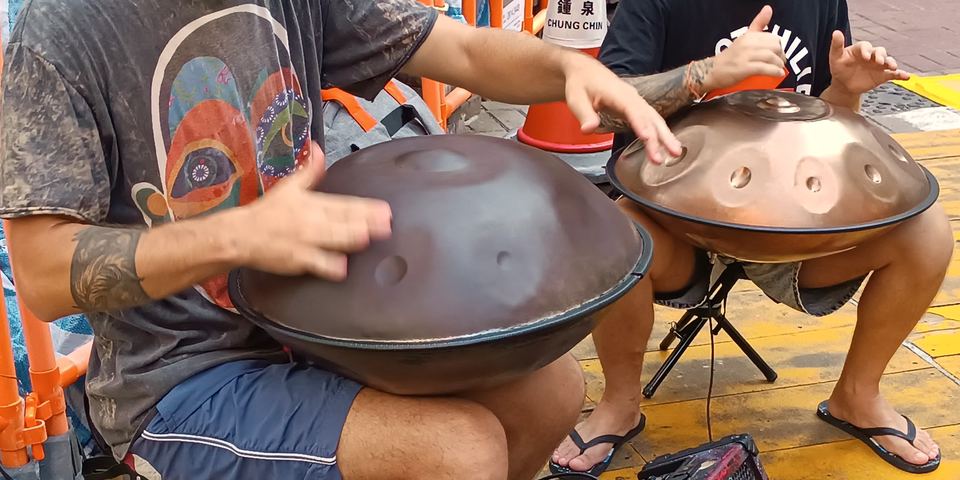
The handpan
A handpan is a steel instrument shaped like a lens and played with the hands. Its top carries a central note with a ring of seven or more notes around it. It grew from the steelpan of Trinidad and Tobago. The first of its kind was made in Switzerland around the turn of the twenty-first century.
The notes of the handpan ring on after the strokes. Hear how they overlap.
Music: Envato (WormwoodMusic)
The sound of the handpan
The three recordings below come from one live handpan performance. Listen to how a note rings on after the stroke and overlaps the next one. A tone field sounds its main note together with two tuned overtones, the octave and the fifth above that octave. A single stroke therefore sounds full.
All the notes of a handpan belong to one scale, so the notes blend easily. Listen for the deep central note under the higher notes of the ring. On many handpans this note is the tonic of the scale.
Names of the handpan
Handpan is the general name for these instruments. The first of them was called the Hang, a word that means both hand and hillside in the Bernese German dialect. Hang is a protected name, so other makers call their instruments handpans. The word handpan first appeared on the website of an American steelpan maker, and players on online forums made it the general name.
Many people say hang drum. The makers of the Hang say that this name is wrong. The instrument sounds from its own metal, as the steelpan does, so it is not a drum in the strict sense. Players call the central note on top the ding and the opening in the bottom the gu. The notes around the ding form the tone circle.
History of the handpan
The handpan comes from the steelpan of Trinidad and Tobago. A steelband played in the Swiss city of Bern, and it led a group of Swiss makers to the steelpan. They learned the art of hammered steel from artists and scientists in Trinidad. In their Bern workshop they built steelpans and studied how a hammered dome of steel holds its pitch.
Around the turn of the twenty-first century, the same workshop presented a new instrument at a trade fair in Frankfurt. It joined two shells of steel into a closed lens. The top carried a central note with seven or eight notes around it, and the bottom had a round opening. The makers called it the Hang.
The first Hang came in many scales. Some drew on scales of other musical cultures. Among them were the Akebono scale of Japan and the Hijaz of Arabic music. Later versions had lower notes and a coat of brass over the steel. In the end the makers settled on a single scale. The workshop then stopped making the Hang and turned to new instruments of its own.
Interest in the Hang far outran the supply. Other builders began to make similar instruments, and the general name handpan spread with them. Handpans are now made by many builders around the world. They differ in their steel, their shape, the forming of their notes and their ways of tuning.
The role of the handpan in music
A handpan is a melody instrument with a small set of notes. A handpan is tuned to a single scale, and the scale is set when the instrument is made. To play in another key, a player needs another handpan. Some players set two handpans with different scales side by side, so they can reach more notes.
The handpan can carry a melody over its own bass, so it often plays alone. It also accompanies singers and joins guitars, flutes and percussion in small groups.
Music for the handpan
Handpan music is a young tradition. Players learn from one another, and much of the music is composed or improvised by the players themselves. The early scales of the Hang drew on scales from several cultures. Their names include Aeolian, Hijaz and Akebono. Aeolian is the natural minor scale of Western music. Akebono is a five-note scale from Japan.
The notes of the tone circle are laid out in a zigzag from low to high. A player who strikes them with the left and right hands in turn climbs or descends the scale. Many handpan melodies grow from this layout. The ding sounds below them as a low tonic.
How the handpan is built
A handpan is made from two shells of steel. The shells are pressed into shape and glued together at the rim, so the inside is hollow. The notes on the top shell are shaped areas of metal called tone fields. A field is flattened, and a small dome rises at its center.
The tuner shapes the fields with a hammer. The hammer work sets the stresses in the steel. The tuner works until the main note, its octave and the fifth above that octave sound in tune together. A larger field gives a lower note. The central note on top is called the ding.
The bottom shell has a round opening called the gu. The air inside the shell and the air in the opening sound a deep bass note together. This is called a Helmholtz resonance, and it works like the note of a bottle when you blow across its mouth.
The first instruments used steel hardened by nitriding. Nitriding is a treatment with hot gas. Many makers also use stainless steel.
How the handpan is played
The player rests the handpan on the lap and strikes the notes with the fingers and the hands. A handpan played by hand sounds softer and warmer than a steelpan played with sticks.
The notes are tuned with two of their overtones: the octave and the fifth above that octave. The place and the force of a stroke can bring out these overtones or mute them. A light, quick stroke lets the note ring freely.
Players also tap the rim of the gu for a high note with a long ring. A hand over the opening changes the bass, and a hand slid across the surface gives a sound like a shaker. To learn the notes, play the tone fields in turn and find their notes on the tuner.
What makes a fine handpan
A fine handpan is tuned in its overtones as well as its main notes. On all the fields the main note, its octave and the fifth above the octave should sound in tune with one another. When they agree, the note rings long and clear. When they do not, the note sounds sour or wavers.
The fields must also keep apart. On a well-made handpan, a stroke on one field leaves the neighboring notes almost silent. On a poor one, other notes ring along and blur the melody. The ding should sound as clear as the notes of the ring, and the bass from the gu should be strong and even.
How long the tuning lasts depends on the steel and the hammer work. Nitrided steel has a hard surface, but it needs oil to keep away rust. Stainless steel resists rust better, and its tone differs. Weak hammer work lets a note slip out of tune after strong playing.
Choosing a handpan
Choose a handpan first by its scale. Listen to the scale before you buy, because the notes cannot be changed later.
Nitrided steel needs a thin coat of oil to keep away rust. Stainless steel resists rust better, but it still needs care. Keep any handpan dry.
Before you buy, play all the notes and check them with a tuner. Strike one note and listen to check that the others stay quiet. Ask the maker whether the instrument can be retuned, and how often it will need tuning.
Who keeps these instruments
The Hang was born in a workshop in the Swiss city of Bern. The same workshop still builds instruments of hammered steel and keeps Hang as a protected name.
The craft itself comes from Trinidad and Tobago, where the steelpan is the national instrument. There, steelbands and pan tuners keep the art of hammered and tuned steel alive at Carnival. Handpan builders today draw on that knowledge. Players and builders also meet in online communities that grew from the first forums on the Hang.
First steps on the handpan
Sit with the handpan on your lap so that the ding faces up. Strike the ding with the pad of one finger and lift the finger at once, so the note can ring. A light stroke sounds better than a hard one.
Next, play the notes of the tone circle from the lowest to the highest. Use the left and right hands in turn. Follow the zigzag of the notes. Return to the ding between phrases. Check the notes with the tuner, and learn their names.
A short check
Choose one answer per question.
What is the ding of a handpan?
The ding is the central note on the top shell. The other notes form a circle around it.
Where does the deep bass of a handpan come from?
The air inside the shell sounds through the opening in the bottom. This opening is called the gu. The effect is a Helmholtz resonance. A bottle gives a note in the same way when you blow across it.
Which instrument did the handpan grow from?
The first handpan was built by steelpan makers in Switzerland, who had learned the craft of hammered steel from Trinidad.
Which overtones are tuned in the tone fields?
A tone field sounds its main note with the octave above it and the fifth above that octave.
Sources
Common questions
Is a handpan a drum?
Not in the strict sense. A handpan is a struck steel instrument with tuned notes. It has no stretched skin. Like a bell, it sounds from its own metal.
What is the difference between a handpan and a steelpan?
A steelpan is made from an oil drum and played with rubber-tipped sticks. A handpan is made from two glued shells and played with the hands. Its sound is softer.
Why is it called a hang drum?
The name comes from the Hang, which was the first instrument of this kind. Its makers say that the name is wrong. Handpan is the general name.
How many notes does a handpan have?
The first Hang had a central note with seven or eight notes around it. A bass note also sounds from the opening in the bottom shell.
Is the handpan good for beginners?
Yes, in one way. All the notes of a handpan belong to one scale, so a first melody stays in the key. Clear and even strokes take longer to learn.
How do you take care of a handpan?
Wipe off fingerprints after you play. Oil a nitrided handpan regularly, and keep any handpan away from damp air.
What is the difference between a handpan and a steel tongue drum?
A steel tongue drum has tongues cut into its metal, and the tongues sound one note apiece. A handpan has hammered tone fields with tuned overtones, and its sound is fuller.