Advanced scales
Grade 6 piano exams include scales in many keys and the arpeggio of the diminished seventh. This lesson begins with B major, which has five sharps. The diminished seventh is built from three minor thirds.
The aim of this lesson
Play the B major scale up one octave with the right hand. Then play the arpeggio of the diminished seventh on B. You complete the lesson when you play the scale with no wrong note. The arpeggio shows as a second skill on your skill map.
The B major scale
B major has five sharps: F sharp, C sharp, G sharp, D sharp and A sharp. Only E and B are white keys.
The right hand uses the fingering of C major. Fingers 1, 2 and 3 play B, C sharp and D sharp. The thumb passes under to play E. Fingers 2, 3, 4 and 5 play F sharp, G sharp, A sharp and B.
The left hand starts with finger 4. Fingers 4, 3, 2 and 1 play B, C sharp, D sharp and E. Finger 4 crosses over to play F sharp. Fingers 3, 2 and 1 play G sharp, A sharp and B.
What the exam lists include
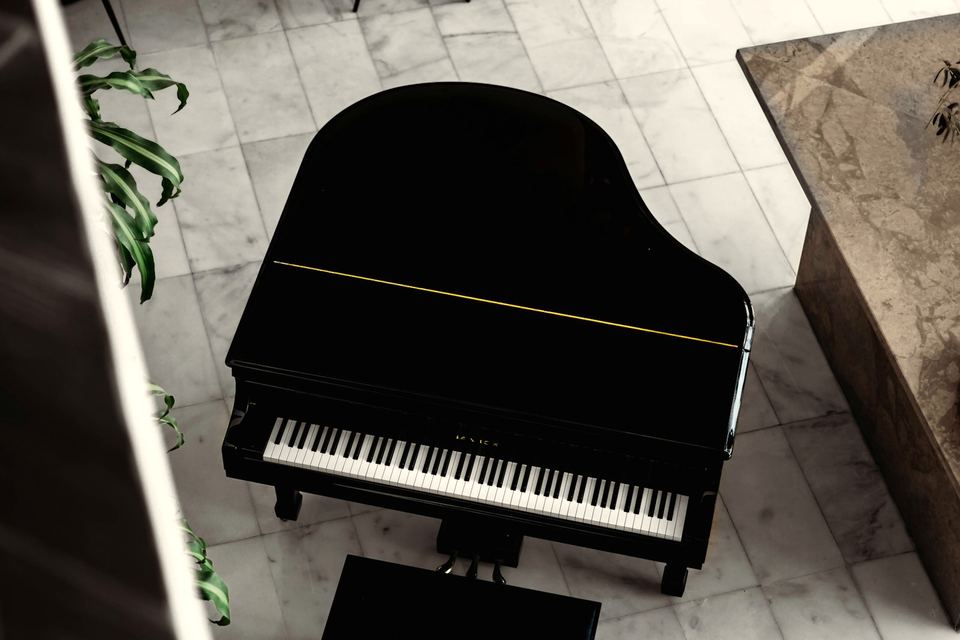
At Grade 6, piano exams include scales with both hands together over several octaves. The lists also include chromatic scales, arpeggios and the arpeggios of seventh chords.
The lists differ from board to board. Check the scale list of your own exam board before you practice.
Music: Envato (StanNau)
Scales in music
Mozart's Sonata in D major, K. 576, has quick runs of scale notes in its first movement. Listen for runs in the right hand and then in the left hand.
A run sounds even only when the thumb passes under smoothly. Practice the thumb movement slowly first.
Playing the B major scale
Play the scale up one octave with the right hand. Start with your thumb on the B below middle C.
The scale has five black keys: C sharp, D sharp, F sharp, G sharp and A sharp.
Play the keys on the screen, or connect a digital piano with a USB cable.
The diminished seventh
A diminished seventh chord is built from three minor thirds. On B, the notes are B, D, F and A flat. All the intervals from one note to the next are minor thirds: B to D, D to F and F to A flat.
B is the leading tone of C minor, and A flat is the sixth note of C harmonic minor. So this chord is the leading-tone seventh of C minor.
For one octave, the right hand plays B, D, F and A flat with fingers 1, 2, 3 and 4. Finger 5 plays the upper B. Play the arpeggio up and down.
Play the keys on the screen, or connect a digital piano with a USB cable.
After playing
If you played A where the scale needs A sharp, say the five sharps aloud before you start. In the arpeggio, A flat is the black key directly to the left of A.
Practice on another day: play B major with the left hand alone. Then play the diminished seventh on C sharp: C sharp, E, G and B flat.
The full level
- Membership costs US$4.99 a month. It includes all the lessons of the Level 6 Western path, the Level 6 test and the certificate.
- You can cancel at any time, and the certificate does not expire.
Next lesson: Analyzing a piece