Music audition guide · United States
New England Conservatory Audition Guide
New England Conservatory (NEC) in Boston asks every applicant for a prescreening video or a portfolio. Applicants who pass the prescreen give a final audition at NEC. Some may send a recorded final in its place. Each instrument and program has its own page of requirements.
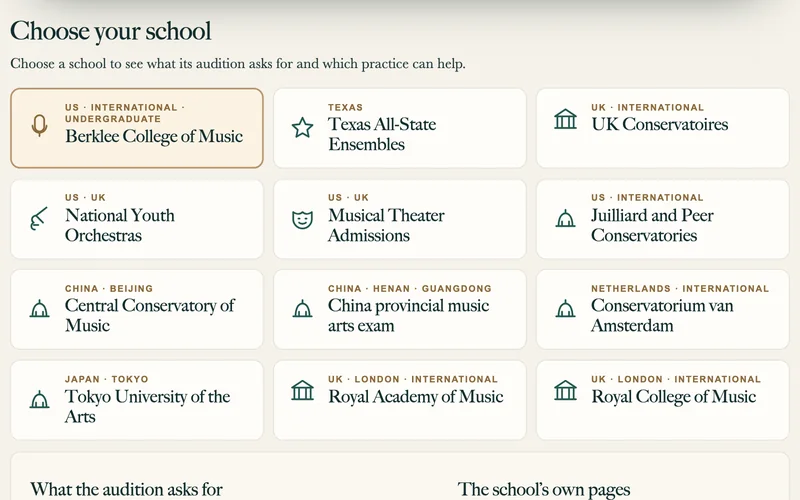 Start conservatory audition practicePractice the parts of the audition in order. Each part explains what the panel listens for.Open
The Music Stem is not affiliated with the New England Conservatory.
The application and the prescreen
Your application includes the prescreening video or portfolio, school transcripts, two short essays and an artistic resume. The resume is a short list of your teachers, performances, competitions and awards. Contemporary Musical Arts applicants write a third essay. You also record a short introductory video, which the faculty uses to get to know you. NEC says this video does not count in the admission decision.
The recording rules are the same for most programs:
- Each piece or movement is one uninterrupted recording with no editing. Contemporary Musical Arts is the one exception.
- Each piece or movement goes in its own file, labeled with the composer, the title and the movement.
- A professional recording is not needed. The sound should be good, and the lighting should be clear.
- The camera shows your whole instrument and how you play it.
- For violin, viola, cello and voice, NEC prefers a pianist where the music has one, but it does not require one.
The final audition
Final auditions take place at NEC in Boston. A recorded final is allowed only in some programs. It is open to applicants who live more than five hundred miles (about eight hundred kilometers) from NEC. After the prescreen decision you can switch between a live and a recorded final. NEC says a switch from live to recorded is the easier one. If you might be able to come in person, choose a live final.
The following are some examples of the final:
- Piano. The prescreen is a complete Classical sonata, a Romantic work and a fast etude. All three are played from memory. At the final you play these and one more piece in a contrasting style.
- Voice. Bachelor of Music singers prepare an art song in English, one in Italian and one in a language of their choice. NEC does not accept arias for this program.
- Percussion. Candidates may be asked to sight-read on any instrument and to play scales, arpeggios and rudiments.
NEC also asks applicants to consider a wide range of repertoire, including music from their own cultural background.
Jazz Performance
For the prescreen you improvise on two contrasting pieces. The first is a blues or a jazz standard, and the second is a piece of your choice. NEC prefers live musicians, but play-along tracks are allowed.
At the live final you play a jazz standard and a contrasting piece from memory, and you improvise on them. Both must differ from your prescreen pieces. NEC provides piano, bass and drums, and you bring three lead sheets. You also identify chords, sing and play back short melodic phrases, and sight-read.
Contemporary Musical Arts
This program is for musicians who write, arrange and lead their own music. For the prescreen you send two contrasting pieces. The first is a new version of an existing piece in your own style. You are its main performer, arranger or director. The second is an original piece or a second new version. NEC does not accept a pair of originals.
At the final you perform both pieces and sing and play back short phrases. You improvise over short chord progressions. You also play a supporting part in a band, such as a bass line or chords behind a soloist. There is an interview and an aural skills test of intervals, chords and memory for melody and rhythm. Recorded finalists do the interview and the test by video call.
Composition
You send three original scores as PDF files. Add recordings where you have them, live or computer-generated. You also record a video of about five to ten minutes that answers NEC's set questions about you as a composer. NEC decides from the portfolio alone. There is no prescreen round and no interview.
After admission
All new students attend orientation. It includes placement exams and ensemble auditions, and orchestral students audition for the orchestra conductors.
How to prepare
A file for each movement. NEC wants each movement as its own unedited file, labeled with the composer, the title and the movement. Label each file that way as soon as you record it, so nothing is mixed up at upload.
The sonata program from memory. Pianists record the sonata, the Romantic work and the etude for the prescreen. Prepare the contrasting final piece to the same standard while you record, so it is ready for the final.
Jazz ear tasks. Practice identifying the quality of chords played on a piano, such as major seventh, dominant seventh and minor seventh. Sing back short phrases after one hearing, and then play them on your instrument.
The reworked piece for Contemporary Musical Arts. Choose an existing song or tune and change at least two things, such as its groove, its harmony or its form. Write down what you changed and why, because the interviewers may ask about it.
The composer video. Answer NEC's set questions in order, and refer to the three scores in your portfolio by their titles.
Practice on The Music Stem
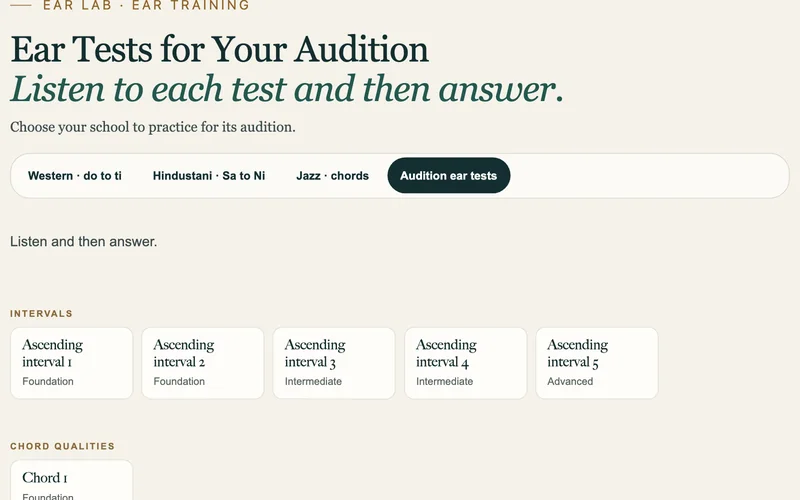 Ear tests for auditionsEar tests for auditions train chord qualities and singing back phrases for the jazz and Contemporary Musical Arts finals.Open →
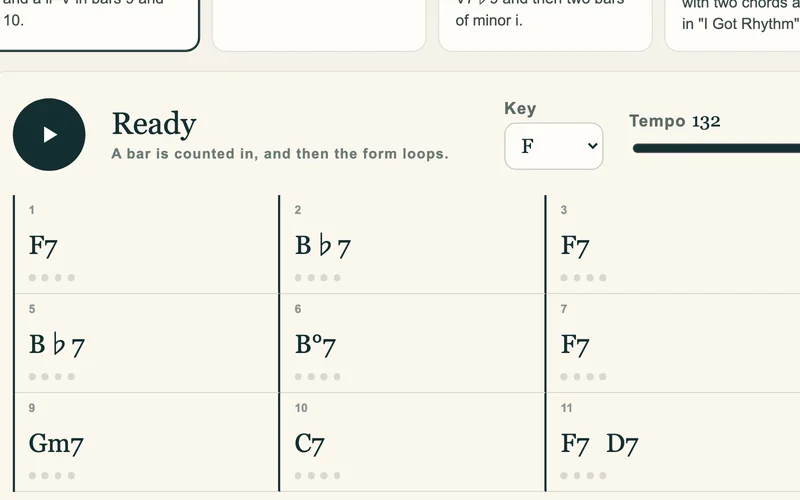 Improvisation practiceImprovisation practice gives jazz applicants a blues and standards to improvise over. It also gives Contemporary Musical Arts applicants short progressions like those in the final.Open →
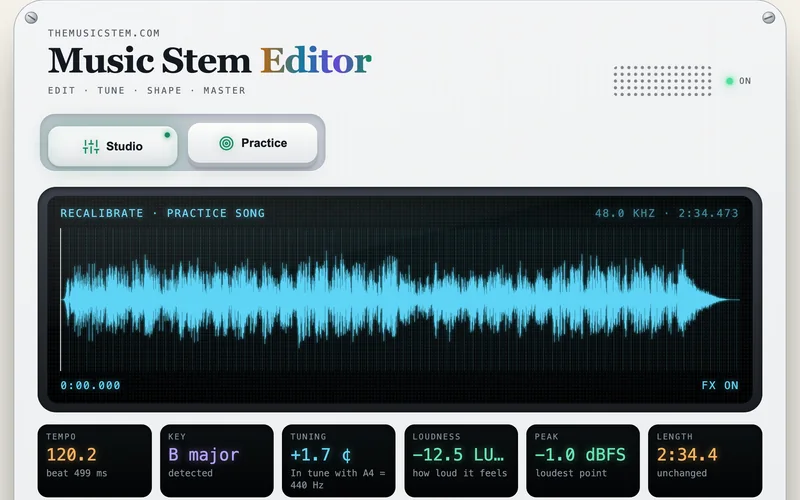 The EditorThe Editor measures the tuning, tempo and loudness of your prescreening recording before you send it.Open →
- Conservatory audition practice checks your prescreening files against recording rules like NEC's before the final.
- Sight-reading practice prepares jazz and percussion applicants for the sight-reading.
NEC's own pages
Requirements can change from year to year. Read your program's page before you apply. Our practice cannot predict an admission decision.